
Inspiration to how you continously achieve value from your AI investments
How to succeed with AI innovation
We all see it and feel it every day – achieving value from AI investments is no easy task. In this article, we unpack the three building blocks moving from AI discovery to AI value.

Companies will spend $2.7trillion on AI in 2026 [Gartner, 2026]. Only 6% attribute 5% or more of theirEBIT to it [McKinsey, 2026].
The conversation has shifted from what AI can do to when it will pay back. Headlines now ask whether AI is a bubble, and investors warn that the bets must pay off – and soon [Bloomberg, 2026]. The question many companies are starting to ask is whether their AI investments return enough to justify continued funding – or whether the focus should shift.
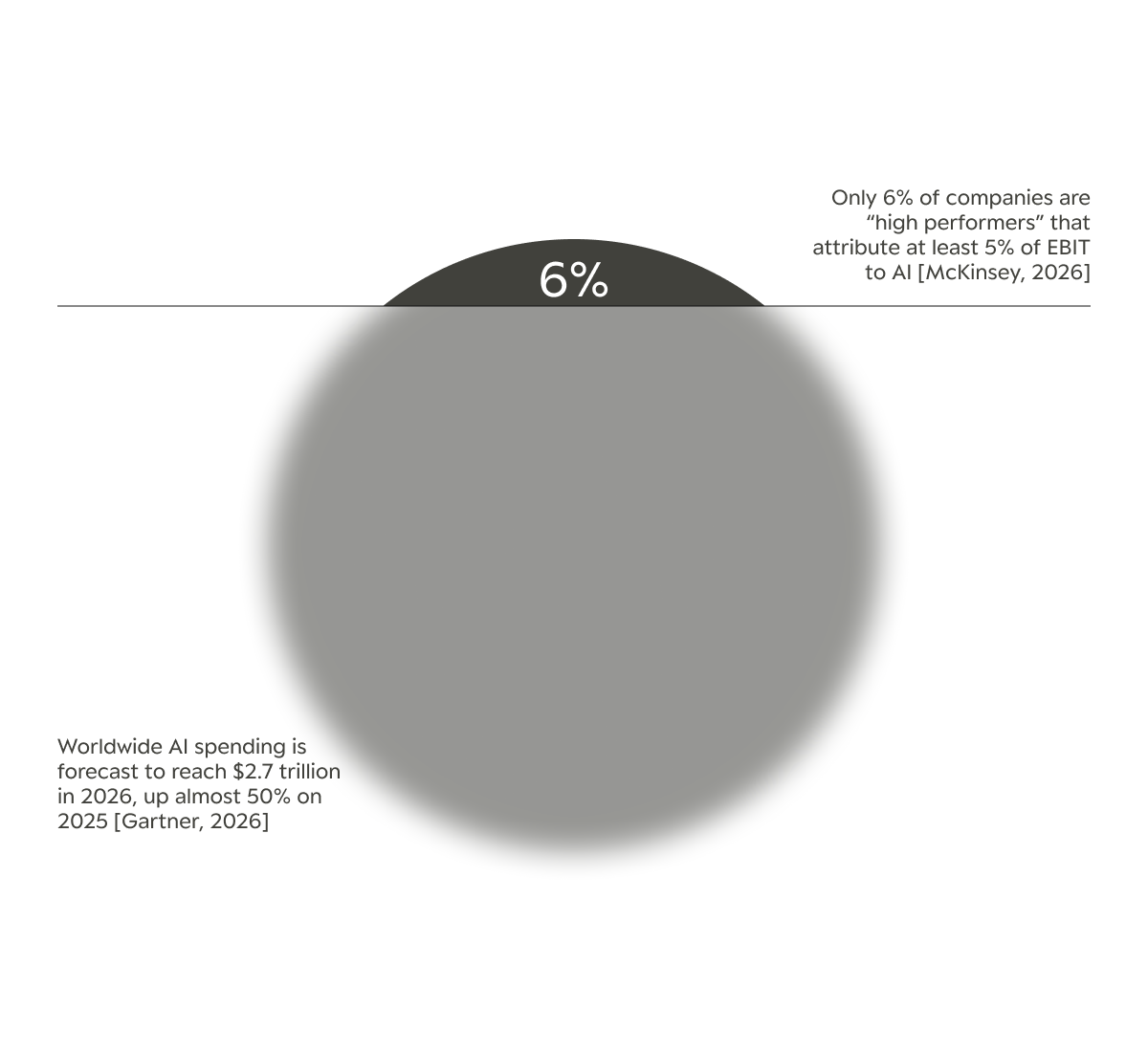
Companies will spend $2.7trillion on AI in 2026 [Gartner, 2026]. Only 6% attribute 5% or more of theirEBIT to it [McKinsey, 2026].
The conversation has shifted from what AI can do to when it will pay back. Headlines now ask whether AI is a bubble, and investors warn that the bets must pay off – and soon [Bloomberg, 2026]. The question many companies are starting to ask is whether their AI investments return enough to justify continued funding – or whether the focus should shift.
Companies will spend $2.7trillion on AI in 2026 [Gartner, 2026]. Only 6% attribute 5% or more of theirEBIT to it [McKinsey, 2026].
The conversation has shifted from what AI can do to when it will pay back. Headlines now ask whether AI is a bubble, and investors warn that the bets must pay off – and soon [Bloomberg, 2026]. The question many companies are starting to ask is whether their AI investments return enough to justify continued funding – or whether the focus should shift.
Achieving value from AI investments is no easy task
Companies will spend $2.7trillion on AI in 2026 [Gartner, 2026]. Only 6% attribute 5% or more of theirEBIT to it [McKinsey, 2026].
The conversation has shifted from what AI can do to when it will pay back. Headlines now ask whether AI is a bubble, and investors warn that the bets must pay off – and soon [Bloomberg, 2026]. The question many companies are starting to ask is whether their AI investments return enough to justify continued funding – or whether the focus should shift.
Achieving value from AI investments is no easy task
Companies will spend $2.7trillion on AI in 2026 [Gartner, 2026]. Only 6% attribute 5% or more of theirEBIT to it [McKinsey, 2026].
The conversation has shifted from what AI can do to when it will pay back. Headlines now ask whether AI is a bubble, and investors warn that the bets must pay off – and soon [Bloomberg, 2026]. The question many companies are starting to ask is whether their AI investments return enough to justify continued funding – or whether the focus should shift.
Achieving value from AI investments is no easy task
Despite the questions on return, the road to value is becoming clearer – and it leads beyond the most obvious initiatives. Successful companies are set up to launch, test, and scale AI initiatives repeatedly. High performers are far more likely to have redesigned workflows around AI (about 75% vs. 25% of others) and to show visible senior leadership commitment [McKinsey, 2026].
As the technology improves, so do the opportunities that it unlocks. But as AI costs increasingly scale with usage [J.P.Morgan, 2026], every initiative carries a running cost, not just a build cost.It becomes critical to prioritize efforts on the initiatives that have the biggest impact.
This paper explains how to move from exploring AI initiatives to realize continuous AI value, through three pillars: Design, Build and Transform.
AI transformation is an innovation discipline, not a technology discipline. It shifts the focus from what can be built to what will bring the most value, with initiatives prioritized based on results.
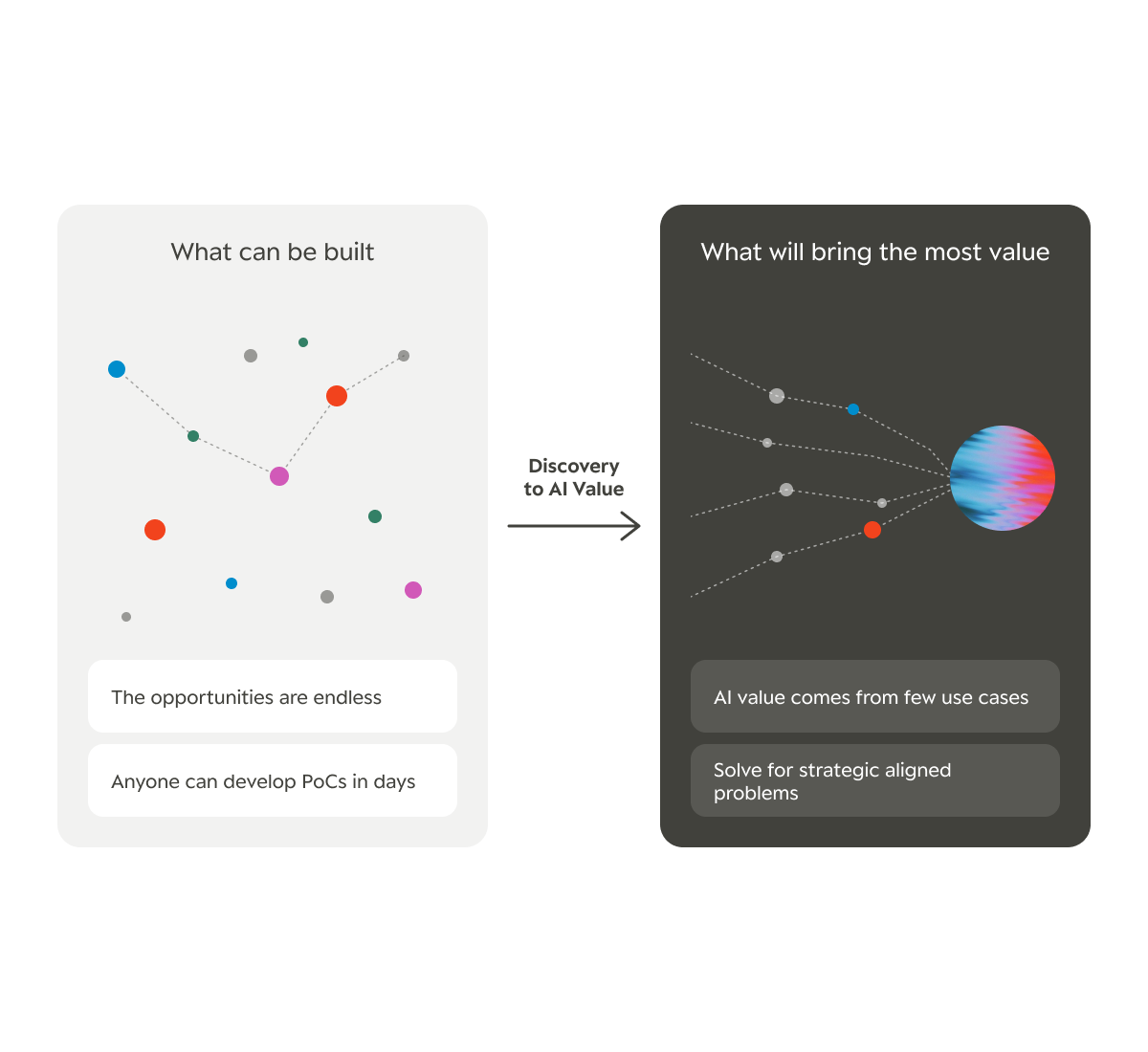
Despite the questions on return, the road to value is becoming clearer – and it leads beyond the most obvious initiatives. Successful companies are set up to launch, test, and scale AI initiatives repeatedly. High performers are far more likely to have redesigned workflows around AI (about 75% vs. 25% of others) and to show visible senior leadership commitment [McKinsey, 2026].
As the technology improves, so do the opportunities that it unlocks. But as AI costs increasingly scale with usage [J.P.Morgan, 2026], every initiative carries a running cost, not just a build cost.It becomes critical to prioritize efforts on the initiatives that have the biggest impact.
This paper explains how to move from exploring AI initiatives to realize continuous AI value, through three pillars: Design, Build and Transform.
AI transformation is an innovation discipline, not a technology discipline. It shifts the focus from what can be built to what will bring the most value, with initiatives prioritized based on results.
Despite the questions on return, the road to value is becoming clearer – and it leads beyond the most obvious initiatives. Successful companies are set up to launch, test, and scale AI initiatives repeatedly. High performers are far more likely to have redesigned workflows around AI (about 75% vs. 25% of others) and to show visible senior leadership commitment [McKinsey, 2026].
As the technology improves, so do the opportunities that it unlocks. But as AI costs increasingly scale with usage [J.P.Morgan, 2026], every initiative carries a running cost, not just a build cost.It becomes critical to prioritize efforts on the initiatives that have the biggest impact.
This paper explains how to move from exploring AI initiatives to realize continuous AI value, through three pillars: Design, Build and Transform.
AI transformation is an innovation discipline, not a technology discipline. It shifts the focus from what can be built to what will bring the most value, with initiatives prioritized based on results.
The recipe for value is becoming clearer
Despite the questions on return, the road to value is becoming clearer – and it leads beyond the most obvious initiatives. Successful companies are set up to launch, test, and scale AI initiatives repeatedly. High performers are far more likely to have redesigned workflows around AI (about 75% vs. 25% of others) and to show visible senior leadership commitment [McKinsey, 2026].
As the technology improves, so do the opportunities that it unlocks. But as AI costs increasingly scale with usage [J.P.Morgan, 2026], every initiative carries a running cost, not just a build cost.It becomes critical to prioritize efforts on the initiatives that have the biggest impact.
This paper explains how to move from exploring AI initiatives to realize continuous AI value, through three pillars: Design, Build and Transform.
AI transformation is an innovation discipline, not a technology discipline. It shifts the focus from what can be built to what will bring the most value, with initiatives prioritized based on results.
The recipe for value is becoming clearer
Despite the questions on return, the road to value is becoming clearer – and it leads beyond the most obvious initiatives. Successful companies are set up to launch, test, and scale AI initiatives repeatedly. High performers are far more likely to have redesigned workflows around AI (about 75% vs. 25% of others) and to show visible senior leadership commitment [McKinsey, 2026].
As the technology improves, so do the opportunities that it unlocks. But as AI costs increasingly scale with usage [J.P.Morgan, 2026], every initiative carries a running cost, not just a build cost.It becomes critical to prioritize efforts on the initiatives that have the biggest impact.
This paper explains how to move from exploring AI initiatives to realize continuous AI value, through three pillars: Design, Build and Transform.
AI transformation is an innovation discipline, not a technology discipline. It shifts the focus from what can be built to what will bring the most value, with initiatives prioritized based on results.
The recipe for value is becoming clearer
We see three main challenges standing between AI experimentation and AI value: no clear direction, no structure for turning ideas into results, and an organization not ready to work differently. To bridge this gap, we use our three-pillar framework to encourage innovation, rapid validation, and continuous enablement of the organization.
- Design: an operating model that sets the ambition, structures how the portfolio is managed, and plans how to enable the organization.
- Build: a way of working that prioritizes use cases on expected value through ongoing stage gates, so only the best progres
- Transform: organizational enablement that evolves how leaders and employees work with AI.
However far along the AI journey you are, these fundamentals will help you focus your efforts where they matter most – and, if done right, will make the results repeatable.
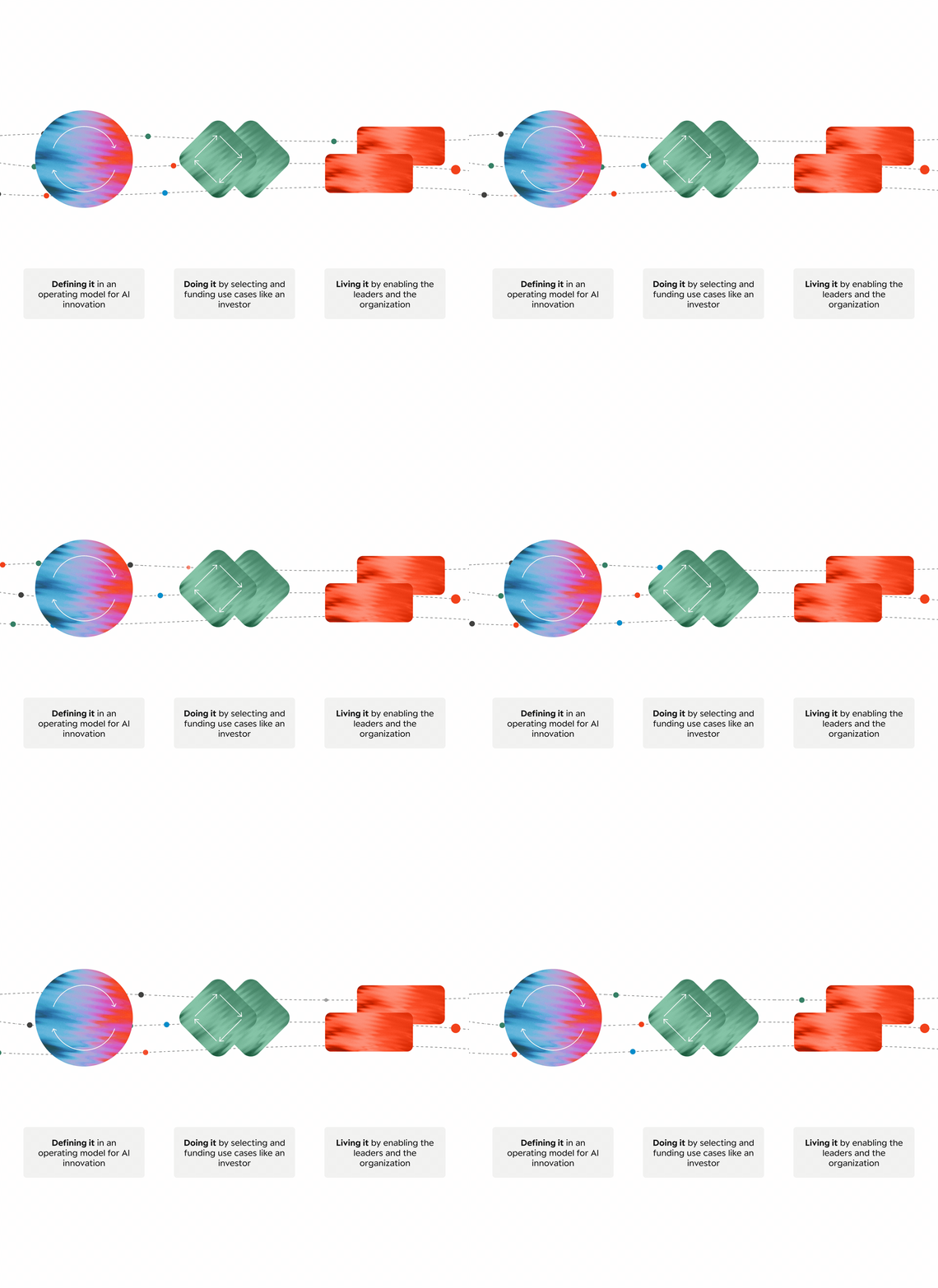
We see three main challenges standing between AI experimentation and AI value: no clear direction, no structure for turning ideas into results, and an organization not ready to work differently. To bridge this gap, we use our three-pillar framework to encourage innovation, rapid validation, and continuous enablement of the organization.
- Design: an operating model that sets the ambition, structures how the portfolio is managed, and plans how to enable the organization.
- Build: a way of working that prioritizes use cases on expected value through ongoing stage gates, so only the best progres
- Transform: organizational enablement that evolves how leaders and employees work with AI.
However far along the AI journey you are, these fundamentals will help you focus your efforts where they matter most – and, if done right, will make the results repeatable.
We see three main challenges standing between AI experimentation and AI value: no clear direction, no structure for turning ideas into results, and an organization not ready to work differently. To bridge this gap, we use our three-pillar framework to encourage innovation, rapid validation, and continuous enablement of the organization.
- Design: an operating model that sets the ambition, structures how the portfolio is managed, and plans how to enable the organization.
- Build: a way of working that prioritizes use cases on expected value through ongoing stage gates, so only the best progres
- Transform: organizational enablement that evolves how leaders and employees work with AI.
However far along the AI journey you are, these fundamentals will help you focus your efforts where they matter most – and, if done right, will make the results repeatable.
Three pillars for value-focused AI
We see three main challenges standing between AI experimentation and AI value: no clear direction, no structure for turning ideas into results, and an organization not ready to work differently. To bridge this gap, we use our three-pillar framework to encourage innovation, rapid validation, and continuous enablement of the organization.
- Design: an operating model that sets the ambition, structures how the portfolio is managed, and plans how to enable the organization.
- Build: a way of working that prioritizes use cases on expected value through ongoing stage gates, so only the best progres
- Transform: organizational enablement that evolves how leaders and employees work with AI.
However far along the AI journey you are, these fundamentals will help you focus your efforts where they matter most – and, if done right, will make the results repeatable.
Three pillars for value-focused AI
We see three main challenges standing between AI experimentation and AI value: no clear direction, no structure for turning ideas into results, and an organization not ready to work differently. To bridge this gap, we use our three-pillar framework to encourage innovation, rapid validation, and continuous enablement of the organization.
- Design: an operating model that sets the ambition, structures how the portfolio is managed, and plans how to enable the organization.
- Build: a way of working that prioritizes use cases on expected value through ongoing stage gates, so only the best progres
- Transform: organizational enablement that evolves how leaders and employees work with AI.
However far along the AI journey you are, these fundamentals will help you focus your efforts where they matter most – and, if done right, will make the results repeatable.
Three pillars for value-focused AI
An operating model for AI development defines a recipe for success and guides every initiative from first idea to scale.
An AI operating model consists of three core components:
- • Aspiration: Setting a vision tied to business outcomes rather than tool adoption, formalizing the mandate, and defining the governance to steer it.
- • Portfolio: Identifying opportunity spaces and defining how to manage and execute the initiatives in the portfoli
- • Enablers: Assessing and defining the capabilities, skills, tools, and processes needed to deliver on the aspiration.
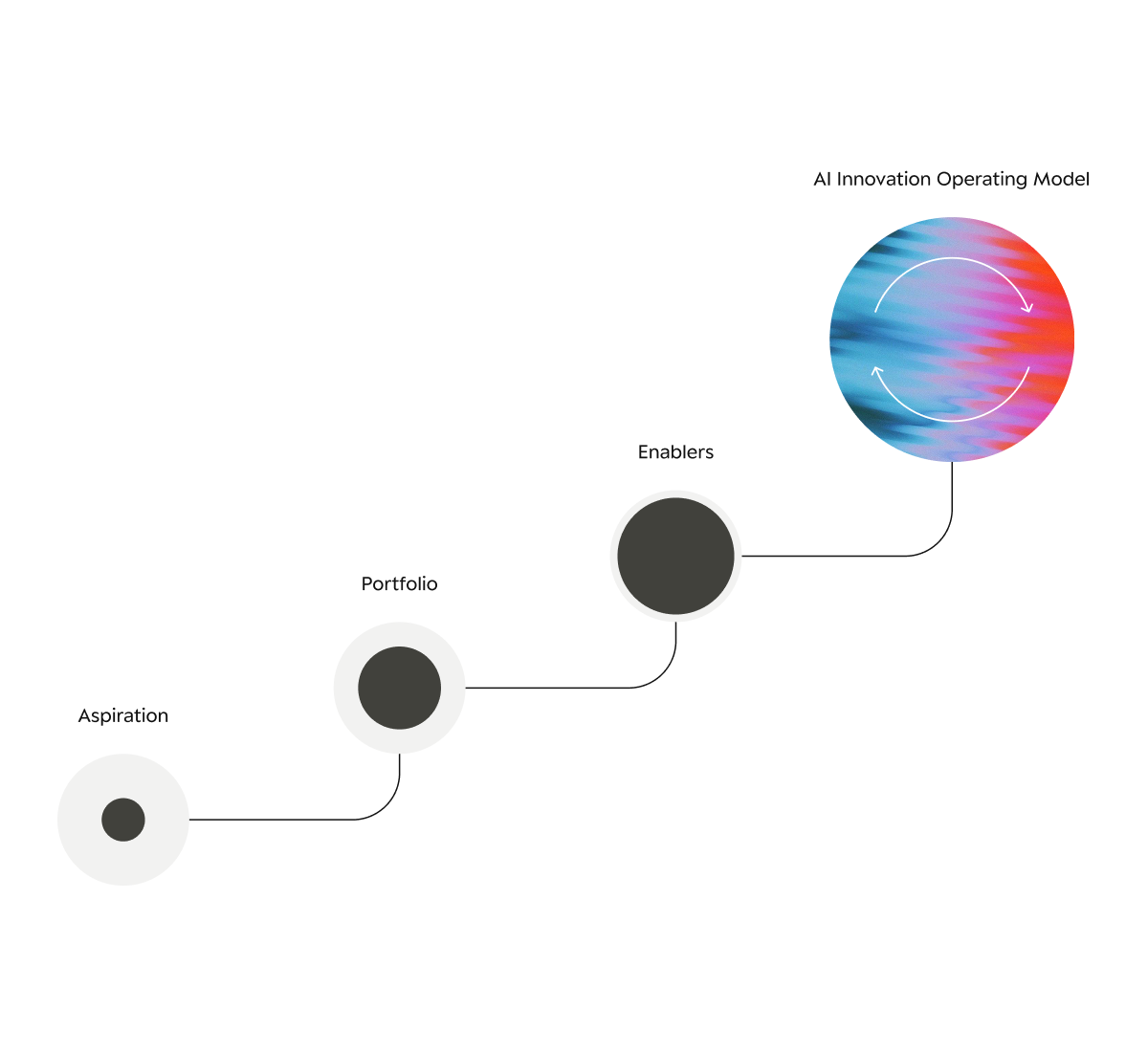
An operating model for AI development defines a recipe for success and guides every initiative from first idea to scale.
An AI operating model consists of three core components:
- • Aspiration: Setting a vision tied to business outcomes rather than tool adoption, formalizing the mandate, and defining the governance to steer it.
- • Portfolio: Identifying opportunity spaces and defining how to manage and execute the initiatives in the portfoli
- • Enablers: Assessing and defining the capabilities, skills, tools, and processes needed to deliver on the aspiration.
An operating model for AI development defines a recipe for success and guides every initiative from first idea to scale.
An AI operating model consists of three core components:
- • Aspiration: Setting a vision tied to business outcomes rather than tool adoption, formalizing the mandate, and defining the governance to steer it.
- • Portfolio: Identifying opportunity spaces and defining how to manage and execute the initiatives in the portfoli
- • Enablers: Assessing and defining the capabilities, skills, tools, and processes needed to deliver on the aspiration.
An operating model that sets direction and mandate
An operating model for AI development defines a recipe for success and guides every initiative from first idea to scale.
An AI operating model consists of three core components:
- • Aspiration: Setting a vision tied to business outcomes rather than tool adoption, formalizing the mandate, and defining the governance to steer it.
- • Portfolio: Identifying opportunity spaces and defining how to manage and execute the initiatives in the portfoli
- • Enablers: Assessing and defining the capabilities, skills, tools, and processes needed to deliver on the aspiration.
An operating model that sets direction and mandate
An operating model for AI development defines a recipe for success and guides every initiative from first idea to scale.
An AI operating model consists of three core components:
- • Aspiration: Setting a vision tied to business outcomes rather than tool adoption, formalizing the mandate, and defining the governance to steer it.
- • Portfolio: Identifying opportunity spaces and defining how to manage and execute the initiatives in the portfoli
- • Enablers: Assessing and defining the capabilities, skills, tools, and processes needed to deliver on the aspiration.
An operating model that sets direction and mandate
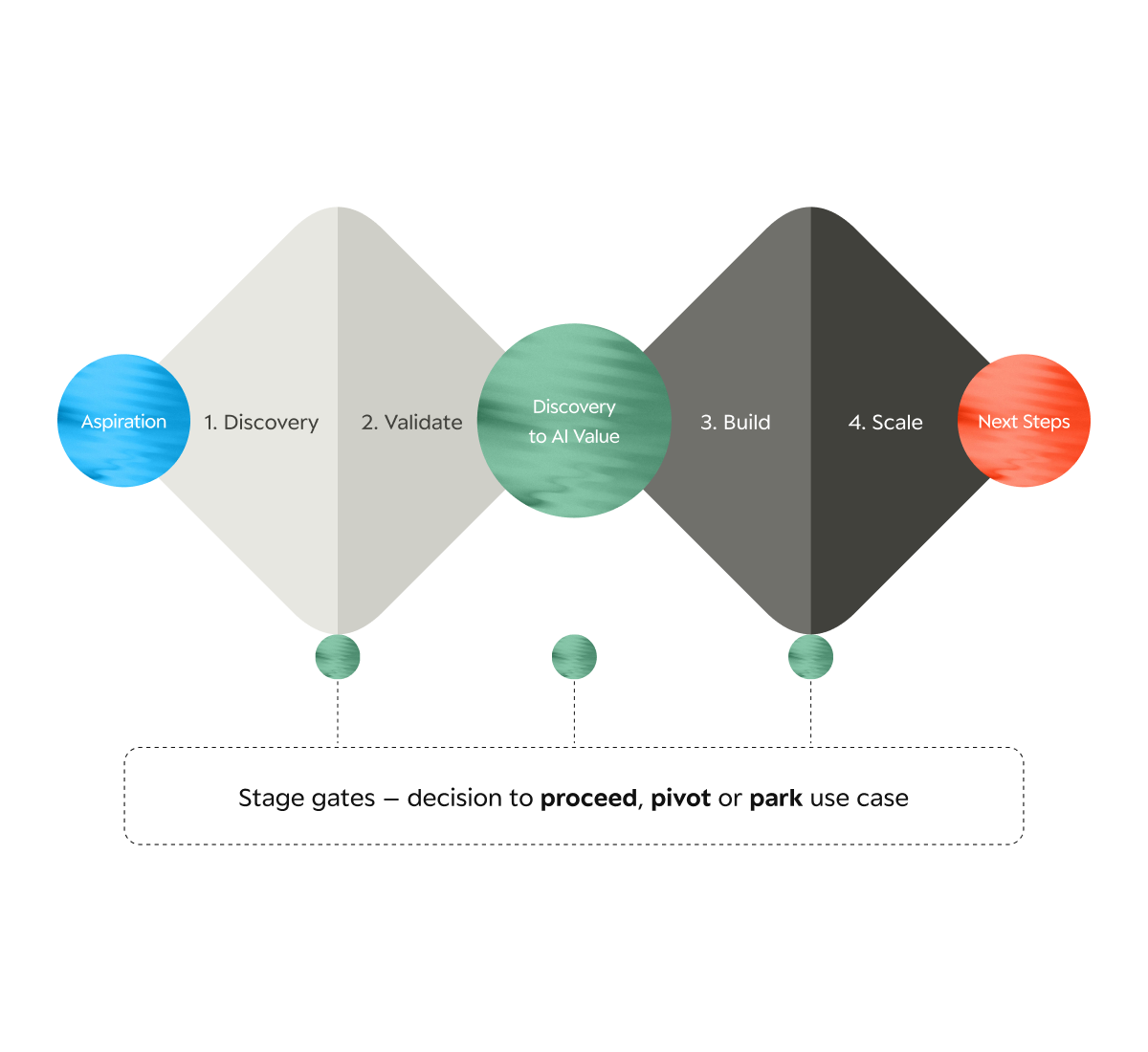
Build is a way of working that, like a venture investor, makes many cheap early bets and concentrates investment on those that prove their value. It continuously evaluates initiatives – failing fast and scaling what works – across four stages:
- Discovery gathers business needs into a long list of opportunities.
- Validation tests the long list against desirability, viability and feasibility to narrow it down.
- Build delivers a minimum viable product (MVP) that tests the value of the prioritized initiative.
- Scale rolls out the initiative across the organization.
Stage gates are planned checkpoints for evaluating initiatives. Based on performance against predefined KPIs, each gate has the mandate to proceed as planned, pivot by incorporating new input, or park the initiative until decided otherwise.
Build is a way of working that, like a venture investor, makes many cheap early bets and concentrates investment on those that prove their value. It continuously evaluates initiatives – failing fast and scaling what works – across four stages:
- Discovery gathers business needs into a long list of opportunities.
- Validation tests the long list against desirability, viability and feasibility to narrow it down.
- Build delivers a minimum viable product (MVP) that tests the value of the prioritized initiative.
- Scale rolls out the initiative across the organization.
Stage gates are planned checkpoints for evaluating initiatives. Based on performance against predefined KPIs, each gate has the mandate to proceed as planned, pivot by incorporating new input, or park the initiative until decided otherwise.
Build is a way of working that, like a venture investor, makes many cheap early bets and concentrates investment on those that prove their value. It continuously evaluates initiatives – failing fast and scaling what works – across four stages:
- Discovery gathers business needs into a long list of opportunities.
- Validation tests the long list against desirability, viability and feasibility to narrow it down.
- Build delivers a minimum viable product (MVP) that tests the value of the prioritized initiative.
- Scale rolls out the initiative across the organization.
Stage gates are planned checkpoints for evaluating initiatives. Based on performance against predefined KPIs, each gate has the mandate to proceed as planned, pivot by incorporating new input, or park the initiative until decided otherwise.
Manage initiatives like a venture capitalist
Build is a way of working that, like a venture investor, makes many cheap early bets and concentrates investment on those that prove their value. It continuously evaluates initiatives – failing fast and scaling what works – across four stages:
- Discovery gathers business needs into a long list of opportunities.
- Validation tests the long list against desirability, viability and feasibility to narrow it down.
- Build delivers a minimum viable product (MVP) that tests the value of the prioritized initiative.
- Scale rolls out the initiative across the organization.
Stage gates are planned checkpoints for evaluating initiatives. Based on performance against predefined KPIs, each gate has the mandate to proceed as planned, pivot by incorporating new input, or park the initiative until decided otherwise.
Manage initiatives like a venture capitalist
Build is a way of working that, like a venture investor, makes many cheap early bets and concentrates investment on those that prove their value. It continuously evaluates initiatives – failing fast and scaling what works – across four stages:
- Discovery gathers business needs into a long list of opportunities.
- Validation tests the long list against desirability, viability and feasibility to narrow it down.
- Build delivers a minimum viable product (MVP) that tests the value of the prioritized initiative.
- Scale rolls out the initiative across the organization.
Stage gates are planned checkpoints for evaluating initiatives. Based on performance against predefined KPIs, each gate has the mandate to proceed as planned, pivot by incorporating new input, or park the initiative until decided otherwise.
Manage initiatives like a venture capitalist
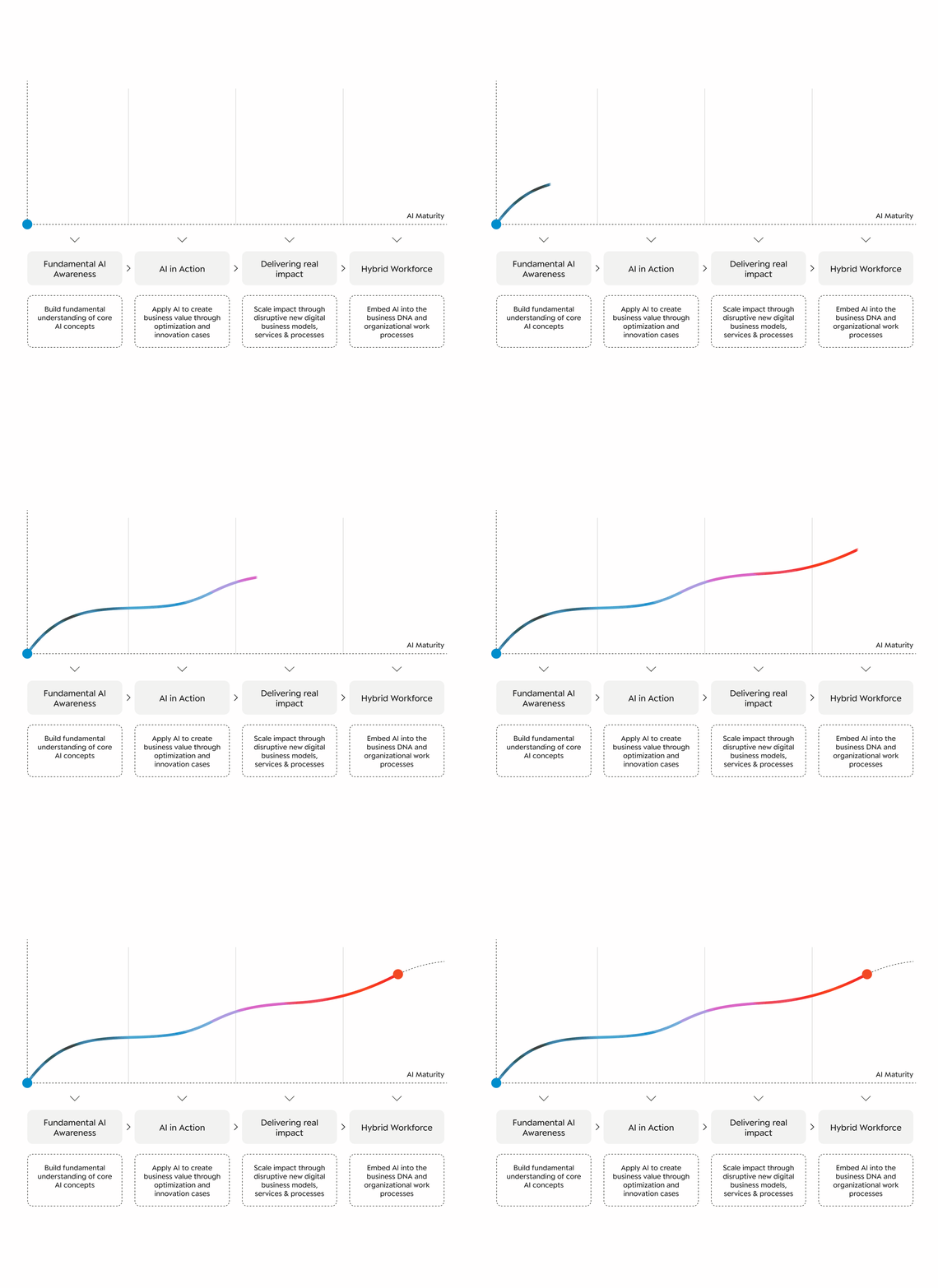
Redesigning how work gets done, rather than layering AI on top of existing workflows, is what separates organizations that capture value from those that do not. This means continuously equipping leaders and employees to drive their part of the AI journey. For leaders, that means prioritizing hard –prioritizing initiatives with a value driving business case over initiatives with sponsorship – and learning to lead a hybrid workforce of people and agents. For employees, it means literacy beyond prompt training: using AI in real work, trusting it enough to rely on it yet checking it, and redesigning their own processes with it.
The aim is coherence. The initiatives you prioritize should match your organization’s maturity, so that initiatives and workforce evolve in parallel. Pilots that fail often do so not because the models are weak, but because they land in an organization that cannot yet absorb them.
Redesigning how work gets done, rather than layering AI on top of existing workflows, is what separates organizations that capture value from those that do not. This means continuously equipping leaders and employees to drive their part of the AI journey. For leaders, that means prioritizing hard –prioritizing initiatives with a value driving business case over initiatives with sponsorship – and learning to lead a hybrid workforce of people and agents. For employees, it means literacy beyond prompt training: using AI in real work, trusting it enough to rely on it yet checking it, and redesigning their own processes with it.
The aim is coherence. The initiatives you prioritize should match your organization’s maturity, so that initiatives and workforce evolve in parallel. Pilots that fail often do so not because the models are weak, but because they land in an organization that cannot yet absorb them.
Redesigning how work gets done, rather than layering AI on top of existing workflows, is what separates organizations that capture value from those that do not. This means continuously equipping leaders and employees to drive their part of the AI journey. For leaders, that means prioritizing hard –prioritizing initiatives with a value driving business case over initiatives with sponsorship – and learning to lead a hybrid workforce of people and agents. For employees, it means literacy beyond prompt training: using AI in real work, trusting it enough to rely on it yet checking it, and redesigning their own processes with it.
The aim is coherence. The initiatives you prioritize should match your organization’s maturity, so that initiatives and workforce evolve in parallel. Pilots that fail often do so not because the models are weak, but because they land in an organization that cannot yet absorb them.
Equip leaders and employees to live the change
Redesigning how work gets done, rather than layering AI on top of existing workflows, is what separates organizations that capture value from those that do not. This means continuously equipping leaders and employees to drive their part of the AI journey. For leaders, that means prioritizing hard –prioritizing initiatives with a value driving business case over initiatives with sponsorship – and learning to lead a hybrid workforce of people and agents. For employees, it means literacy beyond prompt training: using AI in real work, trusting it enough to rely on it yet checking it, and redesigning their own processes with it.
The aim is coherence. The initiatives you prioritize should match your organization’s maturity, so that initiatives and workforce evolve in parallel. Pilots that fail often do so not because the models are weak, but because they land in an organization that cannot yet absorb them.
Equip leaders and employees to live the change
Redesigning how work gets done, rather than layering AI on top of existing workflows, is what separates organizations that capture value from those that do not. This means continuously equipping leaders and employees to drive their part of the AI journey. For leaders, that means prioritizing hard –prioritizing initiatives with a value driving business case over initiatives with sponsorship – and learning to lead a hybrid workforce of people and agents. For employees, it means literacy beyond prompt training: using AI in real work, trusting it enough to rely on it yet checking it, and redesigning their own processes with it.
The aim is coherence. The initiatives you prioritize should match your organization’s maturity, so that initiatives and workforce evolve in parallel. Pilots that fail often do so not because the models are weak, but because they land in an organization that cannot yet absorb them.
Equip leaders and employees to live the change
No matter how far you've come on your AI journey, a structured approach to AI development helps you get the most from your investment. Here's how we can help you apply an innovation lens to your AI portfolio, wherever you are today.
No matter how far you've come on your AI journey, a structured approach to AI development helps you get the most from your investment. Here's how we can help you apply an innovation lens to your AI portfolio, wherever you are today.
No matter how far you've come on your AI journey, a structured approach to AI development helps you get the most from your investment. Here's how we can help you apply an innovation lens to your AI portfolio, wherever you are today.
No two journeys are the same
No matter how far you've come on your AI journey, a structured approach to AI development helps you get the most from your investment. Here's how we can help you apply an innovation lens to your AI portfolio, wherever you are today.
No two journeys are the same
No matter how far you've come on your AI journey, a structured approach to AI development helps you get the most from your investment. Here's how we can help you apply an innovation lens to your AI portfolio, wherever you are today.
No two journeys are the same
.png)
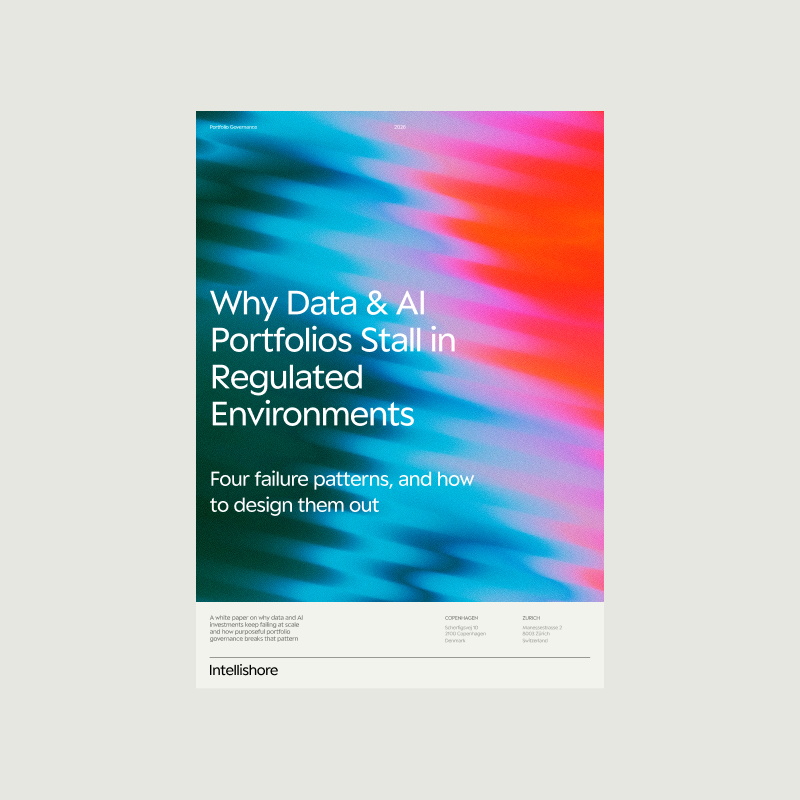
The whitepaper breaks down the full governance model: intake and prioritization criteria, decision rights, funding models, a value framework covering financial, capacity, and risk outcomes, and the kill triggers that let leaders stop work without stigma.
We can help you get started with your AI journey.
We help the world's leading companies make AI come to life. Reach out to us.


We all see it and feel it every day – achieving value from AI investments is no easy task. In this article, we unpack the three building blocks moving from AI discovery to AI value.
Click to read more
Dexcom's stake in Oura and Abbott's investment in Whoop signal that glucose and activity data are converging. One of our consultants, who lives with type 1 diabetes, unpacks why this matters – and the three challenges (data, regulation, and reimbursement) that stand between this convergence and real impact for patients.
Click to read more
In this article, we map out the system behind a live opportunity assessment engine, and how it learns which signals matter to a decision and which are just noise.
Click to read more
A portfolio governance model for regulated environments: intake funnel, decision rights, benefit ownership, and the move into business-as-usual
Click to read more