
How agentic AI turns market signals into a portfolio bet you can defend
Assessing Market Opportunity at the Speed the Market Actually Moves
In the full article, we break down the two-level framework for assessing market opportunity, and how agentic AI fits into the process.

Developing a therapy area or disease area strategy used to mean weeks of manual secondary research - analysts crawling trial registries, regulatory databases, HTA decision records, and epidemiology sources before any strategic judgment could be applied. A typical early-stage market opportunity assessment tied up a team of four to six people for three to four weeks. That was fine when the landscape moved slowly.
But the landscape doesn’t move slowly anymore. Pipelines are extremely crowded; a competitor readout, a new regulatory designation, a payer decision in a key market - any of these can reshape the attractiveness of an indication overnight. The old method was not built for this pace, and it is starting to show.
Agentic AI changes the equation. The same assessment can now be populated in days - automatically, systematically, and continuously updated as the market moves. That means knowing where to place your bets, when to double down, and when to divest - before your competitors do.
Imagine you are the head of neurology at a mid-size life science company. Your blockbuster is approaching loss of exclusivity. The revenue cliff is three years out, and your pipeline does not have anything to backfill the revenue loss from this asset. The board wants a Business Development and Licensing (BD&L) strategy. Your team has flagged twenty indications as potentially interesting. Your job is to get down to two or three - the spaces worth committing real resources to, where you will then go hunting for the assets that will be most competitive.
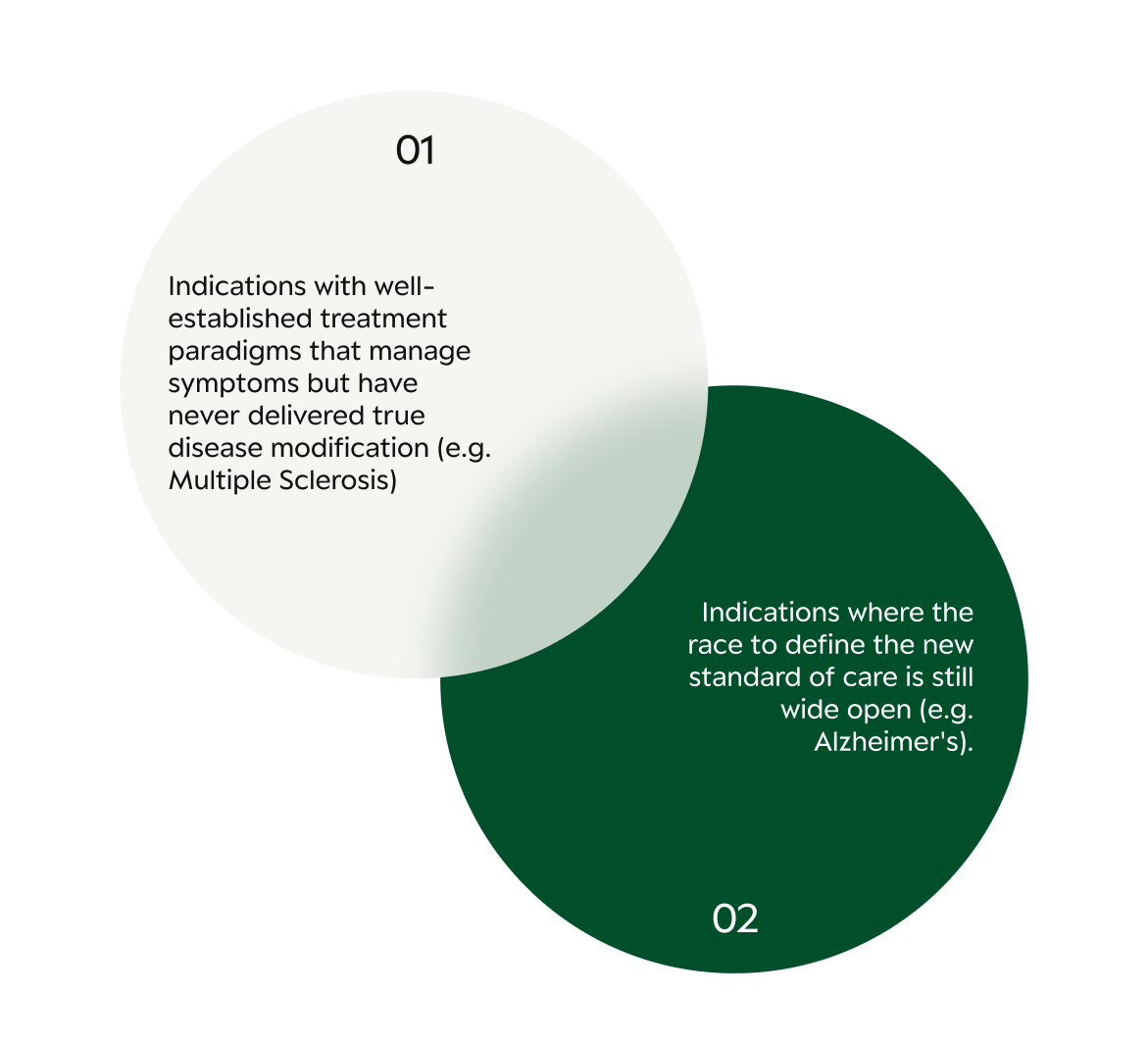
On one side: indications with well-established treatment paradigms that manage symptoms but have never delivered true disease modification (e.g. Multiple Sclerosis). On the other: indications where the race to define the new standard of care is still wide open (e.g. Alzheimer's). Each represents a patient population that is suffering. Each also represents years of work and hundreds of millions of dollars in investment.
The question has always been the same: where do you place your bet?
Answering this question has always been hard, and it is not a question that yields to intuition alone. Good portfolio strategy is a decision architecture problem. The companies that build better pipelines are the ones that ask the right questions, at the right level of rigor, at the right moment. This article describes a framework designed to help you do exactly that.
Developing a therapy area or disease area strategy used to mean weeks of manual secondary research - analysts crawling trial registries, regulatory databases, HTA decision records, and epidemiology sources before any strategic judgment could be applied. A typical early-stage market opportunity assessment tied up a team of four to six people for three to four weeks. That was fine when the landscape moved slowly.
But the landscape doesn’t move slowly anymore. Pipelines are extremely crowded; a competitor readout, a new regulatory designation, a payer decision in a key market - any of these can reshape the attractiveness of an indication overnight. The old method was not built for this pace, and it is starting to show.
Agentic AI changes the equation. The same assessment can now be populated in days - automatically, systematically, and continuously updated as the market moves. That means knowing where to place your bets, when to double down, and when to divest - before your competitors do.
Imagine you are the head of neurology at a mid-size life science company. Your blockbuster is approaching loss of exclusivity. The revenue cliff is three years out, and your pipeline does not have anything to backfill the revenue loss from this asset. The board wants a Business Development and Licensing (BD&L) strategy. Your team has flagged twenty indications as potentially interesting. Your job is to get down to two or three - the spaces worth committing real resources to, where you will then go hunting for the assets that will be most competitive.
On one side: indications with well-established treatment paradigms that manage symptoms but have never delivered true disease modification (e.g. Multiple Sclerosis). On the other: indications where the race to define the new standard of care is still wide open (e.g. Alzheimer's). Each represents a patient population that is suffering. Each also represents years of work and hundreds of millions of dollars in investment.
The question has always been the same: where do you place your bet?
Answering this question has always been hard, and it is not a question that yields to intuition alone. Good portfolio strategy is a decision architecture problem. The companies that build better pipelines are the ones that ask the right questions, at the right level of rigor, at the right moment. This article describes a framework designed to help you do exactly that.
Developing a therapy area or disease area strategy used to mean weeks of manual secondary research - analysts crawling trial registries, regulatory databases, HTA decision records, and epidemiology sources before any strategic judgment could be applied. A typical early-stage market opportunity assessment tied up a team of four to six people for three to four weeks. That was fine when the landscape moved slowly.
But the landscape doesn’t move slowly anymore. Pipelines are extremely crowded; a competitor readout, a new regulatory designation, a payer decision in a key market - any of these can reshape the attractiveness of an indication overnight. The old method was not built for this pace, and it is starting to show.
Agentic AI changes the equation. The same assessment can now be populated in days - automatically, systematically, and continuously updated as the market moves. That means knowing where to place your bets, when to double down, and when to divest - before your competitors do.
Imagine you are the head of neurology at a mid-size life science company. Your blockbuster is approaching loss of exclusivity. The revenue cliff is three years out, and your pipeline does not have anything to backfill the revenue loss from this asset. The board wants a Business Development and Licensing (BD&L) strategy. Your team has flagged twenty indications as potentially interesting. Your job is to get down to two or three - the spaces worth committing real resources to, where you will then go hunting for the assets that will be most competitive.
On one side: indications with well-established treatment paradigms that manage symptoms but have never delivered true disease modification (e.g. Multiple Sclerosis). On the other: indications where the race to define the new standard of care is still wide open (e.g. Alzheimer's). Each represents a patient population that is suffering. Each also represents years of work and hundreds of millions of dollars in investment.
The question has always been the same: where do you place your bet?
Answering this question has always been hard, and it is not a question that yields to intuition alone. Good portfolio strategy is a decision architecture problem. The companies that build better pipelines are the ones that ask the right questions, at the right level of rigor, at the right moment. This article describes a framework designed to help you do exactly that.
Making a bet
Developing a therapy area or disease area strategy used to mean weeks of manual secondary research - analysts crawling trial registries, regulatory databases, HTA decision records, and epidemiology sources before any strategic judgment could be applied. A typical early-stage market opportunity assessment tied up a team of four to six people for three to four weeks. That was fine when the landscape moved slowly.
But the landscape doesn’t move slowly anymore. Pipelines are extremely crowded; a competitor readout, a new regulatory designation, a payer decision in a key market - any of these can reshape the attractiveness of an indication overnight. The old method was not built for this pace, and it is starting to show.
Agentic AI changes the equation. The same assessment can now be populated in days - automatically, systematically, and continuously updated as the market moves. That means knowing where to place your bets, when to double down, and when to divest - before your competitors do.
Imagine you are the head of neurology at a mid-size life science company. Your blockbuster is approaching loss of exclusivity. The revenue cliff is three years out, and your pipeline does not have anything to backfill the revenue loss from this asset. The board wants a Business Development and Licensing (BD&L) strategy. Your team has flagged twenty indications as potentially interesting. Your job is to get down to two or three - the spaces worth committing real resources to, where you will then go hunting for the assets that will be most competitive.
On one side: indications with well-established treatment paradigms that manage symptoms but have never delivered true disease modification (e.g. Multiple Sclerosis). On the other: indications where the race to define the new standard of care is still wide open (e.g. Alzheimer's). Each represents a patient population that is suffering. Each also represents years of work and hundreds of millions of dollars in investment.
The question has always been the same: where do you place your bet?
Answering this question has always been hard, and it is not a question that yields to intuition alone. Good portfolio strategy is a decision architecture problem. The companies that build better pipelines are the ones that ask the right questions, at the right level of rigor, at the right moment. This article describes a framework designed to help you do exactly that.
Making a bet
Developing a therapy area or disease area strategy used to mean weeks of manual secondary research - analysts crawling trial registries, regulatory databases, HTA decision records, and epidemiology sources before any strategic judgment could be applied. A typical early-stage market opportunity assessment tied up a team of four to six people for three to four weeks. That was fine when the landscape moved slowly.
But the landscape doesn’t move slowly anymore. Pipelines are extremely crowded; a competitor readout, a new regulatory designation, a payer decision in a key market - any of these can reshape the attractiveness of an indication overnight. The old method was not built for this pace, and it is starting to show.
Agentic AI changes the equation. The same assessment can now be populated in days - automatically, systematically, and continuously updated as the market moves. That means knowing where to place your bets, when to double down, and when to divest - before your competitors do.
Imagine you are the head of neurology at a mid-size life science company. Your blockbuster is approaching loss of exclusivity. The revenue cliff is three years out, and your pipeline does not have anything to backfill the revenue loss from this asset. The board wants a Business Development and Licensing (BD&L) strategy. Your team has flagged twenty indications as potentially interesting. Your job is to get down to two or three - the spaces worth committing real resources to, where you will then go hunting for the assets that will be most competitive.
On one side: indications with well-established treatment paradigms that manage symptoms but have never delivered true disease modification (e.g. Multiple Sclerosis). On the other: indications where the race to define the new standard of care is still wide open (e.g. Alzheimer's). Each represents a patient population that is suffering. Each also represents years of work and hundreds of millions of dollars in investment.
The question has always been the same: where do you place your bet?
Answering this question has always been hard, and it is not a question that yields to intuition alone. Good portfolio strategy is a decision architecture problem. The companies that build better pipelines are the ones that ask the right questions, at the right level of rigor, at the right moment. This article describes a framework designed to help you do exactly that.
Making a bet
Patient Need
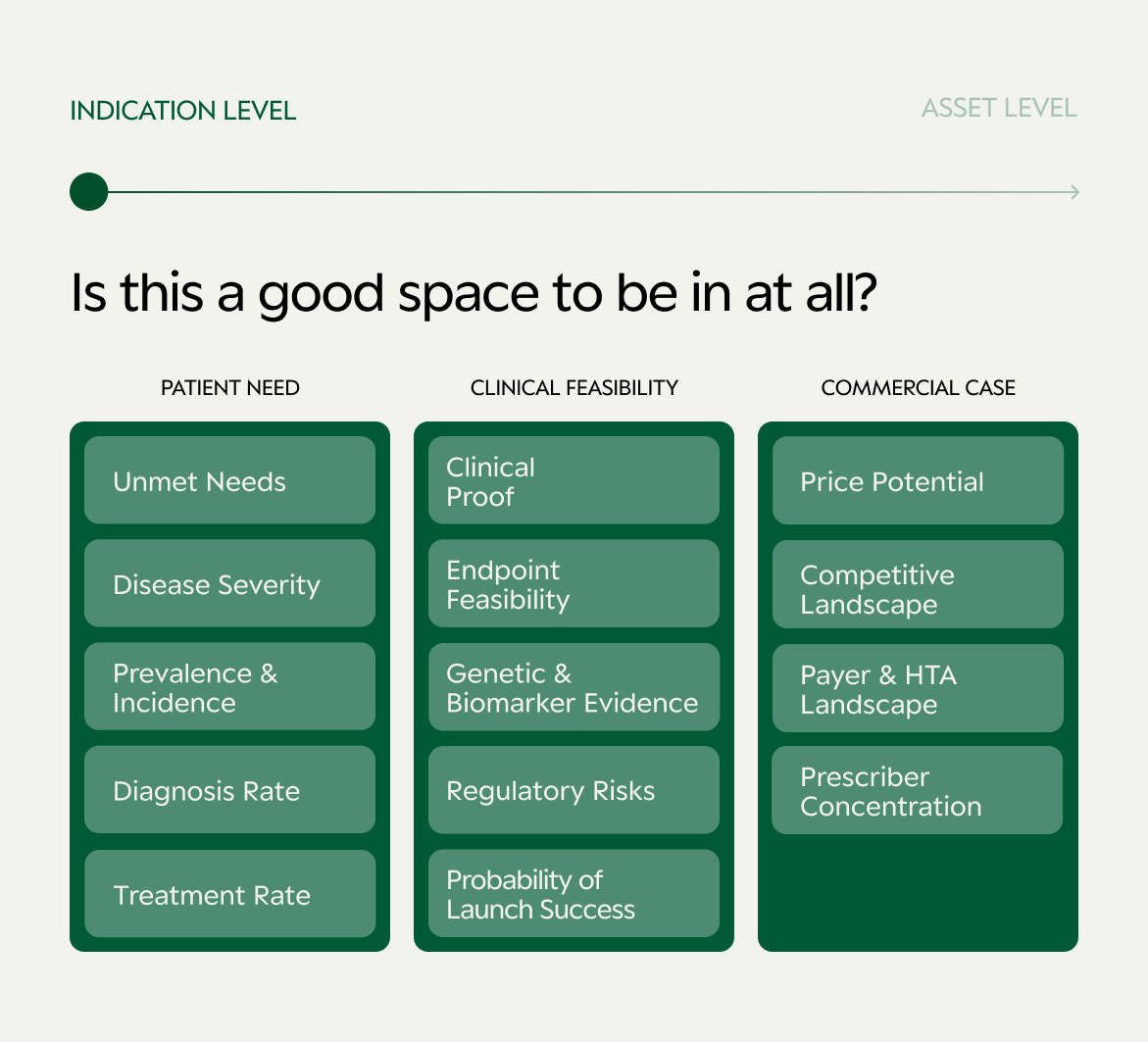
The first question is the most fundamental: are patients being meaningfully underserved? This is about the gap between what the current standard of care delivers and what patients actually need.
Clinical Feasibility
The second bar is whether there is a credible scientific and regulatory path from mechanism to approval. This encompasses the strength of the biological rationale - is there human genetic evidence linking the target to the disease? - through to the practicality of running a trial: are there validated endpoints, regulatory precedents, and an established probability of launch success for this mechanism in this indication?
Commercial Case
The third bar is the commercial reality waiting at the end of development. Pricing benchmarks, payer and HTA behavior, the competitive landscape at launch (not today, but when you finally get to market!), and the degree to which you already have the commercial infrastructure to succeed - all of these determine whether a successful approval translates into a sustainable business.
Patient Need
The first question is the most fundamental: are patients being meaningfully underserved? This is about the gap between what the current standard of care delivers and what patients actually need.
Clinical Feasibility
The second bar is whether there is a credible scientific and regulatory path from mechanism to approval. This encompasses the strength of the biological rationale - is there human genetic evidence linking the target to the disease? - through to the practicality of running a trial: are there validated endpoints, regulatory precedents, and an established probability of launch success for this mechanism in this indication?
Commercial Case
The third bar is the commercial reality waiting at the end of development. Pricing benchmarks, payer and HTA behavior, the competitive landscape at launch (not today, but when you finally get to market!), and the degree to which you already have the commercial infrastructure to succeed - all of these determine whether a successful approval translates into a sustainable business.
Patient Need
The first question is the most fundamental: are patients being meaningfully underserved? This is about the gap between what the current standard of care delivers and what patients actually need.
Clinical Feasibility
The second bar is whether there is a credible scientific and regulatory path from mechanism to approval. This encompasses the strength of the biological rationale - is there human genetic evidence linking the target to the disease? - through to the practicality of running a trial: are there validated endpoints, regulatory precedents, and an established probability of launch success for this mechanism in this indication?
Commercial Case
The third bar is the commercial reality waiting at the end of development. Pricing benchmarks, payer and HTA behavior, the competitive landscape at launch (not today, but when you finally get to market!), and the degree to which you already have the commercial infrastructure to succeed - all of these determine whether a successful approval translates into a sustainable business.
The Criteria You Actually Need to Assess
Patient Need
The first question is the most fundamental: are patients being meaningfully underserved? This is about the gap between what the current standard of care delivers and what patients actually need.
Clinical Feasibility
The second bar is whether there is a credible scientific and regulatory path from mechanism to approval. This encompasses the strength of the biological rationale - is there human genetic evidence linking the target to the disease? - through to the practicality of running a trial: are there validated endpoints, regulatory precedents, and an established probability of launch success for this mechanism in this indication?
Commercial Case
The third bar is the commercial reality waiting at the end of development. Pricing benchmarks, payer and HTA behavior, the competitive landscape at launch (not today, but when you finally get to market!), and the degree to which you already have the commercial infrastructure to succeed - all of these determine whether a successful approval translates into a sustainable business.
The Criteria You Actually Need to Assess
Patient Need
The first question is the most fundamental: are patients being meaningfully underserved? This is about the gap between what the current standard of care delivers and what patients actually need.
Clinical Feasibility
The second bar is whether there is a credible scientific and regulatory path from mechanism to approval. This encompasses the strength of the biological rationale - is there human genetic evidence linking the target to the disease? - through to the practicality of running a trial: are there validated endpoints, regulatory precedents, and an established probability of launch success for this mechanism in this indication?
Commercial Case
The third bar is the commercial reality waiting at the end of development. Pricing benchmarks, payer and HTA behavior, the competitive landscape at launch (not today, but when you finally get to market!), and the degree to which you already have the commercial infrastructure to succeed - all of these determine whether a successful approval translates into a sustainable business.
The Criteria You Actually Need to Assess
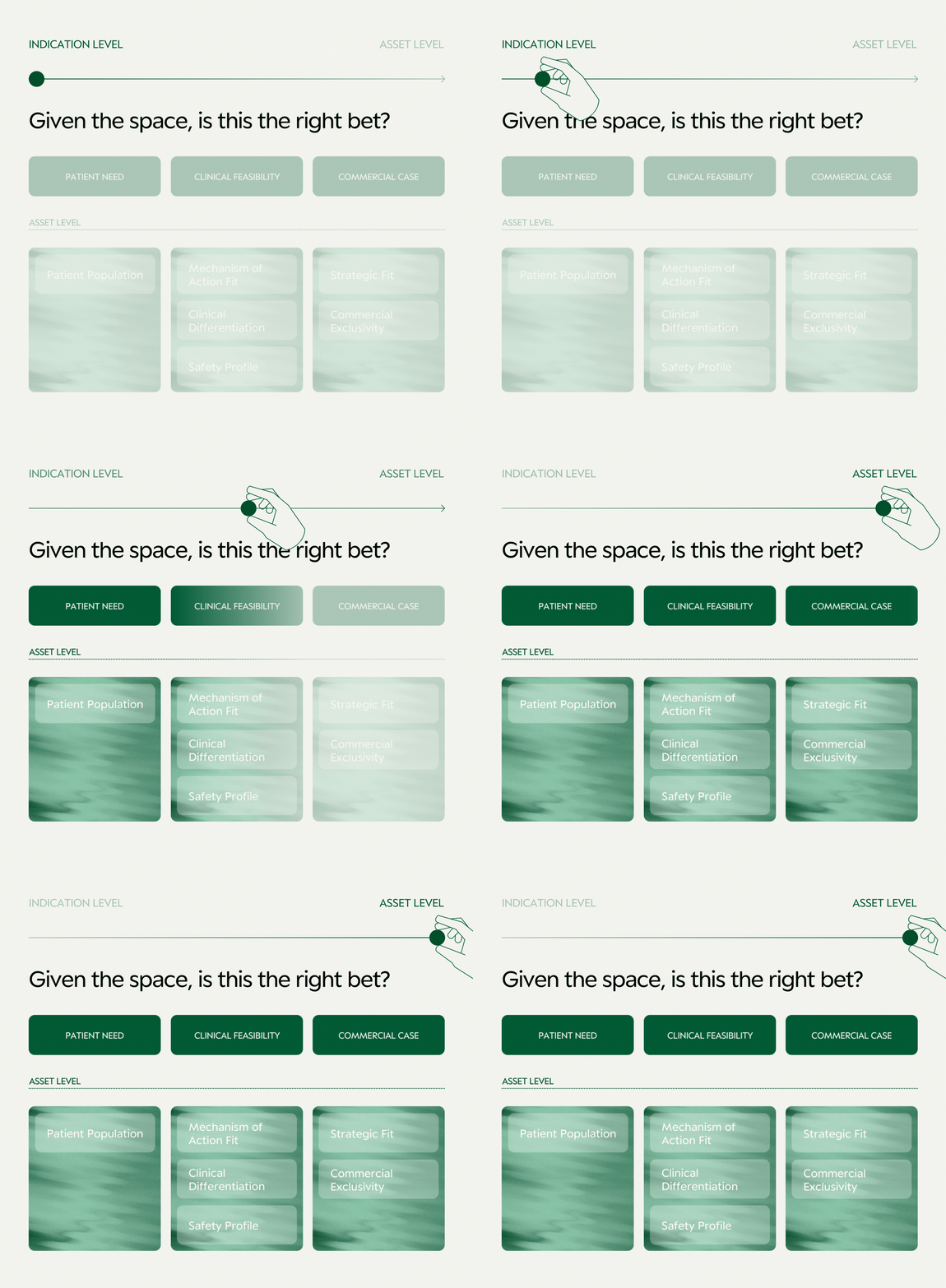
Indication-level assessment asks: is this a good space to be in at all? It is independent of any specific asset - it evaluates the disease, the patient population, the regulatory environment, and the commercial dynamics. This analysis is most useful when a company is building or reviewing its therapeutic area strategy.
Asset-specific assessment then asks: given that we want to be in this space, is this particular mechanism the right bet? It layers on top of the indication-level view with criteria that are specific to the asset's mechanism of action - the MOA fit to disease biology, the clinical differentiation versus existing treatments, and the known safety profile. Two assets in the same indication can look very different at this level.
Indication-level assessment asks: is this a good space to be in at all? It is independent of any specific asset - it evaluates the disease, the patient population, the regulatory environment, and the commercial dynamics. This analysis is most useful when a company is building or reviewing its therapeutic area strategy.
Asset-specific assessment then asks: given that we want to be in this space, is this particular mechanism the right bet? It layers on top of the indication-level view with criteria that are specific to the asset's mechanism of action - the MOA fit to disease biology, the clinical differentiation versus existing treatments, and the known safety profile. Two assets in the same indication can look very different at this level.
Indication-level assessment asks: is this a good space to be in at all? It is independent of any specific asset - it evaluates the disease, the patient population, the regulatory environment, and the commercial dynamics. This analysis is most useful when a company is building or reviewing its therapeutic area strategy.
Asset-specific assessment then asks: given that we want to be in this space, is this particular mechanism the right bet? It layers on top of the indication-level view with criteria that are specific to the asset's mechanism of action - the MOA fit to disease biology, the clinical differentiation versus existing treatments, and the known safety profile. Two assets in the same indication can look very different at this level.
Selecting What Is Worth Betting On
Indication-level assessment asks: is this a good space to be in at all? It is independent of any specific asset - it evaluates the disease, the patient population, the regulatory environment, and the commercial dynamics. This analysis is most useful when a company is building or reviewing its therapeutic area strategy.
Asset-specific assessment then asks: given that we want to be in this space, is this particular mechanism the right bet? It layers on top of the indication-level view with criteria that are specific to the asset's mechanism of action - the MOA fit to disease biology, the clinical differentiation versus existing treatments, and the known safety profile. Two assets in the same indication can look very different at this level.
Selecting What Is Worth Betting On
Indication-level assessment asks: is this a good space to be in at all? It is independent of any specific asset - it evaluates the disease, the patient population, the regulatory environment, and the commercial dynamics. This analysis is most useful when a company is building or reviewing its therapeutic area strategy.
Asset-specific assessment then asks: given that we want to be in this space, is this particular mechanism the right bet? It layers on top of the indication-level view with criteria that are specific to the asset's mechanism of action - the MOA fit to disease biology, the clinical differentiation versus existing treatments, and the known safety profile. Two assets in the same indication can look very different at this level.
Selecting What Is Worth Betting On
The framework is not meant to be a checklist, where each criterion passes or fails in isolation. The outputs only make sense in the context of the full indication profile.
A small patient population is not automatically a problem; in a rare disease, it can support premium pricing that makes the economics work. Validated clinical endpoints are a meaningful advantage, but they're worth a lot less when you're walking into an indication already crowded with disease-modifying therapies. What looks like a weakness in one dimension can be acceptable - or even irrelevant - depending on what the rest of the picture shows.
In an increasingly competitive environment, patient population deserves a harder look than it usually gets. Broad mechanisms don't automatically beat precise sub-group targeting; in some cases, it may be the other way around. Payers and regulators are getting much more explicit about wanting a clear patient selection rationale, and that expectation isn't going away.
The framework gives the conversation structure. The judgment about how everything fits together is what turns it into an actual decision.
The framework is not meant to be a checklist, where each criterion passes or fails in isolation. The outputs only make sense in the context of the full indication profile.
A small patient population is not automatically a problem; in a rare disease, it can support premium pricing that makes the economics work. Validated clinical endpoints are a meaningful advantage, but they're worth a lot less when you're walking into an indication already crowded with disease-modifying therapies. What looks like a weakness in one dimension can be acceptable - or even irrelevant - depending on what the rest of the picture shows.
In an increasingly competitive environment, patient population deserves a harder look than it usually gets. Broad mechanisms don't automatically beat precise sub-group targeting; in some cases, it may be the other way around. Payers and regulators are getting much more explicit about wanting a clear patient selection rationale, and that expectation isn't going away.
The framework gives the conversation structure. The judgment about how everything fits together is what turns it into an actual decision.
The framework is not meant to be a checklist, where each criterion passes or fails in isolation. The outputs only make sense in the context of the full indication profile.
A small patient population is not automatically a problem; in a rare disease, it can support premium pricing that makes the economics work. Validated clinical endpoints are a meaningful advantage, but they're worth a lot less when you're walking into an indication already crowded with disease-modifying therapies. What looks like a weakness in one dimension can be acceptable - or even irrelevant - depending on what the rest of the picture shows.
In an increasingly competitive environment, patient population deserves a harder look than it usually gets. Broad mechanisms don't automatically beat precise sub-group targeting; in some cases, it may be the other way around. Payers and regulators are getting much more explicit about wanting a clear patient selection rationale, and that expectation isn't going away.
The framework gives the conversation structure. The judgment about how everything fits together is what turns it into an actual decision.
How to Apply the Framework
The framework is not meant to be a checklist, where each criterion passes or fails in isolation. The outputs only make sense in the context of the full indication profile.
A small patient population is not automatically a problem; in a rare disease, it can support premium pricing that makes the economics work. Validated clinical endpoints are a meaningful advantage, but they're worth a lot less when you're walking into an indication already crowded with disease-modifying therapies. What looks like a weakness in one dimension can be acceptable - or even irrelevant - depending on what the rest of the picture shows.
In an increasingly competitive environment, patient population deserves a harder look than it usually gets. Broad mechanisms don't automatically beat precise sub-group targeting; in some cases, it may be the other way around. Payers and regulators are getting much more explicit about wanting a clear patient selection rationale, and that expectation isn't going away.
The framework gives the conversation structure. The judgment about how everything fits together is what turns it into an actual decision.
How to Apply the Framework
The framework is not meant to be a checklist, where each criterion passes or fails in isolation. The outputs only make sense in the context of the full indication profile.
A small patient population is not automatically a problem; in a rare disease, it can support premium pricing that makes the economics work. Validated clinical endpoints are a meaningful advantage, but they're worth a lot less when you're walking into an indication already crowded with disease-modifying therapies. What looks like a weakness in one dimension can be acceptable - or even irrelevant - depending on what the rest of the picture shows.
In an increasingly competitive environment, patient population deserves a harder look than it usually gets. Broad mechanisms don't automatically beat precise sub-group targeting; in some cases, it may be the other way around. Payers and regulators are getting much more explicit about wanting a clear patient selection rationale, and that expectation isn't going away.
The framework gives the conversation structure. The judgment about how everything fits together is what turns it into an actual decision.
How to Apply the Framework
The framework is not a one-time scorecard exercise; it is a decision architecture that evolves as an asset moves through development. Each criterion needs to be further and more deeply assessed as an asset moves through development.
At the earliest stage of portfolio strategy, the framework operates as a broad scan. All potential indications for a therapeutic area are scored against criteria using secondary data, and the output is a ranked list with a clear, quantitative basis for prioritization. This is the first gate, and at this stage, the analytical investment is deliberately light. The goal is not precision; it is to get from twenty indications to a handful worth taking seriously.
With a shortlist in hand, the BD&L and scientific teams go hunting! Which assets are in development for these indications? Which mechanisms have the strongest biological rationale? Who is available for licensing, and at what stage?
Once a credible asset or MOA is identified, a directional NPV is built, grounded in the secondary data already assembled. The model is not intended to be definitive at this stage. It is a sense-check: does this asset in this indication represent an opportunity large enough to justify the cost of deeper investigation? If the numbers do not work under generous assumptions, primary research will not save it.
For the opportunities that clear that bar, primary research begins. KOL interviews, early payer advisory boards, physician surveys - the purpose at this stage is to validate and stress-test the framework's signals, refine the NPV assumptions, and start answering the questions that secondary data cannot.
The principle throughout is right granularity at the right time - always doing enough analysis to make the next decision well, not the one three stages ahead.

The framework is not a one-time scorecard exercise; it is a decision architecture that evolves as an asset moves through development. Each criterion needs to be further and more deeply assessed as an asset moves through development.
At the earliest stage of portfolio strategy, the framework operates as a broad scan. All potential indications for a therapeutic area are scored against criteria using secondary data, and the output is a ranked list with a clear, quantitative basis for prioritization. This is the first gate, and at this stage, the analytical investment is deliberately light. The goal is not precision; it is to get from twenty indications to a handful worth taking seriously.
With a shortlist in hand, the BD&L and scientific teams go hunting! Which assets are in development for these indications? Which mechanisms have the strongest biological rationale? Who is available for licensing, and at what stage?
Once a credible asset or MOA is identified, a directional NPV is built, grounded in the secondary data already assembled. The model is not intended to be definitive at this stage. It is a sense-check: does this asset in this indication represent an opportunity large enough to justify the cost of deeper investigation? If the numbers do not work under generous assumptions, primary research will not save it.
For the opportunities that clear that bar, primary research begins. KOL interviews, early payer advisory boards, physician surveys - the purpose at this stage is to validate and stress-test the framework's signals, refine the NPV assumptions, and start answering the questions that secondary data cannot.
The principle throughout is right granularity at the right time - always doing enough analysis to make the next decision well, not the one three stages ahead.
The framework is not a one-time scorecard exercise; it is a decision architecture that evolves as an asset moves through development. Each criterion needs to be further and more deeply assessed as an asset moves through development.
At the earliest stage of portfolio strategy, the framework operates as a broad scan. All potential indications for a therapeutic area are scored against criteria using secondary data, and the output is a ranked list with a clear, quantitative basis for prioritization. This is the first gate, and at this stage, the analytical investment is deliberately light. The goal is not precision; it is to get from twenty indications to a handful worth taking seriously.
With a shortlist in hand, the BD&L and scientific teams go hunting! Which assets are in development for these indications? Which mechanisms have the strongest biological rationale? Who is available for licensing, and at what stage?
Once a credible asset or MOA is identified, a directional NPV is built, grounded in the secondary data already assembled. The model is not intended to be definitive at this stage. It is a sense-check: does this asset in this indication represent an opportunity large enough to justify the cost of deeper investigation? If the numbers do not work under generous assumptions, primary research will not save it.
For the opportunities that clear that bar, primary research begins. KOL interviews, early payer advisory boards, physician surveys - the purpose at this stage is to validate and stress-test the framework's signals, refine the NPV assumptions, and start answering the questions that secondary data cannot.
The principle throughout is right granularity at the right time - always doing enough analysis to make the next decision well, not the one three stages ahead.
From Broad Scan to Focused Investment
The framework is not a one-time scorecard exercise; it is a decision architecture that evolves as an asset moves through development. Each criterion needs to be further and more deeply assessed as an asset moves through development.
At the earliest stage of portfolio strategy, the framework operates as a broad scan. All potential indications for a therapeutic area are scored against criteria using secondary data, and the output is a ranked list with a clear, quantitative basis for prioritization. This is the first gate, and at this stage, the analytical investment is deliberately light. The goal is not precision; it is to get from twenty indications to a handful worth taking seriously.
With a shortlist in hand, the BD&L and scientific teams go hunting! Which assets are in development for these indications? Which mechanisms have the strongest biological rationale? Who is available for licensing, and at what stage?
Once a credible asset or MOA is identified, a directional NPV is built, grounded in the secondary data already assembled. The model is not intended to be definitive at this stage. It is a sense-check: does this asset in this indication represent an opportunity large enough to justify the cost of deeper investigation? If the numbers do not work under generous assumptions, primary research will not save it.
For the opportunities that clear that bar, primary research begins. KOL interviews, early payer advisory boards, physician surveys - the purpose at this stage is to validate and stress-test the framework's signals, refine the NPV assumptions, and start answering the questions that secondary data cannot.
The principle throughout is right granularity at the right time - always doing enough analysis to make the next decision well, not the one three stages ahead.
From Broad Scan to Focused Investment
The framework is not a one-time scorecard exercise; it is a decision architecture that evolves as an asset moves through development. Each criterion needs to be further and more deeply assessed as an asset moves through development.
At the earliest stage of portfolio strategy, the framework operates as a broad scan. All potential indications for a therapeutic area are scored against criteria using secondary data, and the output is a ranked list with a clear, quantitative basis for prioritization. This is the first gate, and at this stage, the analytical investment is deliberately light. The goal is not precision; it is to get from twenty indications to a handful worth taking seriously.
With a shortlist in hand, the BD&L and scientific teams go hunting! Which assets are in development for these indications? Which mechanisms have the strongest biological rationale? Who is available for licensing, and at what stage?
Once a credible asset or MOA is identified, a directional NPV is built, grounded in the secondary data already assembled. The model is not intended to be definitive at this stage. It is a sense-check: does this asset in this indication represent an opportunity large enough to justify the cost of deeper investigation? If the numbers do not work under generous assumptions, primary research will not save it.
For the opportunities that clear that bar, primary research begins. KOL interviews, early payer advisory boards, physician surveys - the purpose at this stage is to validate and stress-test the framework's signals, refine the NPV assumptions, and start answering the questions that secondary data cannot.
The principle throughout is right granularity at the right time - always doing enough analysis to make the next decision well, not the one three stages ahead.
From Broad Scan to Focused Investment
The Old Way
Until recently, populating a framework like this required a substantial team effort. A typical early-stage opportunity assessment would involve a team of four to six analysts working across three to four weeks of secondary research. The workflow was largely manual: one analyst assigned to epidemiology databases, another to ClinicalTrials.gov, another to FDA and EMA regulatory databases, another to HTA decision libraries. Each would work through their assigned sources, extract the relevant data points, and pass them to a senior team member to synthesize and score.
The bottleneck was never decision-making. Senior strategists and scientific leaders have always been capable of interpreting the data and drawing conclusions. The bottleneck was the data gathering itself - the laborious process of searching, extracting, cleaning, and organizing information from a dozen disparate sources before any judgment could be applied.
This mattered less when the pace of change was slower and pipelines were less crowded. Today, pipelines are often very crowded (MASH has more than 75 pipeline therapies). If you need to monitor all of them, a manual process is not possible. By the time the analysis is presented, the landscape it describes may already have moved.
The New Way: Agentic AI
The secondary data sources that underpin this framework are, to a remarkable degree, now programmable. ClinicalTrials.gov, the FDA designation database, the EMA PRIME database, OpenTargets, the GWAS Catalog, IHME burden of disease estimates, HTA decision records from NICE, HAS, G-BA, and a dozen other bodies - all of these can be queried systematically through APIs or structured scraping. The information exists. It has always existed. What has changed is the ability to access it at scale, at speed, and without human hands doing the retrieval.
Agents That Do the Work of Teams
Agentic AI makes it possible to build automated workflows - agents - that replicate what a secondary research team used to do over weeks, and complete it in minutes. An agent can be built to query ClinicalTrials.gov for all trials in an indication, extract the number of Phase 2 and Phase 3 completions, identify which have validated primary endpoints, and return a structured output ready to populate the Clinical Feasibility pillar. Another agent can crawl the FDA and EMA designation databases and return the count of breakthrough, fast-track, and orphan designations for the indication. Another queries OpenTargets and the GWAS Catalog for genetic associations linking a specific mechanism to the target disease.
Read the follow-up piece that walks through how to actually build these agents in practice here.
Reasoning Across Unstructured Sources
The more significant advance is not in structured database retrieval; it is in what agentic AI can do with unstructured sources. Synthesizing the evidence base linking a biological pathway to a disease indication used to require a scientist to read hundreds of PubMed abstracts and summarize the literature. An agentic AI system can now do this with a level of recall and consistency that exceeds what is feasible for a human team under time pressure.
The same applies to HTA rationale analysis. Understanding why NICE rejected a therapy - whether it was a QALY threshold issue or a specific clinical comparator problem - requires reading dense documents. Agents can be built to do this systematically across an entire HTA decision history for an indication, producing structured outputs that directly inform the payer and HTA landscape criteria of the framework.
Where Human Judgment Remains Essential
It is important to be realistic about what can and cannot be automated. The framework is designed with this distinction built in. Criteria that draw on publicly available, structured or semi-structured sources are highly amenable to automation. These are flagged in the framework as high-scrapability inputs.
Criteria that require internal data or qualitative expert judgment are explicitly identified as such. Strategic fit - how much commercial infrastructure already exists for this indication - requires internal knowledge of the company's existing portfolio, field force, and key account relationships. Safety profile at the asset-specific level draws on internal clinical data that is not publicly available. HCP overlap with the existing portfolio requires internal commercial analytics. These criteria cannot be automated, and the framework does not pretend otherwise. What automation enables is that these inputs - which genuinely require human expertise - are the only inputs that actually need human time.

The Old Way
Until recently, populating a framework like this required a substantial team effort. A typical early-stage opportunity assessment would involve a team of four to six analysts working across three to four weeks of secondary research. The workflow was largely manual: one analyst assigned to epidemiology databases, another to ClinicalTrials.gov, another to FDA and EMA regulatory databases, another to HTA decision libraries. Each would work through their assigned sources, extract the relevant data points, and pass them to a senior team member to synthesize and score.
The bottleneck was never decision-making. Senior strategists and scientific leaders have always been capable of interpreting the data and drawing conclusions. The bottleneck was the data gathering itself - the laborious process of searching, extracting, cleaning, and organizing information from a dozen disparate sources before any judgment could be applied.
This mattered less when the pace of change was slower and pipelines were less crowded. Today, pipelines are often very crowded (MASH has more than 75 pipeline therapies). If you need to monitor all of them, a manual process is not possible. By the time the analysis is presented, the landscape it describes may already have moved.
The New Way: Agentic AI
The secondary data sources that underpin this framework are, to a remarkable degree, now programmable. ClinicalTrials.gov, the FDA designation database, the EMA PRIME database, OpenTargets, the GWAS Catalog, IHME burden of disease estimates, HTA decision records from NICE, HAS, G-BA, and a dozen other bodies - all of these can be queried systematically through APIs or structured scraping. The information exists. It has always existed. What has changed is the ability to access it at scale, at speed, and without human hands doing the retrieval.
Agents That Do the Work of Teams
Agentic AI makes it possible to build automated workflows - agents - that replicate what a secondary research team used to do over weeks, and complete it in minutes. An agent can be built to query ClinicalTrials.gov for all trials in an indication, extract the number of Phase 2 and Phase 3 completions, identify which have validated primary endpoints, and return a structured output ready to populate the Clinical Feasibility pillar. Another agent can crawl the FDA and EMA designation databases and return the count of breakthrough, fast-track, and orphan designations for the indication. Another queries OpenTargets and the GWAS Catalog for genetic associations linking a specific mechanism to the target disease.
Read the follow-up piece that walks through how to actually build these agents in practice here.
Reasoning Across Unstructured Sources
The more significant advance is not in structured database retrieval; it is in what agentic AI can do with unstructured sources. Synthesizing the evidence base linking a biological pathway to a disease indication used to require a scientist to read hundreds of PubMed abstracts and summarize the literature. An agentic AI system can now do this with a level of recall and consistency that exceeds what is feasible for a human team under time pressure.
The same applies to HTA rationale analysis. Understanding why NICE rejected a therapy - whether it was a QALY threshold issue or a specific clinical comparator problem - requires reading dense documents. Agents can be built to do this systematically across an entire HTA decision history for an indication, producing structured outputs that directly inform the payer and HTA landscape criteria of the framework.
Where Human Judgment Remains Essential
It is important to be realistic about what can and cannot be automated. The framework is designed with this distinction built in. Criteria that draw on publicly available, structured or semi-structured sources are highly amenable to automation. These are flagged in the framework as high-scrapability inputs.
Criteria that require internal data or qualitative expert judgment are explicitly identified as such. Strategic fit - how much commercial infrastructure already exists for this indication - requires internal knowledge of the company's existing portfolio, field force, and key account relationships. Safety profile at the asset-specific level draws on internal clinical data that is not publicly available. HCP overlap with the existing portfolio requires internal commercial analytics. These criteria cannot be automated, and the framework does not pretend otherwise. What automation enables is that these inputs - which genuinely require human expertise - are the only inputs that actually need human time.
The Old Way
Until recently, populating a framework like this required a substantial team effort. A typical early-stage opportunity assessment would involve a team of four to six analysts working across three to four weeks of secondary research. The workflow was largely manual: one analyst assigned to epidemiology databases, another to ClinicalTrials.gov, another to FDA and EMA regulatory databases, another to HTA decision libraries. Each would work through their assigned sources, extract the relevant data points, and pass them to a senior team member to synthesize and score.
The bottleneck was never decision-making. Senior strategists and scientific leaders have always been capable of interpreting the data and drawing conclusions. The bottleneck was the data gathering itself - the laborious process of searching, extracting, cleaning, and organizing information from a dozen disparate sources before any judgment could be applied.
This mattered less when the pace of change was slower and pipelines were less crowded. Today, pipelines are often very crowded (MASH has more than 75 pipeline therapies). If you need to monitor all of them, a manual process is not possible. By the time the analysis is presented, the landscape it describes may already have moved.
The New Way: Agentic AI
The secondary data sources that underpin this framework are, to a remarkable degree, now programmable. ClinicalTrials.gov, the FDA designation database, the EMA PRIME database, OpenTargets, the GWAS Catalog, IHME burden of disease estimates, HTA decision records from NICE, HAS, G-BA, and a dozen other bodies - all of these can be queried systematically through APIs or structured scraping. The information exists. It has always existed. What has changed is the ability to access it at scale, at speed, and without human hands doing the retrieval.
Agents That Do the Work of Teams
Agentic AI makes it possible to build automated workflows - agents - that replicate what a secondary research team used to do over weeks, and complete it in minutes. An agent can be built to query ClinicalTrials.gov for all trials in an indication, extract the number of Phase 2 and Phase 3 completions, identify which have validated primary endpoints, and return a structured output ready to populate the Clinical Feasibility pillar. Another agent can crawl the FDA and EMA designation databases and return the count of breakthrough, fast-track, and orphan designations for the indication. Another queries OpenTargets and the GWAS Catalog for genetic associations linking a specific mechanism to the target disease.
Read the follow-up piece that walks through how to actually build these agents in practice here.
Reasoning Across Unstructured Sources
The more significant advance is not in structured database retrieval; it is in what agentic AI can do with unstructured sources. Synthesizing the evidence base linking a biological pathway to a disease indication used to require a scientist to read hundreds of PubMed abstracts and summarize the literature. An agentic AI system can now do this with a level of recall and consistency that exceeds what is feasible for a human team under time pressure.
The same applies to HTA rationale analysis. Understanding why NICE rejected a therapy - whether it was a QALY threshold issue or a specific clinical comparator problem - requires reading dense documents. Agents can be built to do this systematically across an entire HTA decision history for an indication, producing structured outputs that directly inform the payer and HTA landscape criteria of the framework.
Where Human Judgment Remains Essential
It is important to be realistic about what can and cannot be automated. The framework is designed with this distinction built in. Criteria that draw on publicly available, structured or semi-structured sources are highly amenable to automation. These are flagged in the framework as high-scrapability inputs.
Criteria that require internal data or qualitative expert judgment are explicitly identified as such. Strategic fit - how much commercial infrastructure already exists for this indication - requires internal knowledge of the company's existing portfolio, field force, and key account relationships. Safety profile at the asset-specific level draws on internal clinical data that is not publicly available. HCP overlap with the existing portfolio requires internal commercial analytics. These criteria cannot be automated, and the framework does not pretend otherwise. What automation enables is that these inputs - which genuinely require human expertise - are the only inputs that actually need human time.
What's Changing
The Old Way
Until recently, populating a framework like this required a substantial team effort. A typical early-stage opportunity assessment would involve a team of four to six analysts working across three to four weeks of secondary research. The workflow was largely manual: one analyst assigned to epidemiology databases, another to ClinicalTrials.gov, another to FDA and EMA regulatory databases, another to HTA decision libraries. Each would work through their assigned sources, extract the relevant data points, and pass them to a senior team member to synthesize and score.
The bottleneck was never decision-making. Senior strategists and scientific leaders have always been capable of interpreting the data and drawing conclusions. The bottleneck was the data gathering itself - the laborious process of searching, extracting, cleaning, and organizing information from a dozen disparate sources before any judgment could be applied.
This mattered less when the pace of change was slower and pipelines were less crowded. Today, pipelines are often very crowded (MASH has more than 75 pipeline therapies). If you need to monitor all of them, a manual process is not possible. By the time the analysis is presented, the landscape it describes may already have moved.
The New Way: Agentic AI
The secondary data sources that underpin this framework are, to a remarkable degree, now programmable. ClinicalTrials.gov, the FDA designation database, the EMA PRIME database, OpenTargets, the GWAS Catalog, IHME burden of disease estimates, HTA decision records from NICE, HAS, G-BA, and a dozen other bodies - all of these can be queried systematically through APIs or structured scraping. The information exists. It has always existed. What has changed is the ability to access it at scale, at speed, and without human hands doing the retrieval.
Agents That Do the Work of Teams
Agentic AI makes it possible to build automated workflows - agents - that replicate what a secondary research team used to do over weeks, and complete it in minutes. An agent can be built to query ClinicalTrials.gov for all trials in an indication, extract the number of Phase 2 and Phase 3 completions, identify which have validated primary endpoints, and return a structured output ready to populate the Clinical Feasibility pillar. Another agent can crawl the FDA and EMA designation databases and return the count of breakthrough, fast-track, and orphan designations for the indication. Another queries OpenTargets and the GWAS Catalog for genetic associations linking a specific mechanism to the target disease.
Read the follow-up piece that walks through how to actually build these agents in practice here.
Reasoning Across Unstructured Sources
The more significant advance is not in structured database retrieval; it is in what agentic AI can do with unstructured sources. Synthesizing the evidence base linking a biological pathway to a disease indication used to require a scientist to read hundreds of PubMed abstracts and summarize the literature. An agentic AI system can now do this with a level of recall and consistency that exceeds what is feasible for a human team under time pressure.
The same applies to HTA rationale analysis. Understanding why NICE rejected a therapy - whether it was a QALY threshold issue or a specific clinical comparator problem - requires reading dense documents. Agents can be built to do this systematically across an entire HTA decision history for an indication, producing structured outputs that directly inform the payer and HTA landscape criteria of the framework.
Where Human Judgment Remains Essential
It is important to be realistic about what can and cannot be automated. The framework is designed with this distinction built in. Criteria that draw on publicly available, structured or semi-structured sources are highly amenable to automation. These are flagged in the framework as high-scrapability inputs.
Criteria that require internal data or qualitative expert judgment are explicitly identified as such. Strategic fit - how much commercial infrastructure already exists for this indication - requires internal knowledge of the company's existing portfolio, field force, and key account relationships. Safety profile at the asset-specific level draws on internal clinical data that is not publicly available. HCP overlap with the existing portfolio requires internal commercial analytics. These criteria cannot be automated, and the framework does not pretend otherwise. What automation enables is that these inputs - which genuinely require human expertise - are the only inputs that actually need human time.
What's Changing
The Old Way
Until recently, populating a framework like this required a substantial team effort. A typical early-stage opportunity assessment would involve a team of four to six analysts working across three to four weeks of secondary research. The workflow was largely manual: one analyst assigned to epidemiology databases, another to ClinicalTrials.gov, another to FDA and EMA regulatory databases, another to HTA decision libraries. Each would work through their assigned sources, extract the relevant data points, and pass them to a senior team member to synthesize and score.
The bottleneck was never decision-making. Senior strategists and scientific leaders have always been capable of interpreting the data and drawing conclusions. The bottleneck was the data gathering itself - the laborious process of searching, extracting, cleaning, and organizing information from a dozen disparate sources before any judgment could be applied.
This mattered less when the pace of change was slower and pipelines were less crowded. Today, pipelines are often very crowded (MASH has more than 75 pipeline therapies). If you need to monitor all of them, a manual process is not possible. By the time the analysis is presented, the landscape it describes may already have moved.
The New Way: Agentic AI
The secondary data sources that underpin this framework are, to a remarkable degree, now programmable. ClinicalTrials.gov, the FDA designation database, the EMA PRIME database, OpenTargets, the GWAS Catalog, IHME burden of disease estimates, HTA decision records from NICE, HAS, G-BA, and a dozen other bodies - all of these can be queried systematically through APIs or structured scraping. The information exists. It has always existed. What has changed is the ability to access it at scale, at speed, and without human hands doing the retrieval.
Agents That Do the Work of Teams
Agentic AI makes it possible to build automated workflows - agents - that replicate what a secondary research team used to do over weeks, and complete it in minutes. An agent can be built to query ClinicalTrials.gov for all trials in an indication, extract the number of Phase 2 and Phase 3 completions, identify which have validated primary endpoints, and return a structured output ready to populate the Clinical Feasibility pillar. Another agent can crawl the FDA and EMA designation databases and return the count of breakthrough, fast-track, and orphan designations for the indication. Another queries OpenTargets and the GWAS Catalog for genetic associations linking a specific mechanism to the target disease.
Read the follow-up piece that walks through how to actually build these agents in practice here.
Reasoning Across Unstructured Sources
The more significant advance is not in structured database retrieval; it is in what agentic AI can do with unstructured sources. Synthesizing the evidence base linking a biological pathway to a disease indication used to require a scientist to read hundreds of PubMed abstracts and summarize the literature. An agentic AI system can now do this with a level of recall and consistency that exceeds what is feasible for a human team under time pressure.
The same applies to HTA rationale analysis. Understanding why NICE rejected a therapy - whether it was a QALY threshold issue or a specific clinical comparator problem - requires reading dense documents. Agents can be built to do this systematically across an entire HTA decision history for an indication, producing structured outputs that directly inform the payer and HTA landscape criteria of the framework.
Where Human Judgment Remains Essential
It is important to be realistic about what can and cannot be automated. The framework is designed with this distinction built in. Criteria that draw on publicly available, structured or semi-structured sources are highly amenable to automation. These are flagged in the framework as high-scrapability inputs.
Criteria that require internal data or qualitative expert judgment are explicitly identified as such. Strategic fit - how much commercial infrastructure already exists for this indication - requires internal knowledge of the company's existing portfolio, field force, and key account relationships. Safety profile at the asset-specific level draws on internal clinical data that is not publicly available. HCP overlap with the existing portfolio requires internal commercial analytics. These criteria cannot be automated, and the framework does not pretend otherwise. What automation enables is that these inputs - which genuinely require human expertise - are the only inputs that actually need human time.
What's Changing
Portfolio reviews can happen more frequently. New signals can be incorporated into the analysis in near real-time, and leadership teams can make go/no-go decisions with current data rather than data that is already months old by the time the analysis is presented.
Parallel Scenario Analysis
The old model required teams to make a choice about which indications to analyze in depth, because time and cost constraints made parallel analysis infeasible. The new model does not have that constraint for the data layer. A company evaluating a C5 inhibitor can now run a full indication-level assessment across all twelve plausible indications simultaneously, with structured, comparable outputs across all of them. The comparison that used to be a high-level prioritization conversation becomes a data-driven portfolio optimization exercise.
Consistency Across Teams and Therapeutic Areas
One of the most underappreciated benefits of a structured framework, populated systematically, is the consistency it creates across different teams and different therapeutic areas within the same organization. When a neurology team and an immunology team are both using the same framework and the same data sources, their outputs are comparable. Leadership can look across two portfolio opportunities in different therapeutic areas and make a resource allocation decision with confidence that the underlying analyzes are methodologically equivalent.
A Foundation That Scales with Development
Because the framework is designed to evolve across development phases, the investment in building and populating it at the asset nomination stage pays dividends throughout the program. Each phase transition refreshes the analysis rather than restarting it. The institutional memory of how the opportunity has been assessed, how the scores have changed, and what has driven those changes becomes part of the program's scientific and commercial record - accessible to new team members, auditable by leadership, and transferable in a licensing or M&A context.
Portfolio reviews can happen more frequently. New signals can be incorporated into the analysis in near real-time, and leadership teams can make go/no-go decisions with current data rather than data that is already months old by the time the analysis is presented.
Parallel Scenario Analysis
The old model required teams to make a choice about which indications to analyze in depth, because time and cost constraints made parallel analysis infeasible. The new model does not have that constraint for the data layer. A company evaluating a C5 inhibitor can now run a full indication-level assessment across all twelve plausible indications simultaneously, with structured, comparable outputs across all of them. The comparison that used to be a high-level prioritization conversation becomes a data-driven portfolio optimization exercise.
Consistency Across Teams and Therapeutic Areas
One of the most underappreciated benefits of a structured framework, populated systematically, is the consistency it creates across different teams and different therapeutic areas within the same organization. When a neurology team and an immunology team are both using the same framework and the same data sources, their outputs are comparable. Leadership can look across two portfolio opportunities in different therapeutic areas and make a resource allocation decision with confidence that the underlying analyzes are methodologically equivalent.
A Foundation That Scales with Development
Because the framework is designed to evolve across development phases, the investment in building and populating it at the asset nomination stage pays dividends throughout the program. Each phase transition refreshes the analysis rather than restarting it. The institutional memory of how the opportunity has been assessed, how the scores have changed, and what has driven those changes becomes part of the program's scientific and commercial record - accessible to new team members, auditable by leadership, and transferable in a licensing or M&A context.
Portfolio reviews can happen more frequently. New signals can be incorporated into the analysis in near real-time, and leadership teams can make go/no-go decisions with current data rather than data that is already months old by the time the analysis is presented.
Parallel Scenario Analysis
The old model required teams to make a choice about which indications to analyze in depth, because time and cost constraints made parallel analysis infeasible. The new model does not have that constraint for the data layer. A company evaluating a C5 inhibitor can now run a full indication-level assessment across all twelve plausible indications simultaneously, with structured, comparable outputs across all of them. The comparison that used to be a high-level prioritization conversation becomes a data-driven portfolio optimization exercise.
Consistency Across Teams and Therapeutic Areas
One of the most underappreciated benefits of a structured framework, populated systematically, is the consistency it creates across different teams and different therapeutic areas within the same organization. When a neurology team and an immunology team are both using the same framework and the same data sources, their outputs are comparable. Leadership can look across two portfolio opportunities in different therapeutic areas and make a resource allocation decision with confidence that the underlying analyzes are methodologically equivalent.
A Foundation That Scales with Development
Because the framework is designed to evolve across development phases, the investment in building and populating it at the asset nomination stage pays dividends throughout the program. Each phase transition refreshes the analysis rather than restarting it. The institutional memory of how the opportunity has been assessed, how the scores have changed, and what has driven those changes becomes part of the program's scientific and commercial record - accessible to new team members, auditable by leadership, and transferable in a licensing or M&A context.
Earlier Conviction, Faster Cycles
Portfolio reviews can happen more frequently. New signals can be incorporated into the analysis in near real-time, and leadership teams can make go/no-go decisions with current data rather than data that is already months old by the time the analysis is presented.
Parallel Scenario Analysis
The old model required teams to make a choice about which indications to analyze in depth, because time and cost constraints made parallel analysis infeasible. The new model does not have that constraint for the data layer. A company evaluating a C5 inhibitor can now run a full indication-level assessment across all twelve plausible indications simultaneously, with structured, comparable outputs across all of them. The comparison that used to be a high-level prioritization conversation becomes a data-driven portfolio optimization exercise.
Consistency Across Teams and Therapeutic Areas
One of the most underappreciated benefits of a structured framework, populated systematically, is the consistency it creates across different teams and different therapeutic areas within the same organization. When a neurology team and an immunology team are both using the same framework and the same data sources, their outputs are comparable. Leadership can look across two portfolio opportunities in different therapeutic areas and make a resource allocation decision with confidence that the underlying analyzes are methodologically equivalent.
A Foundation That Scales with Development
Because the framework is designed to evolve across development phases, the investment in building and populating it at the asset nomination stage pays dividends throughout the program. Each phase transition refreshes the analysis rather than restarting it. The institutional memory of how the opportunity has been assessed, how the scores have changed, and what has driven those changes becomes part of the program's scientific and commercial record - accessible to new team members, auditable by leadership, and transferable in a licensing or M&A context.
Earlier Conviction, Faster Cycles
Portfolio reviews can happen more frequently. New signals can be incorporated into the analysis in near real-time, and leadership teams can make go/no-go decisions with current data rather than data that is already months old by the time the analysis is presented.
Parallel Scenario Analysis
The old model required teams to make a choice about which indications to analyze in depth, because time and cost constraints made parallel analysis infeasible. The new model does not have that constraint for the data layer. A company evaluating a C5 inhibitor can now run a full indication-level assessment across all twelve plausible indications simultaneously, with structured, comparable outputs across all of them. The comparison that used to be a high-level prioritization conversation becomes a data-driven portfolio optimization exercise.
Consistency Across Teams and Therapeutic Areas
One of the most underappreciated benefits of a structured framework, populated systematically, is the consistency it creates across different teams and different therapeutic areas within the same organization. When a neurology team and an immunology team are both using the same framework and the same data sources, their outputs are comparable. Leadership can look across two portfolio opportunities in different therapeutic areas and make a resource allocation decision with confidence that the underlying analyzes are methodologically equivalent.
A Foundation That Scales with Development
Because the framework is designed to evolve across development phases, the investment in building and populating it at the asset nomination stage pays dividends throughout the program. Each phase transition refreshes the analysis rather than restarting it. The institutional memory of how the opportunity has been assessed, how the scores have changed, and what has driven those changes becomes part of the program's scientific and commercial record - accessible to new team members, auditable by leadership, and transferable in a licensing or M&A context.
Earlier Conviction, Faster Cycles
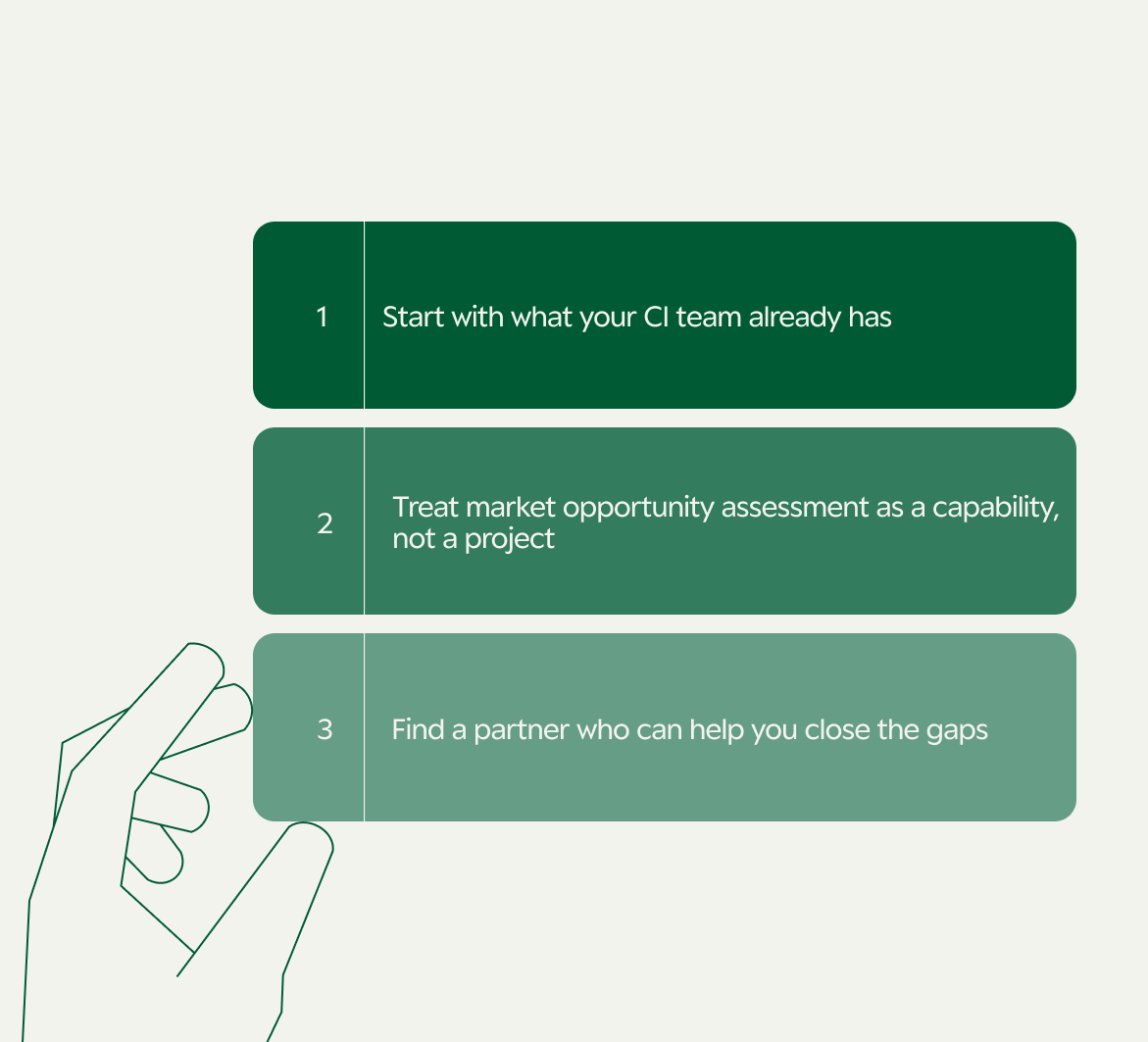
The framework is a starting point. But a framework sitting in a deck does not build a better pipeline – execution does! For teams ready to move, consider these three steps:
1. Start with what your team already has.
You may have some of the required infrastructure built! Competitive intelligence functions often already monitor trial registries, track regulatory designations, and maintain structured data feeds. That might be able to serve as the tool foundation - map it before you build anything new.
2. Treat this as a capability, not a project.
The instinct in most BD&L functions is to commission an assessment when the board asks for one, then move on. The companies that build consistently stronger pipelines treat market opportunity assessments as something they do continuously. They create a living view of the landscape that gets sharper over time.
3. Find a partner who can help you close the gaps.
The transition from a manually populated scorecard to a live, agentic system is achievable - the data sources exist, and the tooling is mature. The right partner accelerates that transition by knowing how to build the tooling and how to interpret the scientific and commercial data.
The framework is a starting point. But a framework sitting in a deck does not build a better pipeline – execution does! For teams ready to move, consider these three steps:
1. Start with what your team already has.
You may have some of the required infrastructure built! Competitive intelligence functions often already monitor trial registries, track regulatory designations, and maintain structured data feeds. That might be able to serve as the tool foundation - map it before you build anything new.
2. Treat this as a capability, not a project.
The instinct in most BD&L functions is to commission an assessment when the board asks for one, then move on. The companies that build consistently stronger pipelines treat market opportunity assessments as something they do continuously. They create a living view of the landscape that gets sharper over time.
3. Find a partner who can help you close the gaps.
The transition from a manually populated scorecard to a live, agentic system is achievable - the data sources exist, and the tooling is mature. The right partner accelerates that transition by knowing how to build the tooling and how to interpret the scientific and commercial data.
The framework is a starting point. But a framework sitting in a deck does not build a better pipeline – execution does! For teams ready to move, consider these three steps:
1. Start with what your team already has.
You may have some of the required infrastructure built! Competitive intelligence functions often already monitor trial registries, track regulatory designations, and maintain structured data feeds. That might be able to serve as the tool foundation - map it before you build anything new.
2. Treat this as a capability, not a project.
The instinct in most BD&L functions is to commission an assessment when the board asks for one, then move on. The companies that build consistently stronger pipelines treat market opportunity assessments as something they do continuously. They create a living view of the landscape that gets sharper over time.
3. Find a partner who can help you close the gaps.
The transition from a manually populated scorecard to a live, agentic system is achievable - the data sources exist, and the tooling is mature. The right partner accelerates that transition by knowing how to build the tooling and how to interpret the scientific and commercial data.
The Companies That Will Win
The framework is a starting point. But a framework sitting in a deck does not build a better pipeline – execution does! For teams ready to move, consider these three steps:
1. Start with what your team already has.
You may have some of the required infrastructure built! Competitive intelligence functions often already monitor trial registries, track regulatory designations, and maintain structured data feeds. That might be able to serve as the tool foundation - map it before you build anything new.
2. Treat this as a capability, not a project.
The instinct in most BD&L functions is to commission an assessment when the board asks for one, then move on. The companies that build consistently stronger pipelines treat market opportunity assessments as something they do continuously. They create a living view of the landscape that gets sharper over time.
3. Find a partner who can help you close the gaps.
The transition from a manually populated scorecard to a live, agentic system is achievable - the data sources exist, and the tooling is mature. The right partner accelerates that transition by knowing how to build the tooling and how to interpret the scientific and commercial data.
The Companies That Will Win
The framework is a starting point. But a framework sitting in a deck does not build a better pipeline – execution does! For teams ready to move, consider these three steps:
1. Start with what your team already has.
You may have some of the required infrastructure built! Competitive intelligence functions often already monitor trial registries, track regulatory designations, and maintain structured data feeds. That might be able to serve as the tool foundation - map it before you build anything new.
2. Treat this as a capability, not a project.
The instinct in most BD&L functions is to commission an assessment when the board asks for one, then move on. The companies that build consistently stronger pipelines treat market opportunity assessments as something they do continuously. They create a living view of the landscape that gets sharper over time.
3. Find a partner who can help you close the gaps.
The transition from a manually populated scorecard to a live, agentic system is achievable - the data sources exist, and the tooling is mature. The right partner accelerates that transition by knowing how to build the tooling and how to interpret the scientific and commercial data.
The Companies That Will Win
The whitepaper breaks down the full governance model: intake and prioritization criteria, decision rights, funding models, a value framework covering financial, capacity, and risk outcomes, and the kill triggers that let leaders stop work without stigma.
Curious how agentic AI could sharpen your next market opportunity assessment?
Get in touch to talk through what this could look like for your pipeline - whether that means exploring agentic AI for your competitive intelligence team, rethinking how you prioritize indications and assets, or simply comparing notes on where to start.



In this four-part series, “Mastering CX in Pharma”, we aim to share our perspective and approaches on how to succeed in designing a winning customer experience. We will deep dive into engagement model design, data as a key enabler, how to design an operating model that supports your strategic ambitions, and the role of change management.
Click to read more
In this four-part series, “Mastering CX in Pharma”, we aim to share our perspective and approaches on how to succeed in designing a winning customer experience. We will deep dive into engagement model design, data as a key enabler, how to design an operating model that supports your strategic ambitions, and the role of change management.
Click to read more
In this four-part series, “Mastering CX in Pharma”, we aim to share our perspective and approaches on how to succeed in designing a winning customer experience. We will deep dive into engagement model design, data as a key enabler, how to design an operating model that supports your strategic ambitions, and the role of change management.
Click to read more
Sign up for the whitepaper and learn how Agentic AI is set to disrupt pharma’s commercial engagement - and why acting now is key to staying ahead. Explore how a strategic approach to AI adoption can help pharma scale impact, optimize operations, and unlock lasting value.
Click to read more