
Global to Local Content Excellence
Global to Local Content Excellence
In this article we give our point of view on how healthcare organizations can design a scalable content engine with local flexibility for impactful customer engagement - and how to succeed where other organizations typically fail.

Within the commercial functions of Pharma, content has always been central to customer engagement. It shapes everything from product information on websites to follow-up emails sent to HCPs (Health Care Professionals), and congress presentations showcasing the company’s latest breakthroughs. Ensuring the content supply chain can produce relevant, personalized, and high-quality material at speed is therefore a core driver of customer engagement and a key factor in overall business success.
This need is growing as competition intensifies, customer preferences gain influence, and companies differentiate more through customer engagement on an international scale. Yet many organizations still operate with decentralized content creation, which often results in slower time-to-market and scattered messaging across countries. While centralization is widely seen as a solution, many companies struggle to achieve it in practice.
This article explores what it takes to establish a centralized content supply chain and answers the question:
“How can we ensure our content creation setup is optimized for impact, speed, and scale, and how do we implement this in practice?”
Within the commercial functions of Pharma, content has always been central to customer engagement. It shapes everything from product information on websites to follow-up emails sent to HCPs (Health Care Professionals), and congress presentations showcasing the company’s latest breakthroughs. Ensuring the content supply chain can produce relevant, personalized, and high-quality material at speed is therefore a core driver of customer engagement and a key factor in overall business success.
This need is growing as competition intensifies, customer preferences gain influence, and companies differentiate more through customer engagement on an international scale. Yet many organizations still operate with decentralized content creation, which often results in slower time-to-market and scattered messaging across countries. While centralization is widely seen as a solution, many companies struggle to achieve it in practice.
This article explores what it takes to establish a centralized content supply chain and answers the question:
“How can we ensure our content creation setup is optimized for impact, speed, and scale, and how do we implement this in practice?”
Within the commercial functions of Pharma, content has always been central to customer engagement. It shapes everything from product information on websites to follow-up emails sent to HCPs (Health Care Professionals), and congress presentations showcasing the company’s latest breakthroughs. Ensuring the content supply chain can produce relevant, personalized, and high-quality material at speed is therefore a core driver of customer engagement and a key factor in overall business success.
This need is growing as competition intensifies, customer preferences gain influence, and companies differentiate more through customer engagement on an international scale. Yet many organizations still operate with decentralized content creation, which often results in slower time-to-market and scattered messaging across countries. While centralization is widely seen as a solution, many companies struggle to achieve it in practice.
This article explores what it takes to establish a centralized content supply chain and answers the question:
“How can we ensure our content creation setup is optimized for impact, speed, and scale, and how do we implement this in practice?”
The healthcare industry is moving toward centralized content engines
Within the commercial functions of Pharma, content has always been central to customer engagement. It shapes everything from product information on websites to follow-up emails sent to HCPs (Health Care Professionals), and congress presentations showcasing the company’s latest breakthroughs. Ensuring the content supply chain can produce relevant, personalized, and high-quality material at speed is therefore a core driver of customer engagement and a key factor in overall business success.
This need is growing as competition intensifies, customer preferences gain influence, and companies differentiate more through customer engagement on an international scale. Yet many organizations still operate with decentralized content creation, which often results in slower time-to-market and scattered messaging across countries. While centralization is widely seen as a solution, many companies struggle to achieve it in practice.
This article explores what it takes to establish a centralized content supply chain and answers the question:
“How can we ensure our content creation setup is optimized for impact, speed, and scale, and how do we implement this in practice?”
The healthcare industry is moving toward centralized content engines
Within the commercial functions of Pharma, content has always been central to customer engagement. It shapes everything from product information on websites to follow-up emails sent to HCPs (Health Care Professionals), and congress presentations showcasing the company’s latest breakthroughs. Ensuring the content supply chain can produce relevant, personalized, and high-quality material at speed is therefore a core driver of customer engagement and a key factor in overall business success.
This need is growing as competition intensifies, customer preferences gain influence, and companies differentiate more through customer engagement on an international scale. Yet many organizations still operate with decentralized content creation, which often results in slower time-to-market and scattered messaging across countries. While centralization is widely seen as a solution, many companies struggle to achieve it in practice.
This article explores what it takes to establish a centralized content supply chain and answers the question:
“How can we ensure our content creation setup is optimized for impact, speed, and scale, and how do we implement this in practice?”
The healthcare industry is moving toward centralized content engines
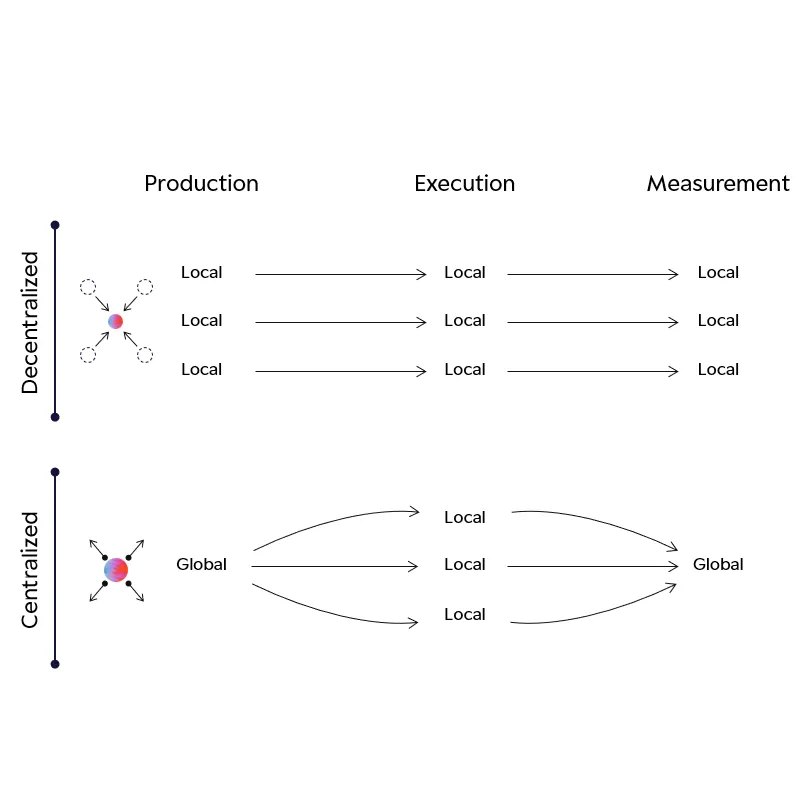
As content becomes more critical to commercial performance, a clear trend is emerging: the centralization of production for strategically important content. Many organizations, once driven by autonomous and local approaches, are now consolidating content creation, governance, and insight generation under a unified operating model. The shift reflects a recognition that consistency, efficiency, and scalability improve when content is managed as a global capability rather than a local activity.
Healthcare and pharma have been slower to adopt centralization compared with other industrie,s and many still rely on affiliate-led structures. This delay represents both a challenge and a strategic opportunity for companies pursuing content excellence. By centralizing the creation of strategically important content, global teams can secure a coherent narrative, while local affiliates can then focus on adjusting and supplementing that content to meet specific market needs. This balance allows companies to maintain a unified story while delivering personalized messages that resonate locally.
The Advantages of Global-to-Local Localization
If set up and enforced correctly, the benefits of centralized creation of core content are clear.
Coherent messaging: Global-to-local reuse ensures that brand narratives remain consistent across markets and channels while reinforcing compliance and medical accuracy
Faster time-to-market: By streamlining workflows and minimizing duplication of effort, content can be deployed more quickly to meet local and global demands
Economies of scale: Centralization of content development eliminates duplication by consolidating production under one coordinated setup, reducing unnecessary costs across the organization.
Together, these advantages allow companies to move from reactive content creation toward proactive, insight-driven storytelling that supports both global ambitions and local needs.
As content becomes more critical to commercial performance, a clear trend is emerging: the centralization of production for strategically important content. Many organizations, once driven by autonomous and local approaches, are now consolidating content creation, governance, and insight generation under a unified operating model. The shift reflects a recognition that consistency, efficiency, and scalability improve when content is managed as a global capability rather than a local activity.
Healthcare and pharma have been slower to adopt centralization compared with other industrie,s and many still rely on affiliate-led structures. This delay represents both a challenge and a strategic opportunity for companies pursuing content excellence. By centralizing the creation of strategically important content, global teams can secure a coherent narrative, while local affiliates can then focus on adjusting and supplementing that content to meet specific market needs. This balance allows companies to maintain a unified story while delivering personalized messages that resonate locally.
The Advantages of Global-to-Local Localization
If set up and enforced correctly, the benefits of centralized creation of core content are clear.
Coherent messaging: Global-to-local reuse ensures that brand narratives remain consistent across markets and channels while reinforcing compliance and medical accuracy
Faster time-to-market: By streamlining workflows and minimizing duplication of effort, content can be deployed more quickly to meet local and global demands
Economies of scale: Centralization of content development eliminates duplication by consolidating production under one coordinated setup, reducing unnecessary costs across the organization.
Together, these advantages allow companies to move from reactive content creation toward proactive, insight-driven storytelling that supports both global ambitions and local needs.
As content becomes more critical to commercial performance, a clear trend is emerging: the centralization of production for strategically important content. Many organizations, once driven by autonomous and local approaches, are now consolidating content creation, governance, and insight generation under a unified operating model. The shift reflects a recognition that consistency, efficiency, and scalability improve when content is managed as a global capability rather than a local activity.
Healthcare and pharma have been slower to adopt centralization compared with other industrie,s and many still rely on affiliate-led structures. This delay represents both a challenge and a strategic opportunity for companies pursuing content excellence. By centralizing the creation of strategically important content, global teams can secure a coherent narrative, while local affiliates can then focus on adjusting and supplementing that content to meet specific market needs. This balance allows companies to maintain a unified story while delivering personalized messages that resonate locally.
The Advantages of Global-to-Local Localization
If set up and enforced correctly, the benefits of centralized creation of core content are clear.
Coherent messaging: Global-to-local reuse ensures that brand narratives remain consistent across markets and channels while reinforcing compliance and medical accuracy
Faster time-to-market: By streamlining workflows and minimizing duplication of effort, content can be deployed more quickly to meet local and global demands
Economies of scale: Centralization of content development eliminates duplication by consolidating production under one coordinated setup, reducing unnecessary costs across the organization.
Together, these advantages allow companies to move from reactive content creation toward proactive, insight-driven storytelling that supports both global ambitions and local needs.
What's driving the shift toward centralized global to local content supply chains?
As content becomes more critical to commercial performance, a clear trend is emerging: the centralization of production for strategically important content. Many organizations, once driven by autonomous and local approaches, are now consolidating content creation, governance, and insight generation under a unified operating model. The shift reflects a recognition that consistency, efficiency, and scalability improve when content is managed as a global capability rather than a local activity.
Healthcare and pharma have been slower to adopt centralization compared with other industrie,s and many still rely on affiliate-led structures. This delay represents both a challenge and a strategic opportunity for companies pursuing content excellence. By centralizing the creation of strategically important content, global teams can secure a coherent narrative, while local affiliates can then focus on adjusting and supplementing that content to meet specific market needs. This balance allows companies to maintain a unified story while delivering personalized messages that resonate locally.
The Advantages of Global-to-Local Localization
If set up and enforced correctly, the benefits of centralized creation of core content are clear.
Coherent messaging: Global-to-local reuse ensures that brand narratives remain consistent across markets and channels while reinforcing compliance and medical accuracy
Faster time-to-market: By streamlining workflows and minimizing duplication of effort, content can be deployed more quickly to meet local and global demands
Economies of scale: Centralization of content development eliminates duplication by consolidating production under one coordinated setup, reducing unnecessary costs across the organization.
Together, these advantages allow companies to move from reactive content creation toward proactive, insight-driven storytelling that supports both global ambitions and local needs.
What's driving the shift toward centralized global to local content supply chains?
As content becomes more critical to commercial performance, a clear trend is emerging: the centralization of production for strategically important content. Many organizations, once driven by autonomous and local approaches, are now consolidating content creation, governance, and insight generation under a unified operating model. The shift reflects a recognition that consistency, efficiency, and scalability improve when content is managed as a global capability rather than a local activity.
Healthcare and pharma have been slower to adopt centralization compared with other industrie,s and many still rely on affiliate-led structures. This delay represents both a challenge and a strategic opportunity for companies pursuing content excellence. By centralizing the creation of strategically important content, global teams can secure a coherent narrative, while local affiliates can then focus on adjusting and supplementing that content to meet specific market needs. This balance allows companies to maintain a unified story while delivering personalized messages that resonate locally.
The Advantages of Global-to-Local Localization
If set up and enforced correctly, the benefits of centralized creation of core content are clear.
Coherent messaging: Global-to-local reuse ensures that brand narratives remain consistent across markets and channels while reinforcing compliance and medical accuracy
Faster time-to-market: By streamlining workflows and minimizing duplication of effort, content can be deployed more quickly to meet local and global demands
Economies of scale: Centralization of content development eliminates duplication by consolidating production under one coordinated setup, reducing unnecessary costs across the organization.
Together, these advantages allow companies to move from reactive content creation toward proactive, insight-driven storytelling that supports both global ambitions and local needs.
What's driving the shift toward centralized global to local content supply chains?
Despite its benefits, the transition to a centralized model is challenging. When poorly planned, centralization can introduce new barriers:
Operational bottlenecks
Without the right processes, the governance required for localization can slow time-to-market. This happens when central creation or approval structures become too rigid, particularly when priorities shift or demand increases.
Limited local adaptability
If global content is not designed for flexibility, affiliates can struggle to tailor messages to local market dynamics, cultural nuances, or regulatory requirements. Translation alone can also delay timelines. AI-based tools can help reduce this manual effort and accelerate localization.
Low buy-in from affiliates
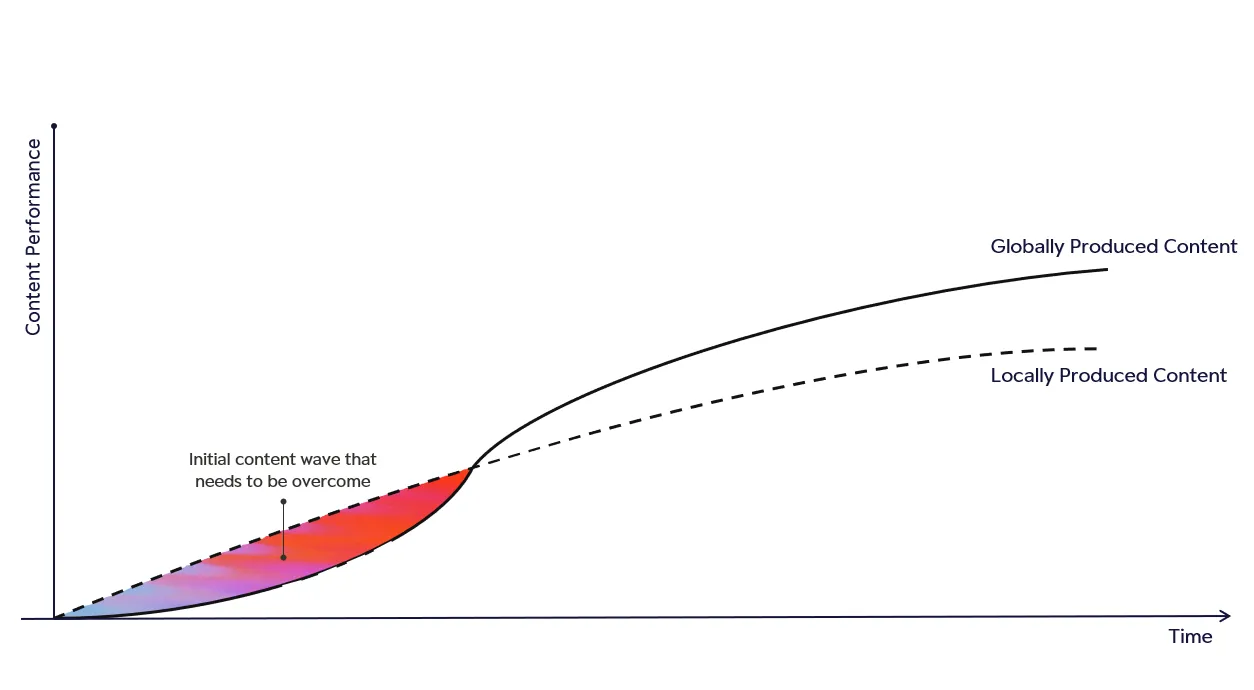
Even with strong planning, affiliates may doubt the value of global content. Early waves of centralized content often underperform when compared to fully local production, and this initial gap can discourage local teams. However, once global content improves through shared learnings and feedback across markets, the long-term model outperforms local production in speed, quality, engagement, and cost.
To succeed, companies must balance global control with local flexibility. A strong model captures the efficiencies of centralization without losing the agility needed for effective market engagement.
Despite its benefits, the transition to a centralized model is challenging. When poorly planned, centralization can introduce new barriers:
Operational bottlenecks
Without the right processes, the governance required for localization can slow time-to-market. This happens when central creation or approval structures become too rigid, particularly when priorities shift or demand increases.
Limited local adaptability
If global content is not designed for flexibility, affiliates can struggle to tailor messages to local market dynamics, cultural nuances, or regulatory requirements. Translation alone can also delay timelines. AI-based tools can help reduce this manual effort and accelerate localization.
Low buy-in from affiliates
Even with strong planning, affiliates may doubt the value of global content. Early waves of centralized content often underperform when compared to fully local production, and this initial gap can discourage local teams. However, once global content improves through shared learnings and feedback across markets, the long-term model outperforms local production in speed, quality, engagement, and cost.
To succeed, companies must balance global control with local flexibility. A strong model captures the efficiencies of centralization without losing the agility needed for effective market engagement.
Despite its benefits, the transition to a centralized model is challenging. When poorly planned, centralization can introduce new barriers:
Operational bottlenecks
Without the right processes, the governance required for localization can slow time-to-market. This happens when central creation or approval structures become too rigid, particularly when priorities shift or demand increases.
Limited local adaptability
If global content is not designed for flexibility, affiliates can struggle to tailor messages to local market dynamics, cultural nuances, or regulatory requirements. Translation alone can also delay timelines. AI-based tools can help reduce this manual effort and accelerate localization.
Low buy-in from affiliates
Even with strong planning, affiliates may doubt the value of global content. Early waves of centralized content often underperform when compared to fully local production, and this initial gap can discourage local teams. However, once global content improves through shared learnings and feedback across markets, the long-term model outperforms local production in speed, quality, engagement, and cost.
To succeed, companies must balance global control with local flexibility. A strong model captures the efficiencies of centralization without losing the agility needed for effective market engagement.
What challenges and frictions can centralization introduce, if not managed well?
Despite its benefits, the transition to a centralized model is challenging. When poorly planned, centralization can introduce new barriers:
Operational bottlenecks
Without the right processes, the governance required for localization can slow time-to-market. This happens when central creation or approval structures become too rigid, particularly when priorities shift or demand increases.
Limited local adaptability
If global content is not designed for flexibility, affiliates can struggle to tailor messages to local market dynamics, cultural nuances, or regulatory requirements. Translation alone can also delay timelines. AI-based tools can help reduce this manual effort and accelerate localization.
Low buy-in from affiliates
Even with strong planning, affiliates may doubt the value of global content. Early waves of centralized content often underperform when compared to fully local production, and this initial gap can discourage local teams. However, once global content improves through shared learnings and feedback across markets, the long-term model outperforms local production in speed, quality, engagement, and cost.
To succeed, companies must balance global control with local flexibility. A strong model captures the efficiencies of centralization without losing the agility needed for effective market engagement.
What challenges and frictions can centralization introduce, if not managed well?
Despite its benefits, the transition to a centralized model is challenging. When poorly planned, centralization can introduce new barriers:
Operational bottlenecks
Without the right processes, the governance required for localization can slow time-to-market. This happens when central creation or approval structures become too rigid, particularly when priorities shift or demand increases.
Limited local adaptability
If global content is not designed for flexibility, affiliates can struggle to tailor messages to local market dynamics, cultural nuances, or regulatory requirements. Translation alone can also delay timelines. AI-based tools can help reduce this manual effort and accelerate localization.
Low buy-in from affiliates
Even with strong planning, affiliates may doubt the value of global content. Early waves of centralized content often underperform when compared to fully local production, and this initial gap can discourage local teams. However, once global content improves through shared learnings and feedback across markets, the long-term model outperforms local production in speed, quality, engagement, and cost.
To succeed, companies must balance global control with local flexibility. A strong model captures the efficiencies of centralization without losing the agility needed for effective market engagement.
What challenges and frictions can centralization introduce, if not managed well?
Launching global content locally requires close collaboration between headquarters and affiliates across every stage of the content supply chain, spanning planning, production, localization, execution, and measurement. The following sections illustrate this through the example of Pharma Co., a company that recently transitioned to a globally centralized content supply chain.

Launching global content locally requires close collaboration between headquarters and affiliates across every stage of the content supply chain, spanning planning, production, localization, execution, and measurement. The following sections illustrate this through the example of Pharma Co., a company that recently transitioned to a globally centralized content supply chain.
Launching global content locally requires close collaboration between headquarters and affiliates across every stage of the content supply chain, spanning planning, production, localization, execution, and measurement. The following sections illustrate this through the example of Pharma Co., a company that recently transitioned to a globally centralized content supply chain.
How can organizations succeed where others fail?
Launching global content locally requires close collaboration between headquarters and affiliates across every stage of the content supply chain, spanning planning, production, localization, execution, and measurement. The following sections illustrate this through the example of Pharma Co., a company that recently transitioned to a globally centralized content supply chain.
How can organizations succeed where others fail?
Launching global content locally requires close collaboration between headquarters and affiliates across every stage of the content supply chain, spanning planning, production, localization, execution, and measurement. The following sections illustrate this through the example of Pharma Co., a company that recently transitioned to a globally centralized content supply chain.
How can organizations succeed where others fail?
01 | Planning
The centralization of content starts with the centralization of strategy. Headquarters must clearly define the purpose, priorities, and guiding principles for content and marketing. This alignment ensures everyone understands expectations, responsibilities, and the rationale for content centralization.
While the overall content & marketing strategy needs to be provided by headquarters and communicated to all, equally important is establishing the content calendar early. Without clarity on timing, affiliates may feel forced to produce their own content and deviate from the global direction. Governance around localization should also be defined early. This is particularly important in the initial phase, when affiliates are adjusting to a new way of working.
In the case of Pharma Co., their new drug was expected to become a major revenue driver and their content strategy aimed to communicate the benefits of this drug above others on the market. Headquarters developed the key messaging for three new campaigns, communicated the strategic goals to all subsidiaries, and provided a clear structure for how globally produced content would be localized across countries.
02 | Production
Centralizing the production of content needs to allow for local adaptability. This requires that the overall content messaging should be created in collaboration with the most influential local markets. Additionally, global content should be ready to be localized early, and global content production should focus on core content that drives the highest impact towards the set strategic direction. In other words, headquarters should only produce timely, relevant and strategically important content.
Pharma Co. involved its top five markets in shaping the global assets. The affiliate input led to one campaign being discarded, allowing headquarters to focus on the two campaigns with the highest expected impact. Timelines and detailed briefs were shared with all countries, enabling affiliates to prepare for localization instead of creating their own launch content.

01 | Planning
The centralization of content starts with the centralization of strategy. Headquarters must clearly define the purpose, priorities, and guiding principles for content and marketing. This alignment ensures everyone understands expectations, responsibilities, and the rationale for content centralization.
While the overall content & marketing strategy needs to be provided by headquarters and communicated to all, equally important is establishing the content calendar early. Without clarity on timing, affiliates may feel forced to produce their own content and deviate from the global direction. Governance around localization should also be defined early. This is particularly important in the initial phase, when affiliates are adjusting to a new way of working.
In the case of Pharma Co., their new drug was expected to become a major revenue driver and their content strategy aimed to communicate the benefits of this drug above others on the market. Headquarters developed the key messaging for three new campaigns, communicated the strategic goals to all subsidiaries, and provided a clear structure for how globally produced content would be localized across countries.
02 | Production
Centralizing the production of content needs to allow for local adaptability. This requires that the overall content messaging should be created in collaboration with the most influential local markets. Additionally, global content should be ready to be localized early, and global content production should focus on core content that drives the highest impact towards the set strategic direction. In other words, headquarters should only produce timely, relevant and strategically important content.
Pharma Co. involved its top five markets in shaping the global assets. The affiliate input led to one campaign being discarded, allowing headquarters to focus on the two campaigns with the highest expected impact. Timelines and detailed briefs were shared with all countries, enabling affiliates to prepare for localization instead of creating their own launch content.
01 | Planning
The centralization of content starts with the centralization of strategy. Headquarters must clearly define the purpose, priorities, and guiding principles for content and marketing. This alignment ensures everyone understands expectations, responsibilities, and the rationale for content centralization.
While the overall content & marketing strategy needs to be provided by headquarters and communicated to all, equally important is establishing the content calendar early. Without clarity on timing, affiliates may feel forced to produce their own content and deviate from the global direction. Governance around localization should also be defined early. This is particularly important in the initial phase, when affiliates are adjusting to a new way of working.
In the case of Pharma Co., their new drug was expected to become a major revenue driver and their content strategy aimed to communicate the benefits of this drug above others on the market. Headquarters developed the key messaging for three new campaigns, communicated the strategic goals to all subsidiaries, and provided a clear structure for how globally produced content would be localized across countries.
02 | Production
Centralizing the production of content needs to allow for local adaptability. This requires that the overall content messaging should be created in collaboration with the most influential local markets. Additionally, global content should be ready to be localized early, and global content production should focus on core content that drives the highest impact towards the set strategic direction. In other words, headquarters should only produce timely, relevant and strategically important content.
Pharma Co. involved its top five markets in shaping the global assets. The affiliate input led to one campaign being discarded, allowing headquarters to focus on the two campaigns with the highest expected impact. Timelines and detailed briefs were shared with all countries, enabling affiliates to prepare for localization instead of creating their own launch content.
01 | Planning
The centralization of content starts with the centralization of strategy. Headquarters must clearly define the purpose, priorities, and guiding principles for content and marketing. This alignment ensures everyone understands expectations, responsibilities, and the rationale for content centralization.
While the overall content & marketing strategy needs to be provided by headquarters and communicated to all, equally important is establishing the content calendar early. Without clarity on timing, affiliates may feel forced to produce their own content and deviate from the global direction. Governance around localization should also be defined early. This is particularly important in the initial phase, when affiliates are adjusting to a new way of working.
In the case of Pharma Co., their new drug was expected to become a major revenue driver and their content strategy aimed to communicate the benefits of this drug above others on the market. Headquarters developed the key messaging for three new campaigns, communicated the strategic goals to all subsidiaries, and provided a clear structure for how globally produced content would be localized across countries.
02 | Production
Centralizing the production of content needs to allow for local adaptability. This requires that the overall content messaging should be created in collaboration with the most influential local markets. Additionally, global content should be ready to be localized early, and global content production should focus on core content that drives the highest impact towards the set strategic direction. In other words, headquarters should only produce timely, relevant and strategically important content.
Pharma Co. involved its top five markets in shaping the global assets. The affiliate input led to one campaign being discarded, allowing headquarters to focus on the two campaigns with the highest expected impact. Timelines and detailed briefs were shared with all countries, enabling affiliates to prepare for localization instead of creating their own launch content.
01 | Planning
The centralization of content starts with the centralization of strategy. Headquarters must clearly define the purpose, priorities, and guiding principles for content and marketing. This alignment ensures everyone understands expectations, responsibilities, and the rationale for content centralization.
While the overall content & marketing strategy needs to be provided by headquarters and communicated to all, equally important is establishing the content calendar early. Without clarity on timing, affiliates may feel forced to produce their own content and deviate from the global direction. Governance around localization should also be defined early. This is particularly important in the initial phase, when affiliates are adjusting to a new way of working.
In the case of Pharma Co., their new drug was expected to become a major revenue driver and their content strategy aimed to communicate the benefits of this drug above others on the market. Headquarters developed the key messaging for three new campaigns, communicated the strategic goals to all subsidiaries, and provided a clear structure for how globally produced content would be localized across countries.
02 | Production
Centralizing the production of content needs to allow for local adaptability. This requires that the overall content messaging should be created in collaboration with the most influential local markets. Additionally, global content should be ready to be localized early, and global content production should focus on core content that drives the highest impact towards the set strategic direction. In other words, headquarters should only produce timely, relevant and strategically important content.
Pharma Co. involved its top five markets in shaping the global assets. The affiliate input led to one campaign being discarded, allowing headquarters to focus on the two campaigns with the highest expected impact. Timelines and detailed briefs were shared with all countries, enabling affiliates to prepare for localization instead of creating their own launch content.
03 | Localization
Localization is a local exercise enabled by headquarters. The usage of globally produced content needs to be incentivized & measured by Headquarters, while at the same time making discovering, adapting and executing global content in the local context as frictionless as possible. There is a necessity for a global mandate down towards affiliates that globally produced core content needs to be localized. Equally important, the act of localizing global content should be easy for affiliates to follow. This requires balancing the allowed degree of adaptability & customization available for local markets, while ensuring affiliates can translate and adapt the content to fit local regulations & market demands.
While requirements, governance processes and mandate should be in place to incentivize localization, change management and anchoring activities should continuously be activated across all large affiliates. Showcasing learnings & insights that stem from the holistic & cross-border view of content performance needs to highlight the benefits of centralization to secure buy-in from all affiliates.
In the case of Pharma Co., the headquarters had prepared upskilling on new processes, change management on new responsibilities & information on the country-level benefits that centralization provides. Importantly, this was initiated prior to the activation of the globally produced content. A system was implemented to measure each country’s localization efforts once the content became available, resulting in slow-moving countries quickly being identified, allowing headquarters to provide additional support.
04 | Execution
Execution of localized content needs to be fast and efficient, requiring minimal changes during the localization process. This entails that globally produced content should be applicable globally, requiring minimal changes prior to customer engagements. Affiliates' localization process should exist to translate material, ensure compliance with local regulations, and make minimal adaptation to fit the local cultural context. Key messages & the purpose of the content will therefore be the same across affiliates. As global should provide the strategically important core content that is aligned with the global strategy, affiliates should focus on 1) localizing global core content, and 2) planning, producing & executing affiliate specific content on their own.
At Pharma Co., the global content covered the key elements of the launch and was relevant to the majority of markets. With localization processes established early, affiliates could quickly translate the content, adjust visuals, and complete regulatory review for a fast launch. Several affiliates also created complementary materials tailored to their markets, strengthening the overall two campaigns.

03 | Localization
Localization is a local exercise enabled by headquarters. The usage of globally produced content needs to be incentivized & measured by Headquarters, while at the same time making discovering, adapting and executing global content in the local context as frictionless as possible. There is a necessity for a global mandate down towards affiliates that globally produced core content needs to be localized. Equally important, the act of localizing global content should be easy for affiliates to follow. This requires balancing the allowed degree of adaptability & customization available for local markets, while ensuring affiliates can translate and adapt the content to fit local regulations & market demands.
While requirements, governance processes and mandate should be in place to incentivize localization, change management and anchoring activities should continuously be activated across all large affiliates. Showcasing learnings & insights that stem from the holistic & cross-border view of content performance needs to highlight the benefits of centralization to secure buy-in from all affiliates.
In the case of Pharma Co., the headquarters had prepared upskilling on new processes, change management on new responsibilities & information on the country-level benefits that centralization provides. Importantly, this was initiated prior to the activation of the globally produced content. A system was implemented to measure each country’s localization efforts once the content became available, resulting in slow-moving countries quickly being identified, allowing headquarters to provide additional support.
04 | Execution
Execution of localized content needs to be fast and efficient, requiring minimal changes during the localization process. This entails that globally produced content should be applicable globally, requiring minimal changes prior to customer engagements. Affiliates' localization process should exist to translate material, ensure compliance with local regulations, and make minimal adaptation to fit the local cultural context. Key messages & the purpose of the content will therefore be the same across affiliates. As global should provide the strategically important core content that is aligned with the global strategy, affiliates should focus on 1) localizing global core content, and 2) planning, producing & executing affiliate specific content on their own.
At Pharma Co., the global content covered the key elements of the launch and was relevant to the majority of markets. With localization processes established early, affiliates could quickly translate the content, adjust visuals, and complete regulatory review for a fast launch. Several affiliates also created complementary materials tailored to their markets, strengthening the overall two campaigns.
03 | Localization
Localization is a local exercise enabled by headquarters. The usage of globally produced content needs to be incentivized & measured by Headquarters, while at the same time making discovering, adapting and executing global content in the local context as frictionless as possible. There is a necessity for a global mandate down towards affiliates that globally produced core content needs to be localized. Equally important, the act of localizing global content should be easy for affiliates to follow. This requires balancing the allowed degree of adaptability & customization available for local markets, while ensuring affiliates can translate and adapt the content to fit local regulations & market demands.
While requirements, governance processes and mandate should be in place to incentivize localization, change management and anchoring activities should continuously be activated across all large affiliates. Showcasing learnings & insights that stem from the holistic & cross-border view of content performance needs to highlight the benefits of centralization to secure buy-in from all affiliates.
In the case of Pharma Co., the headquarters had prepared upskilling on new processes, change management on new responsibilities & information on the country-level benefits that centralization provides. Importantly, this was initiated prior to the activation of the globally produced content. A system was implemented to measure each country’s localization efforts once the content became available, resulting in slow-moving countries quickly being identified, allowing headquarters to provide additional support.
04 | Execution
Execution of localized content needs to be fast and efficient, requiring minimal changes during the localization process. This entails that globally produced content should be applicable globally, requiring minimal changes prior to customer engagements. Affiliates' localization process should exist to translate material, ensure compliance with local regulations, and make minimal adaptation to fit the local cultural context. Key messages & the purpose of the content will therefore be the same across affiliates. As global should provide the strategically important core content that is aligned with the global strategy, affiliates should focus on 1) localizing global core content, and 2) planning, producing & executing affiliate specific content on their own.
At Pharma Co., the global content covered the key elements of the launch and was relevant to the majority of markets. With localization processes established early, affiliates could quickly translate the content, adjust visuals, and complete regulatory review for a fast launch. Several affiliates also created complementary materials tailored to their markets, strengthening the overall two campaigns.
03 | Localization
Localization is a local exercise enabled by headquarters. The usage of globally produced content needs to be incentivized & measured by Headquarters, while at the same time making discovering, adapting and executing global content in the local context as frictionless as possible. There is a necessity for a global mandate down towards affiliates that globally produced core content needs to be localized. Equally important, the act of localizing global content should be easy for affiliates to follow. This requires balancing the allowed degree of adaptability & customization available for local markets, while ensuring affiliates can translate and adapt the content to fit local regulations & market demands.
While requirements, governance processes and mandate should be in place to incentivize localization, change management and anchoring activities should continuously be activated across all large affiliates. Showcasing learnings & insights that stem from the holistic & cross-border view of content performance needs to highlight the benefits of centralization to secure buy-in from all affiliates.
In the case of Pharma Co., the headquarters had prepared upskilling on new processes, change management on new responsibilities & information on the country-level benefits that centralization provides. Importantly, this was initiated prior to the activation of the globally produced content. A system was implemented to measure each country’s localization efforts once the content became available, resulting in slow-moving countries quickly being identified, allowing headquarters to provide additional support.
04 | Execution
Execution of localized content needs to be fast and efficient, requiring minimal changes during the localization process. This entails that globally produced content should be applicable globally, requiring minimal changes prior to customer engagements. Affiliates' localization process should exist to translate material, ensure compliance with local regulations, and make minimal adaptation to fit the local cultural context. Key messages & the purpose of the content will therefore be the same across affiliates. As global should provide the strategically important core content that is aligned with the global strategy, affiliates should focus on 1) localizing global core content, and 2) planning, producing & executing affiliate specific content on their own.
At Pharma Co., the global content covered the key elements of the launch and was relevant to the majority of markets. With localization processes established early, affiliates could quickly translate the content, adjust visuals, and complete regulatory review for a fast launch. Several affiliates also created complementary materials tailored to their markets, strengthening the overall two campaigns.
03 | Localization
Localization is a local exercise enabled by headquarters. The usage of globally produced content needs to be incentivized & measured by Headquarters, while at the same time making discovering, adapting and executing global content in the local context as frictionless as possible. There is a necessity for a global mandate down towards affiliates that globally produced core content needs to be localized. Equally important, the act of localizing global content should be easy for affiliates to follow. This requires balancing the allowed degree of adaptability & customization available for local markets, while ensuring affiliates can translate and adapt the content to fit local regulations & market demands.
While requirements, governance processes and mandate should be in place to incentivize localization, change management and anchoring activities should continuously be activated across all large affiliates. Showcasing learnings & insights that stem from the holistic & cross-border view of content performance needs to highlight the benefits of centralization to secure buy-in from all affiliates.
In the case of Pharma Co., the headquarters had prepared upskilling on new processes, change management on new responsibilities & information on the country-level benefits that centralization provides. Importantly, this was initiated prior to the activation of the globally produced content. A system was implemented to measure each country’s localization efforts once the content became available, resulting in slow-moving countries quickly being identified, allowing headquarters to provide additional support.
04 | Execution
Execution of localized content needs to be fast and efficient, requiring minimal changes during the localization process. This entails that globally produced content should be applicable globally, requiring minimal changes prior to customer engagements. Affiliates' localization process should exist to translate material, ensure compliance with local regulations, and make minimal adaptation to fit the local cultural context. Key messages & the purpose of the content will therefore be the same across affiliates. As global should provide the strategically important core content that is aligned with the global strategy, affiliates should focus on 1) localizing global core content, and 2) planning, producing & executing affiliate specific content on their own.
At Pharma Co., the global content covered the key elements of the launch and was relevant to the majority of markets. With localization processes established early, affiliates could quickly translate the content, adjust visuals, and complete regulatory review for a fast launch. Several affiliates also created complementary materials tailored to their markets, strengthening the overall two campaigns.
05 | Measurement
Constant improvement is required for success, and improvement cannot be made without measurement & insights. To achieve the full benefits of content centralization, improvements on quality and speed are constantly required. This is especially true in the initial stages when transitioning from a previously de-centralized content supply chain. Three building blocks are necessary to achieve this:
Systems, Platforms & Data: A harmonized data platform is required to combine content production data with engagement performance across affiliates. The aligned data across affiliates acts as the definitive baseline for content performance, and without it, we cannot engage in informed decisions on future improvements for globally produced content. Expanding the aligned data with strong metadata practices, such as tagging messaging, audience, and purpose of content, enable deeper insights and analytics. This unlocks the possibility of personalizing content to specific customer segments or individuals.
Analytics & Insights: Global content will serve different purposes towards different target audiences, which dictates that measurement and performance will be different based on the content in question. KPIs that reflect the desired business outcome need to be formalized by headquarters and aligned across the organization, securing that the KPIs reflect the purpose of the content.
Communication & Feedback: Without robust & established feedback loops between global and local operations, there will be no transfer of the necessary knowledge to improve the content strategy, production or execution. It is crucial to establish affiliate-level roles that act as drivers of global content, responsible for providing upwards feedback and communicating learnings from their country. Similarly, there should be global stakeholders who have the responsibility to gather, compare and implement feedback that has been received from local operations into future global content.
Pharma Co. had an existing data platform, allowing them to focus on harmonizing data ingestion and strengthening metadata practices across global & local operations. During and after the launch of the two global campaigns, consistent analytics were conducted on the performance of each campaign across countries, resulting in insights that improved both the execution of the current campaigns as well as increasing the quality of future content. Lastly, the established roles across all levels of the organization ensured that activities that had the highest impact were not only communicated upwards towards headquarters, but between countries as well.

05 | Measurement
Constant improvement is required for success, and improvement cannot be made without measurement & insights. To achieve the full benefits of content centralization, improvements on quality and speed are constantly required. This is especially true in the initial stages when transitioning from a previously de-centralized content supply chain. Three building blocks are necessary to achieve this:
Systems, Platforms & Data: A harmonized data platform is required to combine content production data with engagement performance across affiliates. The aligned data across affiliates acts as the definitive baseline for content performance, and without it, we cannot engage in informed decisions on future improvements for globally produced content. Expanding the aligned data with strong metadata practices, such as tagging messaging, audience, and purpose of content, enable deeper insights and analytics. This unlocks the possibility of personalizing content to specific customer segments or individuals.
Analytics & Insights: Global content will serve different purposes towards different target audiences, which dictates that measurement and performance will be different based on the content in question. KPIs that reflect the desired business outcome need to be formalized by headquarters and aligned across the organization, securing that the KPIs reflect the purpose of the content.
Communication & Feedback: Without robust & established feedback loops between global and local operations, there will be no transfer of the necessary knowledge to improve the content strategy, production or execution. It is crucial to establish affiliate-level roles that act as drivers of global content, responsible for providing upwards feedback and communicating learnings from their country. Similarly, there should be global stakeholders who have the responsibility to gather, compare and implement feedback that has been received from local operations into future global content.
Pharma Co. had an existing data platform, allowing them to focus on harmonizing data ingestion and strengthening metadata practices across global & local operations. During and after the launch of the two global campaigns, consistent analytics were conducted on the performance of each campaign across countries, resulting in insights that improved both the execution of the current campaigns as well as increasing the quality of future content. Lastly, the established roles across all levels of the organization ensured that activities that had the highest impact were not only communicated upwards towards headquarters, but between countries as well.
05 | Measurement
Constant improvement is required for success, and improvement cannot be made without measurement & insights. To achieve the full benefits of content centralization, improvements on quality and speed are constantly required. This is especially true in the initial stages when transitioning from a previously de-centralized content supply chain. Three building blocks are necessary to achieve this:
Systems, Platforms & Data: A harmonized data platform is required to combine content production data with engagement performance across affiliates. The aligned data across affiliates acts as the definitive baseline for content performance, and without it, we cannot engage in informed decisions on future improvements for globally produced content. Expanding the aligned data with strong metadata practices, such as tagging messaging, audience, and purpose of content, enable deeper insights and analytics. This unlocks the possibility of personalizing content to specific customer segments or individuals.
Analytics & Insights: Global content will serve different purposes towards different target audiences, which dictates that measurement and performance will be different based on the content in question. KPIs that reflect the desired business outcome need to be formalized by headquarters and aligned across the organization, securing that the KPIs reflect the purpose of the content.
Communication & Feedback: Without robust & established feedback loops between global and local operations, there will be no transfer of the necessary knowledge to improve the content strategy, production or execution. It is crucial to establish affiliate-level roles that act as drivers of global content, responsible for providing upwards feedback and communicating learnings from their country. Similarly, there should be global stakeholders who have the responsibility to gather, compare and implement feedback that has been received from local operations into future global content.
Pharma Co. had an existing data platform, allowing them to focus on harmonizing data ingestion and strengthening metadata practices across global & local operations. During and after the launch of the two global campaigns, consistent analytics were conducted on the performance of each campaign across countries, resulting in insights that improved both the execution of the current campaigns as well as increasing the quality of future content. Lastly, the established roles across all levels of the organization ensured that activities that had the highest impact were not only communicated upwards towards headquarters, but between countries as well.
05 | Measurement
Constant improvement is required for success, and improvement cannot be made without measurement & insights. To achieve the full benefits of content centralization, improvements on quality and speed are constantly required. This is especially true in the initial stages when transitioning from a previously de-centralized content supply chain. Three building blocks are necessary to achieve this:
Systems, Platforms & Data: A harmonized data platform is required to combine content production data with engagement performance across affiliates. The aligned data across affiliates acts as the definitive baseline for content performance, and without it, we cannot engage in informed decisions on future improvements for globally produced content. Expanding the aligned data with strong metadata practices, such as tagging messaging, audience, and purpose of content, enable deeper insights and analytics. This unlocks the possibility of personalizing content to specific customer segments or individuals.
Analytics & Insights: Global content will serve different purposes towards different target audiences, which dictates that measurement and performance will be different based on the content in question. KPIs that reflect the desired business outcome need to be formalized by headquarters and aligned across the organization, securing that the KPIs reflect the purpose of the content.
Communication & Feedback: Without robust & established feedback loops between global and local operations, there will be no transfer of the necessary knowledge to improve the content strategy, production or execution. It is crucial to establish affiliate-level roles that act as drivers of global content, responsible for providing upwards feedback and communicating learnings from their country. Similarly, there should be global stakeholders who have the responsibility to gather, compare and implement feedback that has been received from local operations into future global content.
Pharma Co. had an existing data platform, allowing them to focus on harmonizing data ingestion and strengthening metadata practices across global & local operations. During and after the launch of the two global campaigns, consistent analytics were conducted on the performance of each campaign across countries, resulting in insights that improved both the execution of the current campaigns as well as increasing the quality of future content. Lastly, the established roles across all levels of the organization ensured that activities that had the highest impact were not only communicated upwards towards headquarters, but between countries as well.
05 | Measurement
Constant improvement is required for success, and improvement cannot be made without measurement & insights. To achieve the full benefits of content centralization, improvements on quality and speed are constantly required. This is especially true in the initial stages when transitioning from a previously de-centralized content supply chain. Three building blocks are necessary to achieve this:
Systems, Platforms & Data: A harmonized data platform is required to combine content production data with engagement performance across affiliates. The aligned data across affiliates acts as the definitive baseline for content performance, and without it, we cannot engage in informed decisions on future improvements for globally produced content. Expanding the aligned data with strong metadata practices, such as tagging messaging, audience, and purpose of content, enable deeper insights and analytics. This unlocks the possibility of personalizing content to specific customer segments or individuals.
Analytics & Insights: Global content will serve different purposes towards different target audiences, which dictates that measurement and performance will be different based on the content in question. KPIs that reflect the desired business outcome need to be formalized by headquarters and aligned across the organization, securing that the KPIs reflect the purpose of the content.
Communication & Feedback: Without robust & established feedback loops between global and local operations, there will be no transfer of the necessary knowledge to improve the content strategy, production or execution. It is crucial to establish affiliate-level roles that act as drivers of global content, responsible for providing upwards feedback and communicating learnings from their country. Similarly, there should be global stakeholders who have the responsibility to gather, compare and implement feedback that has been received from local operations into future global content.
Pharma Co. had an existing data platform, allowing them to focus on harmonizing data ingestion and strengthening metadata practices across global & local operations. During and after the launch of the two global campaigns, consistent analytics were conducted on the performance of each campaign across countries, resulting in insights that improved both the execution of the current campaigns as well as increasing the quality of future content. Lastly, the established roles across all levels of the organization ensured that activities that had the highest impact were not only communicated upwards towards headquarters, but between countries as well.
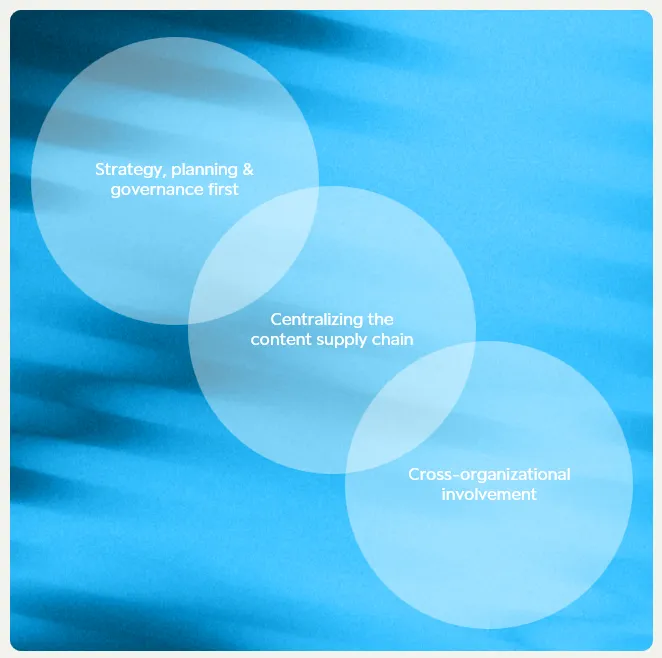
While centralization of the content supply chain has its benefits, it is a complicated and difficult task to succeed in. The companies that try to change fast end up skipping steps, resulting in a more disorganized and scattered supply chain than when they started. Companies that change slowly are outperformed by their competitors. To summarize how to successfully provide centralized production of content in three points:
- Planning, governance and a clearly defined global strategy is the first and most important step in centralization
- Centralizing requires focus on the entire content supply chain, not just content production.
- Ensuring involvement of local operations throughout the process, and just during global content execution
While centralization of the content supply chain has its benefits, it is a complicated and difficult task to succeed in. The companies that try to change fast end up skipping steps, resulting in a more disorganized and scattered supply chain than when they started. Companies that change slowly are outperformed by their competitors. To summarize how to successfully provide centralized production of content in three points:
- Planning, governance and a clearly defined global strategy is the first and most important step in centralization
- Centralizing requires focus on the entire content supply chain, not just content production.
- Ensuring involvement of local operations throughout the process, and just during global content execution
While centralization of the content supply chain has its benefits, it is a complicated and difficult task to succeed in. The companies that try to change fast end up skipping steps, resulting in a more disorganized and scattered supply chain than when they started. Companies that change slowly are outperformed by their competitors. To summarize how to successfully provide centralized production of content in three points:
- Planning, governance and a clearly defined global strategy is the first and most important step in centralization
- Centralizing requires focus on the entire content supply chain, not just content production.
- Ensuring involvement of local operations throughout the process, and just during global content execution
Three things to remember
While centralization of the content supply chain has its benefits, it is a complicated and difficult task to succeed in. The companies that try to change fast end up skipping steps, resulting in a more disorganized and scattered supply chain than when they started. Companies that change slowly are outperformed by their competitors. To summarize how to successfully provide centralized production of content in three points:
- Planning, governance and a clearly defined global strategy is the first and most important step in centralization
- Centralizing requires focus on the entire content supply chain, not just content production.
- Ensuring involvement of local operations throughout the process, and just during global content execution
Three things to remember
While centralization of the content supply chain has its benefits, it is a complicated and difficult task to succeed in. The companies that try to change fast end up skipping steps, resulting in a more disorganized and scattered supply chain than when they started. Companies that change slowly are outperformed by their competitors. To summarize how to successfully provide centralized production of content in three points:
- Planning, governance and a clearly defined global strategy is the first and most important step in centralization
- Centralizing requires focus on the entire content supply chain, not just content production.
- Ensuring involvement of local operations throughout the process, and just during global content execution
Three things to remember
The whitepaper breaks down the full governance model: intake and prioritization criteria, decision rights, funding models, a value framework covering financial, capacity, and risk outcomes, and the kill triggers that let leaders stop work without stigma.

What's blocking your content supply chain from driving more meaningful customer engagement?
If you want to talk more about Content Excellence, reach out to the people below.



In this article, we map out the system behind a live opportunity assessment engine, and how it learns which signals matter to a decision and which are just noise.
Click to read more
A portfolio governance model for regulated environments: intake funnel, decision rights, benefit ownership, and the move into business-as-usual
Click to read more
In the full article, we break down the two-level framework for assessing market opportunity, and how agentic AI fits into the process.
Click to read more
In this article, we outline why effective data governance starts with ownership, not tools - and how organizations can build the structures that make data trustworthy and scalable.
Click to read more