
Rethinking Data Governance as a Business-Led Discipline
Rethinking Data Governance as a Business-Led Discipline
In this article, we outline why effective data governance starts with ownership, not tools - and how organizations can build the structures that make data trustworthy and scalable.

Organizations are investing heavily in AI and advanced machine learning to strengthen decision-making, automate processes, and scale business outcomes. Yet, many struggle to realize the expected value because a critical enabler remains overlooked - a strong data foundation. With increasing regulatory pressure, growing data volumes and complexity, and AI amplifying the impact of poor data quality, data governance is becoming a structural necessity rather than just good data hygiene.
The symptoms are easy to recognize:
↘ Ownership of data is unclear and accountability gradually drifts toward IT
↘ Data quality deteriorates and creates parallel versions of the truth
↘ Insights lose credibility and models underperform
Effective data governance can address these challenges. Done right, it establishes the guardrails that define clear policies and responsibilities, ensuring data is secure, reliable, and aligned with business goals.
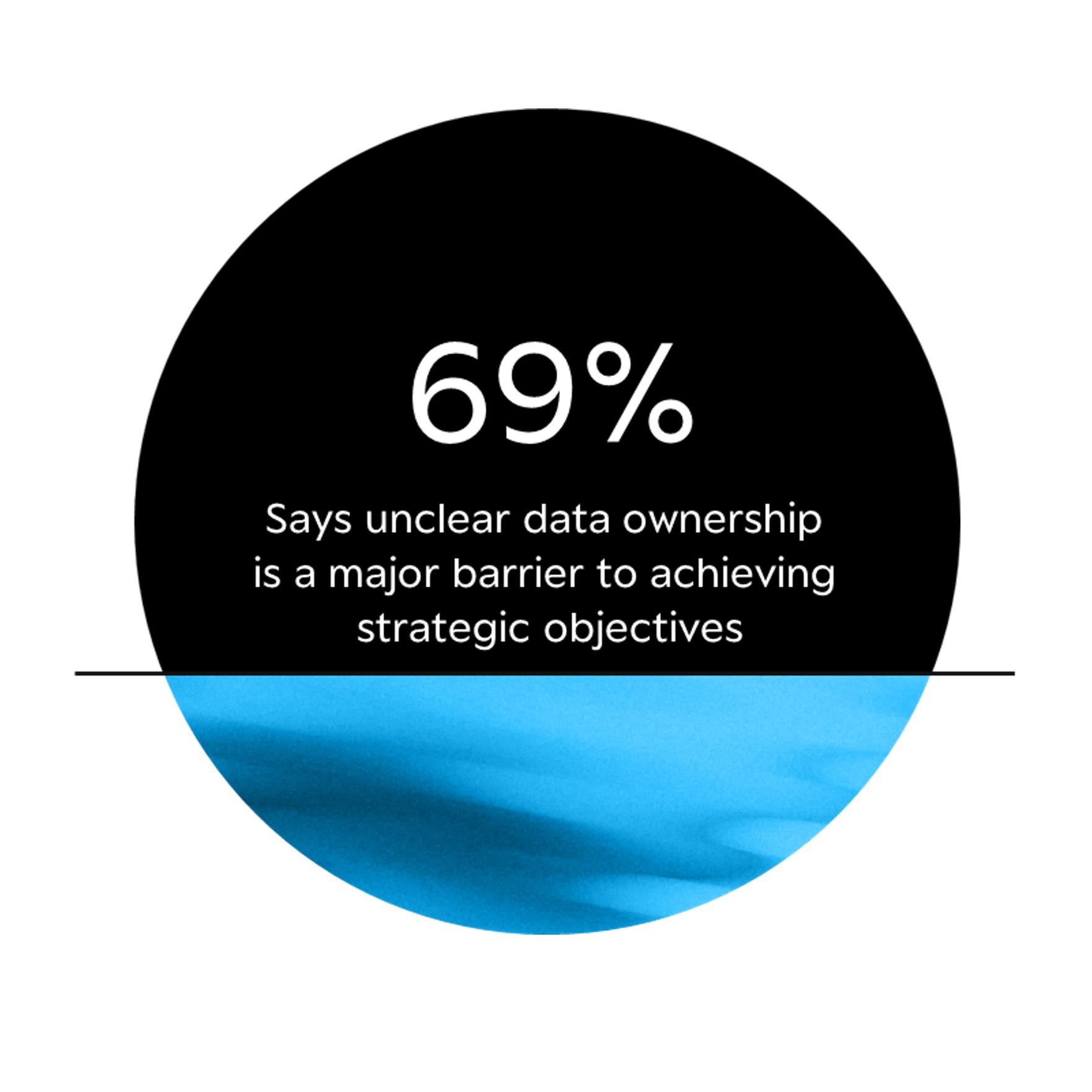
Because data governance is often seen as complex, it is critical to prioritize where to start. 69% of organizations cite unclear or incorrect data ownership as a major barrier to achieving their strategic objectives. As such, establishing a central data governance office, a clear operating model, and defined data ownership are essential first steps.
Equally important, governance should start within the business rather than IT to avoid initiatives turning into technology programs, where the focus shifts to tooling and architecture rather than enabling strategic decision-making.
Organizations that succeed, treat governance differently. They approach it as a strategic discipline and recognize it as part of the organization’s operational backbone.
So, what does effective data governance look like in practice?
Organizations are investing heavily in AI and advanced machine learning to strengthen decision-making, automate processes, and scale business outcomes. Yet, many struggle to realize the expected value because a critical enabler remains overlooked - a strong data foundation. With increasing regulatory pressure, growing data volumes and complexity, and AI amplifying the impact of poor data quality, data governance is becoming a structural necessity rather than just good data hygiene.
The symptoms are easy to recognize:
↘ Ownership of data is unclear and accountability gradually drifts toward IT
↘ Data quality deteriorates and creates parallel versions of the truth
↘ Insights lose credibility and models underperform
Effective data governance can address these challenges. Done right, it establishes the guardrails that define clear policies and responsibilities, ensuring data is secure, reliable, and aligned with business goals.
Because data governance is often seen as complex, it is critical to prioritize where to start. 69% of organizations cite unclear or incorrect data ownership as a major barrier to achieving their strategic objectives. As such, establishing a central data governance office, a clear operating model, and defined data ownership are essential first steps.
Equally important, governance should start within the business rather than IT to avoid initiatives turning into technology programs, where the focus shifts to tooling and architecture rather than enabling strategic decision-making.
Organizations that succeed, treat governance differently. They approach it as a strategic discipline and recognize it as part of the organization’s operational backbone.
So, what does effective data governance look like in practice?
Organizations are investing heavily in AI and advanced machine learning to strengthen decision-making, automate processes, and scale business outcomes. Yet, many struggle to realize the expected value because a critical enabler remains overlooked - a strong data foundation. With increasing regulatory pressure, growing data volumes and complexity, and AI amplifying the impact of poor data quality, data governance is becoming a structural necessity rather than just good data hygiene.
The symptoms are easy to recognize:
↘ Ownership of data is unclear and accountability gradually drifts toward IT
↘ Data quality deteriorates and creates parallel versions of the truth
↘ Insights lose credibility and models underperform
Effective data governance can address these challenges. Done right, it establishes the guardrails that define clear policies and responsibilities, ensuring data is secure, reliable, and aligned with business goals.
Because data governance is often seen as complex, it is critical to prioritize where to start. 69% of organizations cite unclear or incorrect data ownership as a major barrier to achieving their strategic objectives. As such, establishing a central data governance office, a clear operating model, and defined data ownership are essential first steps.
Equally important, governance should start within the business rather than IT to avoid initiatives turning into technology programs, where the focus shifts to tooling and architecture rather than enabling strategic decision-making.
Organizations that succeed, treat governance differently. They approach it as a strategic discipline and recognize it as part of the organization’s operational backbone.
So, what does effective data governance look like in practice?
Effective governance of data is more important than ever
Organizations are investing heavily in AI and advanced machine learning to strengthen decision-making, automate processes, and scale business outcomes. Yet, many struggle to realize the expected value because a critical enabler remains overlooked - a strong data foundation. With increasing regulatory pressure, growing data volumes and complexity, and AI amplifying the impact of poor data quality, data governance is becoming a structural necessity rather than just good data hygiene.
The symptoms are easy to recognize:
↘ Ownership of data is unclear and accountability gradually drifts toward IT
↘ Data quality deteriorates and creates parallel versions of the truth
↘ Insights lose credibility and models underperform
Effective data governance can address these challenges. Done right, it establishes the guardrails that define clear policies and responsibilities, ensuring data is secure, reliable, and aligned with business goals.
Because data governance is often seen as complex, it is critical to prioritize where to start. 69% of organizations cite unclear or incorrect data ownership as a major barrier to achieving their strategic objectives. As such, establishing a central data governance office, a clear operating model, and defined data ownership are essential first steps.
Equally important, governance should start within the business rather than IT to avoid initiatives turning into technology programs, where the focus shifts to tooling and architecture rather than enabling strategic decision-making.
Organizations that succeed, treat governance differently. They approach it as a strategic discipline and recognize it as part of the organization’s operational backbone.
So, what does effective data governance look like in practice?
Effective governance of data is more important than ever
Organizations are investing heavily in AI and advanced machine learning to strengthen decision-making, automate processes, and scale business outcomes. Yet, many struggle to realize the expected value because a critical enabler remains overlooked - a strong data foundation. With increasing regulatory pressure, growing data volumes and complexity, and AI amplifying the impact of poor data quality, data governance is becoming a structural necessity rather than just good data hygiene.
The symptoms are easy to recognize:
↘ Ownership of data is unclear and accountability gradually drifts toward IT
↘ Data quality deteriorates and creates parallel versions of the truth
↘ Insights lose credibility and models underperform
Effective data governance can address these challenges. Done right, it establishes the guardrails that define clear policies and responsibilities, ensuring data is secure, reliable, and aligned with business goals.
Because data governance is often seen as complex, it is critical to prioritize where to start. 69% of organizations cite unclear or incorrect data ownership as a major barrier to achieving their strategic objectives. As such, establishing a central data governance office, a clear operating model, and defined data ownership are essential first steps.
Equally important, governance should start within the business rather than IT to avoid initiatives turning into technology programs, where the focus shifts to tooling and architecture rather than enabling strategic decision-making.
Organizations that succeed, treat governance differently. They approach it as a strategic discipline and recognize it as part of the organization’s operational backbone.
So, what does effective data governance look like in practice?
Effective governance of data is more important than ever
The concept of data governance is not new. Yet, there remains confusion about what it actually means and how to leverage it strategically.
In practical terms, data governance defines who is accountable for data, what rules apply, how decisions are made, and how those decisions translate into day-to-day behavior across teams, processes, and systems.
It is not a control layer owned by IT. Rather, it is the operating model that connects business ownership with the processes and technology required to make data reliable, reusable, and fit for purpose.
In essence, governance ensures that business users take control of their data - and that data is of good enough quality to support the organization’s objectives.
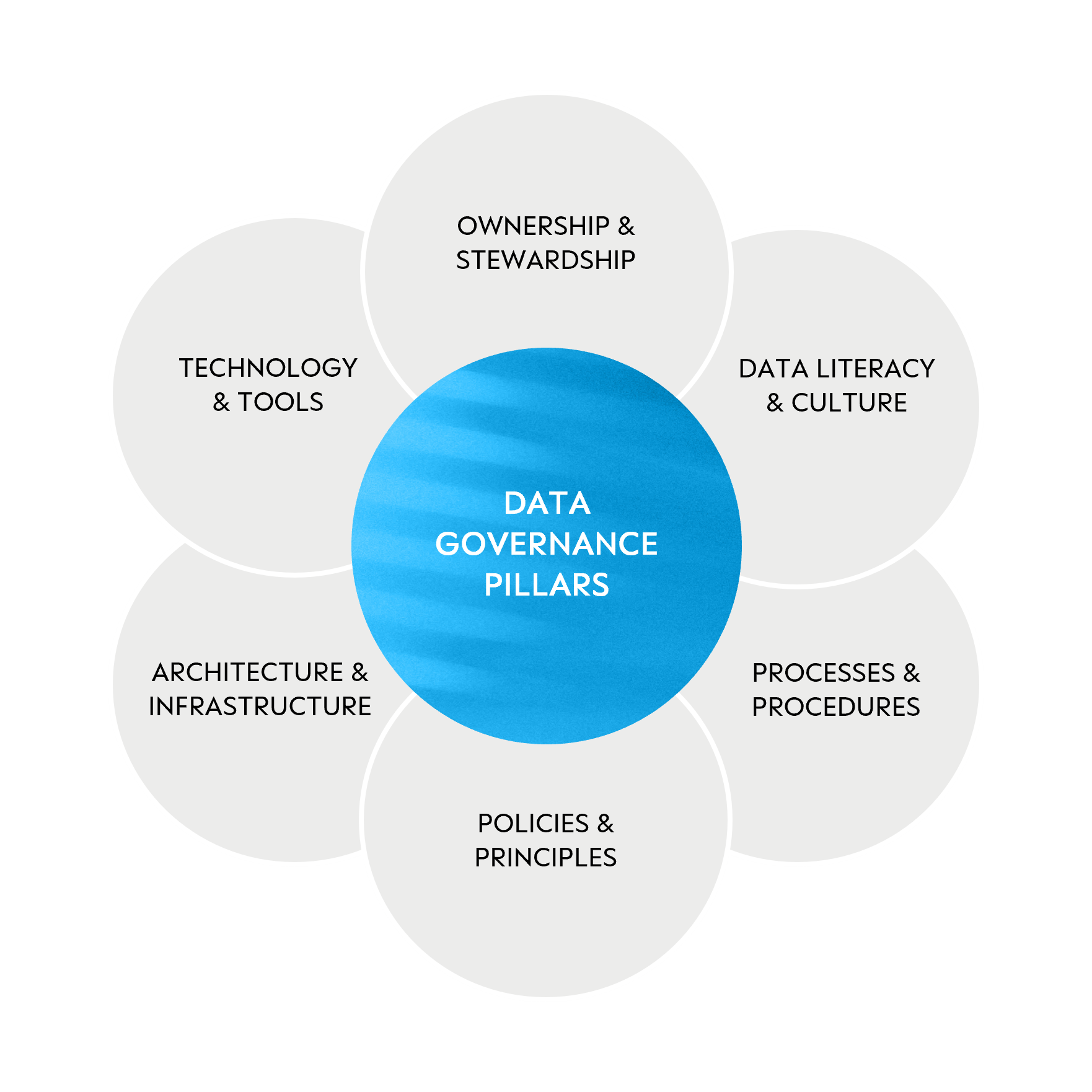
To simplify, data governance can be understood as a core made up of six interconnected pillars:
↘ Ownership & stewardship (who is accountable)
↘ Data literacy & culture (how people understand and use data)
↘ Processes & procedures (how changes happen)
↘ Policies & principles (what is allowed and what isn’t)
↘ Architecture & infrastructure (how data is stored and integrated)
↘ Technology & tools (how governance is enabled and automated)
The goal is not to build all six pillars at once. Effective governance develops step by step - starting with ownership and business alignment, and gradually evolving into the structures and capabilities that make data a trusted and scalable asset.
With that in place, the real challenge begins when organizations try to put it into practice.
The concept of data governance is not new. Yet, there remains confusion about what it actually means and how to leverage it strategically.
In practical terms, data governance defines who is accountable for data, what rules apply, how decisions are made, and how those decisions translate into day-to-day behavior across teams, processes, and systems.
It is not a control layer owned by IT. Rather, it is the operating model that connects business ownership with the processes and technology required to make data reliable, reusable, and fit for purpose.
In essence, governance ensures that business users take control of their data - and that data is of good enough quality to support the organization’s objectives.
To simplify, data governance can be understood as a core made up of six interconnected pillars:
↘ Ownership & stewardship (who is accountable)
↘ Data literacy & culture (how people understand and use data)
↘ Processes & procedures (how changes happen)
↘ Policies & principles (what is allowed and what isn’t)
↘ Architecture & infrastructure (how data is stored and integrated)
↘ Technology & tools (how governance is enabled and automated)
The goal is not to build all six pillars at once. Effective governance develops step by step - starting with ownership and business alignment, and gradually evolving into the structures and capabilities that make data a trusted and scalable asset.
With that in place, the real challenge begins when organizations try to put it into practice.
The concept of data governance is not new. Yet, there remains confusion about what it actually means and how to leverage it strategically.
In practical terms, data governance defines who is accountable for data, what rules apply, how decisions are made, and how those decisions translate into day-to-day behavior across teams, processes, and systems.
It is not a control layer owned by IT. Rather, it is the operating model that connects business ownership with the processes and technology required to make data reliable, reusable, and fit for purpose.
In essence, governance ensures that business users take control of their data - and that data is of good enough quality to support the organization’s objectives.
To simplify, data governance can be understood as a core made up of six interconnected pillars:
↘ Ownership & stewardship (who is accountable)
↘ Data literacy & culture (how people understand and use data)
↘ Processes & procedures (how changes happen)
↘ Policies & principles (what is allowed and what isn’t)
↘ Architecture & infrastructure (how data is stored and integrated)
↘ Technology & tools (how governance is enabled and automated)
The goal is not to build all six pillars at once. Effective governance develops step by step - starting with ownership and business alignment, and gradually evolving into the structures and capabilities that make data a trusted and scalable asset.
With that in place, the real challenge begins when organizations try to put it into practice.
Data governance is not just a framework but a strategic imperative to enable data-driven and AI-ready enterprises
The concept of data governance is not new. Yet, there remains confusion about what it actually means and how to leverage it strategically.
In practical terms, data governance defines who is accountable for data, what rules apply, how decisions are made, and how those decisions translate into day-to-day behavior across teams, processes, and systems.
It is not a control layer owned by IT. Rather, it is the operating model that connects business ownership with the processes and technology required to make data reliable, reusable, and fit for purpose.
In essence, governance ensures that business users take control of their data - and that data is of good enough quality to support the organization’s objectives.
To simplify, data governance can be understood as a core made up of six interconnected pillars:
↘ Ownership & stewardship (who is accountable)
↘ Data literacy & culture (how people understand and use data)
↘ Processes & procedures (how changes happen)
↘ Policies & principles (what is allowed and what isn’t)
↘ Architecture & infrastructure (how data is stored and integrated)
↘ Technology & tools (how governance is enabled and automated)
The goal is not to build all six pillars at once. Effective governance develops step by step - starting with ownership and business alignment, and gradually evolving into the structures and capabilities that make data a trusted and scalable asset.
With that in place, the real challenge begins when organizations try to put it into practice.
Data governance is not just a framework but a strategic imperative to enable data-driven and AI-ready enterprises
The concept of data governance is not new. Yet, there remains confusion about what it actually means and how to leverage it strategically.
In practical terms, data governance defines who is accountable for data, what rules apply, how decisions are made, and how those decisions translate into day-to-day behavior across teams, processes, and systems.
It is not a control layer owned by IT. Rather, it is the operating model that connects business ownership with the processes and technology required to make data reliable, reusable, and fit for purpose.
In essence, governance ensures that business users take control of their data - and that data is of good enough quality to support the organization’s objectives.
To simplify, data governance can be understood as a core made up of six interconnected pillars:
↘ Ownership & stewardship (who is accountable)
↘ Data literacy & culture (how people understand and use data)
↘ Processes & procedures (how changes happen)
↘ Policies & principles (what is allowed and what isn’t)
↘ Architecture & infrastructure (how data is stored and integrated)
↘ Technology & tools (how governance is enabled and automated)
The goal is not to build all six pillars at once. Effective governance develops step by step - starting with ownership and business alignment, and gradually evolving into the structures and capabilities that make data a trusted and scalable asset.
With that in place, the real challenge begins when organizations try to put it into practice.
Data governance is not just a framework but a strategic imperative to enable data-driven and AI-ready enterprises
Most organizations don’t struggle with setting ambitions for good data practices. They struggle with execution. The problem becomes clear when no one can answer the simple question: Who decides what this data means - and whether it’s good enough to use?
Without that clarity, tools don’t help, policies don’t stick, and quality becomes a never-ending clean-up exercise.
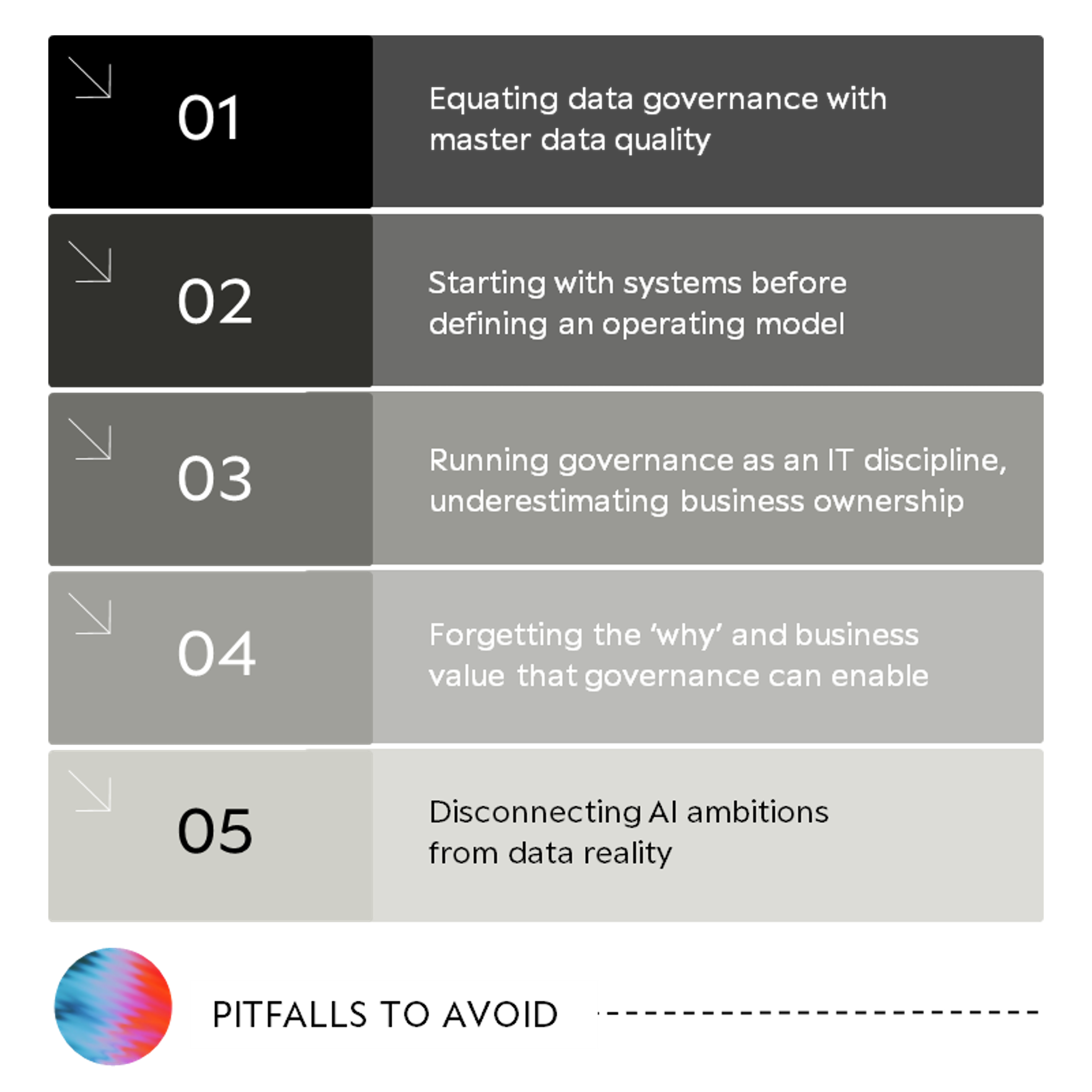
From experience, we repeatedly see five common pitfalls:
1. Equating data governance with master data quality
Quality rules are debated, but definitions and accountability remain fuzzy.
2. Starting with systems before defining the operating model
MDM, catalog, or lineage tools are implemented before governance roles and decision rights are agreed.
3. Running governance as a strict IT discipline
IT becomes the default owner while the business remains a passive stakeholder.
4. Forgetting the “why”
Long governance programs drift away from the concrete decisions and value cases they were meant to support.
5. Disconnecting AI ambitions from data reality
Teams push innovation while definitions, lineage, access, and quality thresholds remain unclear, slowing delivery and increasing risk for business.
Avoiding these pitfalls requires putting accountability and business outcomes first. Clarify the decisions that governance should support, define ownership and an operating model to enforce them, and then layer in processes and tools.
When governance is structured this way, it moves from theory to measurable impact.
And that impact ultimately depends on one thing above all else: clear ownership.
Most organizations don’t struggle with setting ambitions for good data practices. They struggle with execution. The problem becomes clear when no one can answer the simple question: Who decides what this data means - and whether it’s good enough to use?
Without that clarity, tools don’t help, policies don’t stick, and quality becomes a never-ending clean-up exercise.
From experience, we repeatedly see five common pitfalls:
1. Equating data governance with master data quality
Quality rules are debated, but definitions and accountability remain fuzzy.
2. Starting with systems before defining the operating model
MDM, catalog, or lineage tools are implemented before governance roles and decision rights are agreed.
3. Running governance as a strict IT discipline
IT becomes the default owner while the business remains a passive stakeholder.
4. Forgetting the “why”
Long governance programs drift away from the concrete decisions and value cases they were meant to support.
5. Disconnecting AI ambitions from data reality
Teams push innovation while definitions, lineage, access, and quality thresholds remain unclear, slowing delivery and increasing risk for business.
Avoiding these pitfalls requires putting accountability and business outcomes first. Clarify the decisions that governance should support, define ownership and an operating model to enforce them, and then layer in processes and tools.
When governance is structured this way, it moves from theory to measurable impact.
And that impact ultimately depends on one thing above all else: clear ownership.
Most organizations don’t struggle with setting ambitions for good data practices. They struggle with execution. The problem becomes clear when no one can answer the simple question: Who decides what this data means - and whether it’s good enough to use?
Without that clarity, tools don’t help, policies don’t stick, and quality becomes a never-ending clean-up exercise.
From experience, we repeatedly see five common pitfalls:
1. Equating data governance with master data quality
Quality rules are debated, but definitions and accountability remain fuzzy.
2. Starting with systems before defining the operating model
MDM, catalog, or lineage tools are implemented before governance roles and decision rights are agreed.
3. Running governance as a strict IT discipline
IT becomes the default owner while the business remains a passive stakeholder.
4. Forgetting the “why”
Long governance programs drift away from the concrete decisions and value cases they were meant to support.
5. Disconnecting AI ambitions from data reality
Teams push innovation while definitions, lineage, access, and quality thresholds remain unclear, slowing delivery and increasing risk for business.
Avoiding these pitfalls requires putting accountability and business outcomes first. Clarify the decisions that governance should support, define ownership and an operating model to enforce them, and then layer in processes and tools.
When governance is structured this way, it moves from theory to measurable impact.
And that impact ultimately depends on one thing above all else: clear ownership.
Pitfalls occur when governance is built around systems instead of strategic business objectives
Most organizations don’t struggle with setting ambitions for good data practices. They struggle with execution. The problem becomes clear when no one can answer the simple question: Who decides what this data means - and whether it’s good enough to use?
Without that clarity, tools don’t help, policies don’t stick, and quality becomes a never-ending clean-up exercise.
From experience, we repeatedly see five common pitfalls:
1. Equating data governance with master data quality
Quality rules are debated, but definitions and accountability remain fuzzy.
2. Starting with systems before defining the operating model
MDM, catalog, or lineage tools are implemented before governance roles and decision rights are agreed.
3. Running governance as a strict IT discipline
IT becomes the default owner while the business remains a passive stakeholder.
4. Forgetting the “why”
Long governance programs drift away from the concrete decisions and value cases they were meant to support.
5. Disconnecting AI ambitions from data reality
Teams push innovation while definitions, lineage, access, and quality thresholds remain unclear, slowing delivery and increasing risk for business.
Avoiding these pitfalls requires putting accountability and business outcomes first. Clarify the decisions that governance should support, define ownership and an operating model to enforce them, and then layer in processes and tools.
When governance is structured this way, it moves from theory to measurable impact.
And that impact ultimately depends on one thing above all else: clear ownership.
Pitfalls occur when governance is built around systems instead of strategic business objectives
Most organizations don’t struggle with setting ambitions for good data practices. They struggle with execution. The problem becomes clear when no one can answer the simple question: Who decides what this data means - and whether it’s good enough to use?
Without that clarity, tools don’t help, policies don’t stick, and quality becomes a never-ending clean-up exercise.
From experience, we repeatedly see five common pitfalls:
1. Equating data governance with master data quality
Quality rules are debated, but definitions and accountability remain fuzzy.
2. Starting with systems before defining the operating model
MDM, catalog, or lineage tools are implemented before governance roles and decision rights are agreed.
3. Running governance as a strict IT discipline
IT becomes the default owner while the business remains a passive stakeholder.
4. Forgetting the “why”
Long governance programs drift away from the concrete decisions and value cases they were meant to support.
5. Disconnecting AI ambitions from data reality
Teams push innovation while definitions, lineage, access, and quality thresholds remain unclear, slowing delivery and increasing risk for business.
Avoiding these pitfalls requires putting accountability and business outcomes first. Clarify the decisions that governance should support, define ownership and an operating model to enforce them, and then layer in processes and tools.
When governance is structured this way, it moves from theory to measurable impact.
And that impact ultimately depends on one thing above all else: clear ownership.
Pitfalls occur when governance is built around systems instead of strategic business objectives
While data governance is not a one-size-fits-all concept, success - like most initiatives - starts with defining clear roles and ownership.
Organizations must recognize that ownership cannot be “everyone’s responsibility” in theory and “IT’s problem” in practice.
The most effective way to make accountability stick is to formalize the roles closest to the data and the decisions it supports.
Data governance frameworks often describe many roles, but the key principle is simpler: identify and engage people who understand the value of data and are willing to actively manage it as a business asset.
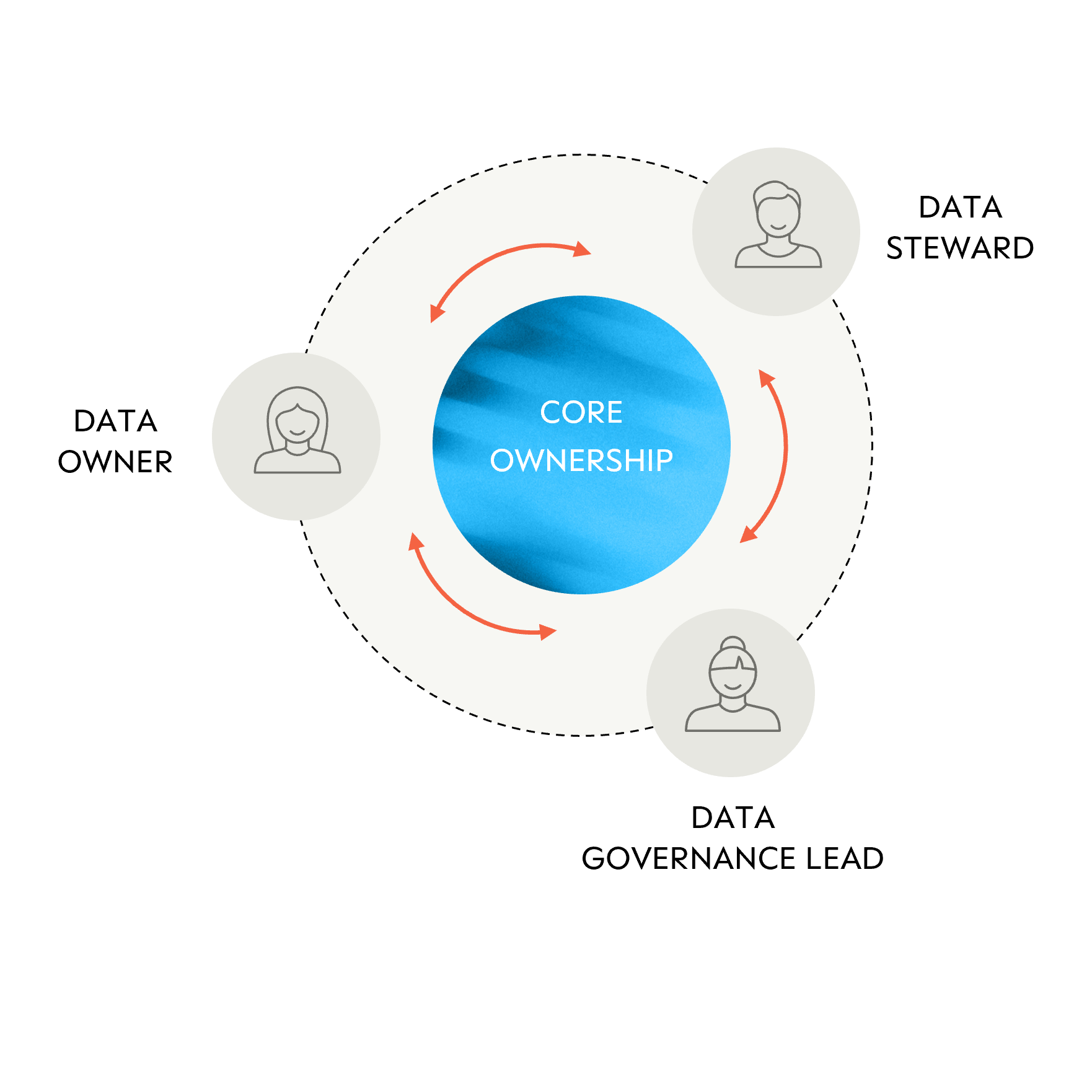
A strong starting point is to establish three core roles.
1. Data Owners – accountable for data quality and standards
Data owners are business representatives with deep knowledge of one or more data domains. They treat these domains as business assets and are ultimately accountable for their quality, meaning, accessibility, and prioritization.
In practice, they make final decisions on definitions, thresholds, access rights, and priorities. Effective data owners also balance operational oversight with a broader strategic perspective.
2. Data Stewards – executing and maintaining standards
Data stewards work hands-on with data and form the operational backbone of governance. They implement data standards, maintain quality, and ensure policies are applied in daily operations.
Working closely with data owners, stewards monitor issues, resolve operational problems, and surface insights requiring strategic attention.
3. Data Governance Lead – enabling the governance ecosystem
The data governance lead designs and drives the governance framework and the operating model of the data office.
Although sometimes seen as a temporary role to “get things started,” in reality it is a long-term enabler. Governance leads coordinate the collaboration between owners and stewards, guide teams on standards, and ensure governance decisions translate into consistent practices across domains.
Clear ownership across roles is essential, and responsibilities should not be diluted by spreading them across too many individuals. But roles alone do not create governance.
Real change happens when these roles operate through shared practices, leadership support, and a clear path for scaling governance across the organization.
While data governance is not a one-size-fits-all concept, success - like most initiatives - starts with defining clear roles and ownership.
Organizations must recognize that ownership cannot be “everyone’s responsibility” in theory and “IT’s problem” in practice.
The most effective way to make accountability stick is to formalize the roles closest to the data and the decisions it supports.
Data governance frameworks often describe many roles, but the key principle is simpler: identify and engage people who understand the value of data and are willing to actively manage it as a business asset.
A strong starting point is to establish three core roles.
1. Data Owners – accountable for data quality and standards
Data owners are business representatives with deep knowledge of one or more data domains. They treat these domains as business assets and are ultimately accountable for their quality, meaning, accessibility, and prioritization.
In practice, they make final decisions on definitions, thresholds, access rights, and priorities. Effective data owners also balance operational oversight with a broader strategic perspective.
2. Data Stewards – executing and maintaining standards
Data stewards work hands-on with data and form the operational backbone of governance. They implement data standards, maintain quality, and ensure policies are applied in daily operations.
Working closely with data owners, stewards monitor issues, resolve operational problems, and surface insights requiring strategic attention.
3. Data Governance Lead – enabling the governance ecosystem
The data governance lead designs and drives the governance framework and the operating model of the data office.
Although sometimes seen as a temporary role to “get things started,” in reality it is a long-term enabler. Governance leads coordinate the collaboration between owners and stewards, guide teams on standards, and ensure governance decisions translate into consistent practices across domains.
Clear ownership across roles is essential, and responsibilities should not be diluted by spreading them across too many individuals. But roles alone do not create governance.
Real change happens when these roles operate through shared practices, leadership support, and a clear path for scaling governance across the organization.
While data governance is not a one-size-fits-all concept, success - like most initiatives - starts with defining clear roles and ownership.
Organizations must recognize that ownership cannot be “everyone’s responsibility” in theory and “IT’s problem” in practice.
The most effective way to make accountability stick is to formalize the roles closest to the data and the decisions it supports.
Data governance frameworks often describe many roles, but the key principle is simpler: identify and engage people who understand the value of data and are willing to actively manage it as a business asset.
A strong starting point is to establish three core roles.
1. Data Owners – accountable for data quality and standards
Data owners are business representatives with deep knowledge of one or more data domains. They treat these domains as business assets and are ultimately accountable for their quality, meaning, accessibility, and prioritization.
In practice, they make final decisions on definitions, thresholds, access rights, and priorities. Effective data owners also balance operational oversight with a broader strategic perspective.
2. Data Stewards – executing and maintaining standards
Data stewards work hands-on with data and form the operational backbone of governance. They implement data standards, maintain quality, and ensure policies are applied in daily operations.
Working closely with data owners, stewards monitor issues, resolve operational problems, and surface insights requiring strategic attention.
3. Data Governance Lead – enabling the governance ecosystem
The data governance lead designs and drives the governance framework and the operating model of the data office.
Although sometimes seen as a temporary role to “get things started,” in reality it is a long-term enabler. Governance leads coordinate the collaboration between owners and stewards, guide teams on standards, and ensure governance decisions translate into consistent practices across domains.
Clear ownership across roles is essential, and responsibilities should not be diluted by spreading them across too many individuals. But roles alone do not create governance.
Real change happens when these roles operate through shared practices, leadership support, and a clear path for scaling governance across the organization.
Establish clear roles and responsibilities to manage data as a strategic asset
While data governance is not a one-size-fits-all concept, success - like most initiatives - starts with defining clear roles and ownership.
Organizations must recognize that ownership cannot be “everyone’s responsibility” in theory and “IT’s problem” in practice.
The most effective way to make accountability stick is to formalize the roles closest to the data and the decisions it supports.
Data governance frameworks often describe many roles, but the key principle is simpler: identify and engage people who understand the value of data and are willing to actively manage it as a business asset.
A strong starting point is to establish three core roles.
1. Data Owners – accountable for data quality and standards
Data owners are business representatives with deep knowledge of one or more data domains. They treat these domains as business assets and are ultimately accountable for their quality, meaning, accessibility, and prioritization.
In practice, they make final decisions on definitions, thresholds, access rights, and priorities. Effective data owners also balance operational oversight with a broader strategic perspective.
2. Data Stewards – executing and maintaining standards
Data stewards work hands-on with data and form the operational backbone of governance. They implement data standards, maintain quality, and ensure policies are applied in daily operations.
Working closely with data owners, stewards monitor issues, resolve operational problems, and surface insights requiring strategic attention.
3. Data Governance Lead – enabling the governance ecosystem
The data governance lead designs and drives the governance framework and the operating model of the data office.
Although sometimes seen as a temporary role to “get things started,” in reality it is a long-term enabler. Governance leads coordinate the collaboration between owners and stewards, guide teams on standards, and ensure governance decisions translate into consistent practices across domains.
Clear ownership across roles is essential, and responsibilities should not be diluted by spreading them across too many individuals. But roles alone do not create governance.
Real change happens when these roles operate through shared practices, leadership support, and a clear path for scaling governance across the organization.
Establish clear roles and responsibilities to manage data as a strategic asset
While data governance is not a one-size-fits-all concept, success - like most initiatives - starts with defining clear roles and ownership.
Organizations must recognize that ownership cannot be “everyone’s responsibility” in theory and “IT’s problem” in practice.
The most effective way to make accountability stick is to formalize the roles closest to the data and the decisions it supports.
Data governance frameworks often describe many roles, but the key principle is simpler: identify and engage people who understand the value of data and are willing to actively manage it as a business asset.
A strong starting point is to establish three core roles.
1. Data Owners – accountable for data quality and standards
Data owners are business representatives with deep knowledge of one or more data domains. They treat these domains as business assets and are ultimately accountable for their quality, meaning, accessibility, and prioritization.
In practice, they make final decisions on definitions, thresholds, access rights, and priorities. Effective data owners also balance operational oversight with a broader strategic perspective.
2. Data Stewards – executing and maintaining standards
Data stewards work hands-on with data and form the operational backbone of governance. They implement data standards, maintain quality, and ensure policies are applied in daily operations.
Working closely with data owners, stewards monitor issues, resolve operational problems, and surface insights requiring strategic attention.
3. Data Governance Lead – enabling the governance ecosystem
The data governance lead designs and drives the governance framework and the operating model of the data office.
Although sometimes seen as a temporary role to “get things started,” in reality it is a long-term enabler. Governance leads coordinate the collaboration between owners and stewards, guide teams on standards, and ensure governance decisions translate into consistent practices across domains.
Clear ownership across roles is essential, and responsibilities should not be diluted by spreading them across too many individuals. But roles alone do not create governance.
Real change happens when these roles operate through shared practices, leadership support, and a clear path for scaling governance across the organization.
Establish clear roles and responsibilities to manage data as a strategic asset
Effective data governance rarely begins with a large-scale rollout.
Instead, it starts with a few foundational structures, demonstrates value in priority areas, and builds momentum over time.
When leadership support, clear operating models, and engaged domain experts come together, governance evolves from an abstract concept into a practical capability that strengthens the organization’s entire data foundation.
A pragmatic starting point often includes three steps:
↗ Secure leadership buy-in
Ensure the governance program is recognized as a strategic priority with clear senior sponsorship. Leadership must understand not only the risks of poor data but also the return on investment that strong governance enables.
↗ Establish a data office and operating model
Define the governance operating model and establish a central data governance office to provide coordination and guidance across domains.
Position governance clearly as a business capability - not an IT initiative, and locate it centrally and independently in line with other important business functions.
↗ Outline data domains and involve owners
Map the primary data domains of the business, often guided by the organization’s value chain. Involve the people who understand the data best to ensure governance connects directly to business objectives.
Sustainable governance grows from early, visible wins. Start small, demonstrate value, and expand gradually.
Over time, what begins as a focused initiative becomes a core capability that makes data a trusted, scalable, and strategic asset.
And once governance reaches that point, it stops being a project and becomes part of how the organization operates.

Effective data governance rarely begins with a large-scale rollout.
Instead, it starts with a few foundational structures, demonstrates value in priority areas, and builds momentum over time.
When leadership support, clear operating models, and engaged domain experts come together, governance evolves from an abstract concept into a practical capability that strengthens the organization’s entire data foundation.
A pragmatic starting point often includes three steps:
↗ Secure leadership buy-in
Ensure the governance program is recognized as a strategic priority with clear senior sponsorship. Leadership must understand not only the risks of poor data but also the return on investment that strong governance enables.
↗ Establish a data office and operating model
Define the governance operating model and establish a central data governance office to provide coordination and guidance across domains.
Position governance clearly as a business capability - not an IT initiative, and locate it centrally and independently in line with other important business functions.
↗ Outline data domains and involve owners
Map the primary data domains of the business, often guided by the organization’s value chain. Involve the people who understand the data best to ensure governance connects directly to business objectives.
Sustainable governance grows from early, visible wins. Start small, demonstrate value, and expand gradually.
Over time, what begins as a focused initiative becomes a core capability that makes data a trusted, scalable, and strategic asset.
And once governance reaches that point, it stops being a project and becomes part of how the organization operates.
Effective data governance rarely begins with a large-scale rollout.
Instead, it starts with a few foundational structures, demonstrates value in priority areas, and builds momentum over time.
When leadership support, clear operating models, and engaged domain experts come together, governance evolves from an abstract concept into a practical capability that strengthens the organization’s entire data foundation.
A pragmatic starting point often includes three steps:
↗ Secure leadership buy-in
Ensure the governance program is recognized as a strategic priority with clear senior sponsorship. Leadership must understand not only the risks of poor data but also the return on investment that strong governance enables.
↗ Establish a data office and operating model
Define the governance operating model and establish a central data governance office to provide coordination and guidance across domains.
Position governance clearly as a business capability - not an IT initiative, and locate it centrally and independently in line with other important business functions.
↗ Outline data domains and involve owners
Map the primary data domains of the business, often guided by the organization’s value chain. Involve the people who understand the data best to ensure governance connects directly to business objectives.
Sustainable governance grows from early, visible wins. Start small, demonstrate value, and expand gradually.
Over time, what begins as a focused initiative becomes a core capability that makes data a trusted, scalable, and strategic asset.
And once governance reaches that point, it stops being a project and becomes part of how the organization operates.
Build the fundamental structures and secure leadership buy-in
Effective data governance rarely begins with a large-scale rollout.
Instead, it starts with a few foundational structures, demonstrates value in priority areas, and builds momentum over time.
When leadership support, clear operating models, and engaged domain experts come together, governance evolves from an abstract concept into a practical capability that strengthens the organization’s entire data foundation.
A pragmatic starting point often includes three steps:
↗ Secure leadership buy-in
Ensure the governance program is recognized as a strategic priority with clear senior sponsorship. Leadership must understand not only the risks of poor data but also the return on investment that strong governance enables.
↗ Establish a data office and operating model
Define the governance operating model and establish a central data governance office to provide coordination and guidance across domains.
Position governance clearly as a business capability - not an IT initiative, and locate it centrally and independently in line with other important business functions.
↗ Outline data domains and involve owners
Map the primary data domains of the business, often guided by the organization’s value chain. Involve the people who understand the data best to ensure governance connects directly to business objectives.
Sustainable governance grows from early, visible wins. Start small, demonstrate value, and expand gradually.
Over time, what begins as a focused initiative becomes a core capability that makes data a trusted, scalable, and strategic asset.
And once governance reaches that point, it stops being a project and becomes part of how the organization operates.
Build the fundamental structures and secure leadership buy-in
Effective data governance rarely begins with a large-scale rollout.
Instead, it starts with a few foundational structures, demonstrates value in priority areas, and builds momentum over time.
When leadership support, clear operating models, and engaged domain experts come together, governance evolves from an abstract concept into a practical capability that strengthens the organization’s entire data foundation.
A pragmatic starting point often includes three steps:
↗ Secure leadership buy-in
Ensure the governance program is recognized as a strategic priority with clear senior sponsorship. Leadership must understand not only the risks of poor data but also the return on investment that strong governance enables.
↗ Establish a data office and operating model
Define the governance operating model and establish a central data governance office to provide coordination and guidance across domains.
Position governance clearly as a business capability - not an IT initiative, and locate it centrally and independently in line with other important business functions.
↗ Outline data domains and involve owners
Map the primary data domains of the business, often guided by the organization’s value chain. Involve the people who understand the data best to ensure governance connects directly to business objectives.
Sustainable governance grows from early, visible wins. Start small, demonstrate value, and expand gradually.
Over time, what begins as a focused initiative becomes a core capability that makes data a trusted, scalable, and strategic asset.
And once governance reaches that point, it stops being a project and becomes part of how the organization operates.
Build the fundamental structures and secure leadership buy-in
Building a strong data foundation is critcal. Using data governance as the key is becoming a structural necessity. Remember:
↗ Governance is not a tool or a committee. It is the capability to define, manage, and enforce policies and responsibilities that ensure data is trustworthy, secure, and support business outcomes.
↗ Start with ownership - then enable it. Tools accelerate governance; they don’t substitute for decision-making.
↗ Anchor governance in business outcomes. If it doesn’t improve decisions, speed, risk, or trust, it won’t last.
↗ Avoid “boiling the ocean. Start with one domain where pain is real, produce tangible artifacts, then scale.
↗ Treat the data office as a facilitator, not a gatekeeper. It connects data owners, stewards, andleadership to ensure collaboration and consistent governance practices
Building a strong data foundation is critcal. Using data governance as the key is becoming a structural necessity. Remember:
↗ Governance is not a tool or a committee. It is the capability to define, manage, and enforce policies and responsibilities that ensure data is trustworthy, secure, and support business outcomes.
↗ Start with ownership - then enable it. Tools accelerate governance; they don’t substitute for decision-making.
↗ Anchor governance in business outcomes. If it doesn’t improve decisions, speed, risk, or trust, it won’t last.
↗ Avoid “boiling the ocean. Start with one domain where pain is real, produce tangible artifacts, then scale.
↗ Treat the data office as a facilitator, not a gatekeeper. It connects data owners, stewards, andleadership to ensure collaboration and consistent governance practices
Building a strong data foundation is critcal. Using data governance as the key is becoming a structural necessity. Remember:
↗ Governance is not a tool or a committee. It is the capability to define, manage, and enforce policies and responsibilities that ensure data is trustworthy, secure, and support business outcomes.
↗ Start with ownership - then enable it. Tools accelerate governance; they don’t substitute for decision-making.
↗ Anchor governance in business outcomes. If it doesn’t improve decisions, speed, risk, or trust, it won’t last.
↗ Avoid “boiling the ocean. Start with one domain where pain is real, produce tangible artifacts, then scale.
↗ Treat the data office as a facilitator, not a gatekeeper. It connects data owners, stewards, andleadership to ensure collaboration and consistent governance practices
What leaders should remember
Building a strong data foundation is critcal. Using data governance as the key is becoming a structural necessity. Remember:
↗ Governance is not a tool or a committee. It is the capability to define, manage, and enforce policies and responsibilities that ensure data is trustworthy, secure, and support business outcomes.
↗ Start with ownership - then enable it. Tools accelerate governance; they don’t substitute for decision-making.
↗ Anchor governance in business outcomes. If it doesn’t improve decisions, speed, risk, or trust, it won’t last.
↗ Avoid “boiling the ocean. Start with one domain where pain is real, produce tangible artifacts, then scale.
↗ Treat the data office as a facilitator, not a gatekeeper. It connects data owners, stewards, andleadership to ensure collaboration and consistent governance practices
What leaders should remember
Building a strong data foundation is critcal. Using data governance as the key is becoming a structural necessity. Remember:
↗ Governance is not a tool or a committee. It is the capability to define, manage, and enforce policies and responsibilities that ensure data is trustworthy, secure, and support business outcomes.
↗ Start with ownership - then enable it. Tools accelerate governance; they don’t substitute for decision-making.
↗ Anchor governance in business outcomes. If it doesn’t improve decisions, speed, risk, or trust, it won’t last.
↗ Avoid “boiling the ocean. Start with one domain where pain is real, produce tangible artifacts, then scale.
↗ Treat the data office as a facilitator, not a gatekeeper. It connects data owners, stewards, andleadership to ensure collaboration and consistent governance practices
What leaders should remember
The whitepaper breaks down the full governance model: intake and prioritization criteria, decision rights, funding models, a value framework covering financial, capacity, and risk outcomes, and the kill triggers that let leaders stop work without stigma.
Data governance looks different for every organization. Let's talk about what it looks like for yours.
Reach out if you’d like to explore how to turn data governance into a practical business capability.




In this four-part series, “Mastering CX in Pharma”, we aim to share our perspective and approaches on how to succeed in designing a winning customer experience. We will deep dive into engagement model design, data as a key enabler, how to design an operating model that supports your strategic ambitions, and the role of change management.
Click to read more
Sign up for the whitepaper and learn how Agentic AI is set to disrupt pharma’s commercial engagement - and why acting now is key to staying ahead. Explore how a strategic approach to AI adoption can help pharma scale impact, optimize operations, and unlock lasting value.
Click to read more
AI is revolutionizing the pharmaceutical industry, improving efficiency in drug discovery, clinical development, and customer engagement. Key applications like content creation, insights extraction, and predictive analytics streamline operations. To maximize AI’s potential, a strategic, holistic approach is crucial, avoiding siloed efforts and aligning with business goals for scalable success.
Click to read more
AI has the potential to revolutionize the pharmaceutical industry, but success hinges on selecting the right use cases. Without a structured approach, companies risk spreading resources too thin and missing out on scalable, impactful solutions. This article explores a strategic framework for evaluating and prioritizing AI projects, ensuring they align with corporate goals and deliver maximum value
Click to read more