
Predicting Loss of Exclusivity Sales Erosion with Drivers-Based Machine Learning
Explore how we helped a global pharma organization move from manual, one-off loss of exclusivity analyses to a scalable, drivers-based ML forecasting engine

Predicting Loss of Exclusivity Sales Erosion with Drivers-Based Machine Learning
Explore how we helped a global pharma organization move from manual, one-off loss of exclusivity analyses to a scalable, drivers-based ML forecasting engine
For global pharma companies, loss of exclusivity (LoE) is one of the most financially significant events in a brand’s lifecycle. When generic or biosimilar competitors enter the market at significantly lower price points, the originator brand can experience rapid and deep sales erosion. These dynamics directly inform high-stakes decisions such as pricing strategy, market prioritization, and whether to defend or de-invest in late-lifecycle brands.
Yet, forecasting LoE impact remains difficult. Because LoE happens only once per product, traditional forecasting methods - largely based on a brand’s own historical sales - struggle to predict post-LoE behavior accurately. As a result, many organizations still rely on manual, market-by-market erosion estimates and bespoke external analyses. These approaches are time-consuming, expensive, hard to scale, and often inaccurate, leading to both premature de-investment and over-investment in brands post-LoE.
The client needed an internal, scalable machine-learning capability to forecast LoE erosion faster, cheaper, and with higher accuracy than human planners, while reducing reliance on subjective judgement.
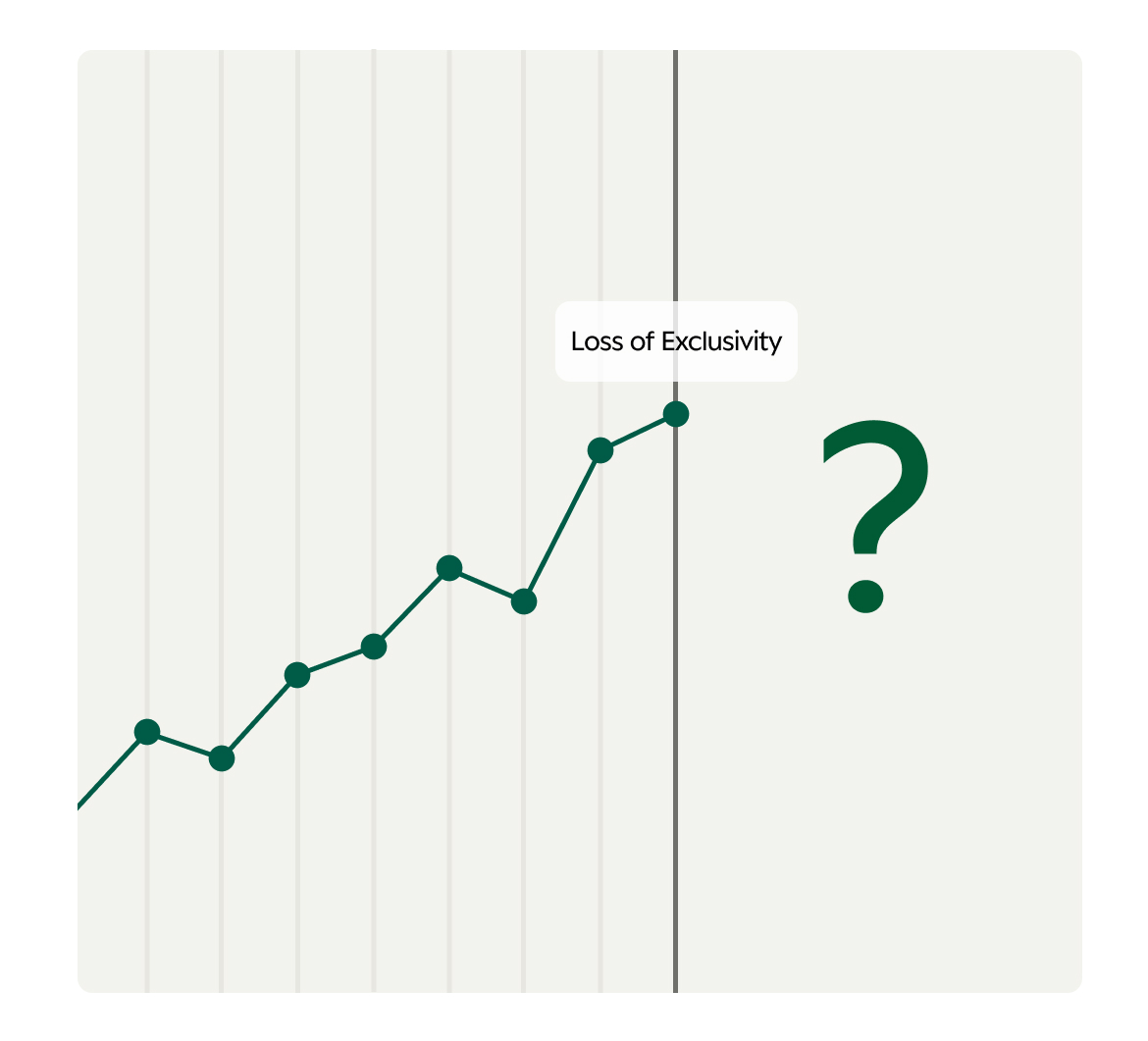
For global pharma companies, loss of exclusivity (LoE) is one of the most financially significant events in a brand’s lifecycle. When generic or biosimilar competitors enter the market at significantly lower price points, the originator brand can experience rapid and deep sales erosion. These dynamics directly inform high-stakes decisions such as pricing strategy, market prioritization, and whether to defend or de-invest in late-lifecycle brands.
Yet, forecasting LoE impact remains difficult. Because LoE happens only once per product, traditional forecasting methods - largely based on a brand’s own historical sales - struggle to predict post-LoE behavior accurately. As a result, many organizations still rely on manual, market-by-market erosion estimates and bespoke external analyses. These approaches are time-consuming, expensive, hard to scale, and often inaccurate, leading to both premature de-investment and over-investment in brands post-LoE.
The client needed an internal, scalable machine-learning capability to forecast LoE erosion faster, cheaper, and with higher accuracy than human planners, while reducing reliance on subjective judgement.
For global pharma companies, loss of exclusivity (LoE) is one of the most financially significant events in a brand’s lifecycle. When generic or biosimilar competitors enter the market at significantly lower price points, the originator brand can experience rapid and deep sales erosion. These dynamics directly inform high-stakes decisions such as pricing strategy, market prioritization, and whether to defend or de-invest in late-lifecycle brands.
Yet, forecasting LoE impact remains difficult. Because LoE happens only once per product, traditional forecasting methods - largely based on a brand’s own historical sales - struggle to predict post-LoE behavior accurately. As a result, many organizations still rely on manual, market-by-market erosion estimates and bespoke external analyses. These approaches are time-consuming, expensive, hard to scale, and often inaccurate, leading to both premature de-investment and over-investment in brands post-LoE.
The client needed an internal, scalable machine-learning capability to forecast LoE erosion faster, cheaper, and with higher accuracy than human planners, while reducing reliance on subjective judgement.
How do you reliably estimate LoE impact without slow, manual one-off analyses?
For global pharma companies, loss of exclusivity (LoE) is one of the most financially significant events in a brand’s lifecycle. When generic or biosimilar competitors enter the market at significantly lower price points, the originator brand can experience rapid and deep sales erosion. These dynamics directly inform high-stakes decisions such as pricing strategy, market prioritization, and whether to defend or de-invest in late-lifecycle brands.
Yet, forecasting LoE impact remains difficult. Because LoE happens only once per product, traditional forecasting methods - largely based on a brand’s own historical sales - struggle to predict post-LoE behavior accurately. As a result, many organizations still rely on manual, market-by-market erosion estimates and bespoke external analyses. These approaches are time-consuming, expensive, hard to scale, and often inaccurate, leading to both premature de-investment and over-investment in brands post-LoE.
The client needed an internal, scalable machine-learning capability to forecast LoE erosion faster, cheaper, and with higher accuracy than human planners, while reducing reliance on subjective judgement.
How do you reliably estimate LoE impact without slow, manual one-off analyses?
For global pharma companies, loss of exclusivity (LoE) is one of the most financially significant events in a brand’s lifecycle. When generic or biosimilar competitors enter the market at significantly lower price points, the originator brand can experience rapid and deep sales erosion. These dynamics directly inform high-stakes decisions such as pricing strategy, market prioritization, and whether to defend or de-invest in late-lifecycle brands.
Yet, forecasting LoE impact remains difficult. Because LoE happens only once per product, traditional forecasting methods - largely based on a brand’s own historical sales - struggle to predict post-LoE behavior accurately. As a result, many organizations still rely on manual, market-by-market erosion estimates and bespoke external analyses. These approaches are time-consuming, expensive, hard to scale, and often inaccurate, leading to both premature de-investment and over-investment in brands post-LoE.
The client needed an internal, scalable machine-learning capability to forecast LoE erosion faster, cheaper, and with higher accuracy than human planners, while reducing reliance on subjective judgement.
Historically, our client estimated LoE impact using a small set of erosion observations from manually selected local analogues from its own portfolio. This exercise had to be done market by market and was frequently supplemented by costly external consultant analyses. The limitation of this approach is structural: LoE behavior is highly contextual and driven by a complex interaction between product characteristics and local market dynamics. A handful of hand-picked analogues cannot reliably capture this variability.
The strategic shift was to move from one-off analyses to a reusable, data-driven forecasting engine - leveraging a large-scale external data foundation to learn from hundreds of historical LoE events across markets, rather than a small number of internal examples. Together with finance and forecasting stakeholders, we set out to:
- Establish a unified data model across markets, manufacturers, and brands with standardized inputs (e.g. sales history, time on market, LoE and generic entry dates)
- Build a large-scale analogue library and derive comparable historical erosion curves across products and countries
- Generate forward-looking erosion predictions that integrate seamlessly into existing forecasting and planning processes
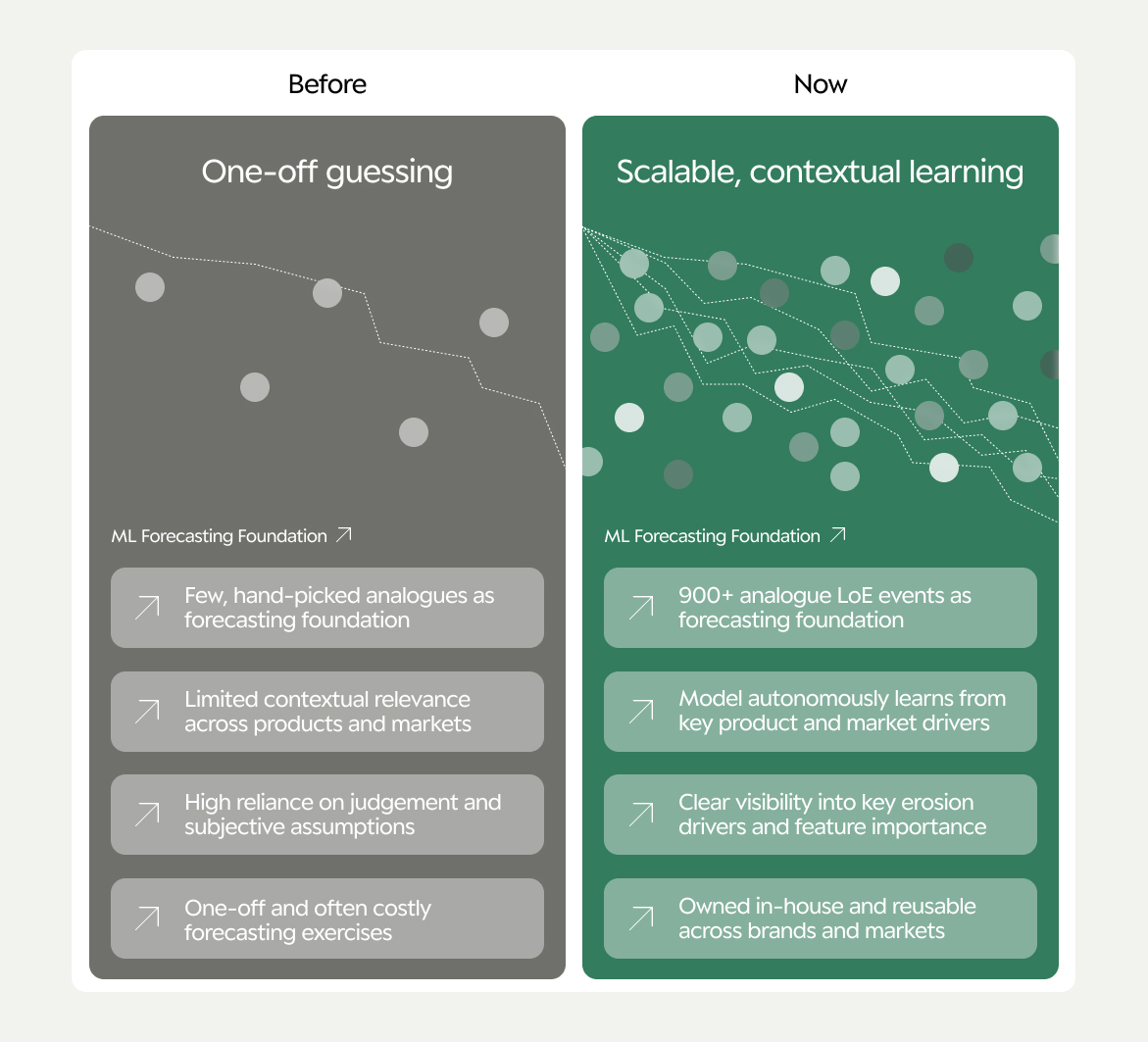
Historically, our client estimated LoE impact using a small set of erosion observations from manually selected local analogues from its own portfolio. This exercise had to be done market by market and was frequently supplemented by costly external consultant analyses. The limitation of this approach is structural: LoE behavior is highly contextual and driven by a complex interaction between product characteristics and local market dynamics. A handful of hand-picked analogues cannot reliably capture this variability.
The strategic shift was to move from one-off analyses to a reusable, data-driven forecasting engine - leveraging a large-scale external data foundation to learn from hundreds of historical LoE events across markets, rather than a small number of internal examples. Together with finance and forecasting stakeholders, we set out to:
- Establish a unified data model across markets, manufacturers, and brands with standardized inputs (e.g. sales history, time on market, LoE and generic entry dates)
- Build a large-scale analogue library and derive comparable historical erosion curves across products and countries
- Generate forward-looking erosion predictions that integrate seamlessly into existing forecasting and planning processes
Historically, our client estimated LoE impact using a small set of erosion observations from manually selected local analogues from its own portfolio. This exercise had to be done market by market and was frequently supplemented by costly external consultant analyses. The limitation of this approach is structural: LoE behavior is highly contextual and driven by a complex interaction between product characteristics and local market dynamics. A handful of hand-picked analogues cannot reliably capture this variability.
The strategic shift was to move from one-off analyses to a reusable, data-driven forecasting engine - leveraging a large-scale external data foundation to learn from hundreds of historical LoE events across markets, rather than a small number of internal examples. Together with finance and forecasting stakeholders, we set out to:
- Establish a unified data model across markets, manufacturers, and brands with standardized inputs (e.g. sales history, time on market, LoE and generic entry dates)
- Build a large-scale analogue library and derive comparable historical erosion curves across products and countries
- Generate forward-looking erosion predictions that integrate seamlessly into existing forecasting and planning processes
From manual analogues to a scalable forecasting engine
Historically, our client estimated LoE impact using a small set of erosion observations from manually selected local analogues from its own portfolio. This exercise had to be done market by market and was frequently supplemented by costly external consultant analyses. The limitation of this approach is structural: LoE behavior is highly contextual and driven by a complex interaction between product characteristics and local market dynamics. A handful of hand-picked analogues cannot reliably capture this variability.
The strategic shift was to move from one-off analyses to a reusable, data-driven forecasting engine - leveraging a large-scale external data foundation to learn from hundreds of historical LoE events across markets, rather than a small number of internal examples. Together with finance and forecasting stakeholders, we set out to:
- Establish a unified data model across markets, manufacturers, and brands with standardized inputs (e.g. sales history, time on market, LoE and generic entry dates)
- Build a large-scale analogue library and derive comparable historical erosion curves across products and countries
- Generate forward-looking erosion predictions that integrate seamlessly into existing forecasting and planning processes
From manual analogues to a scalable forecasting engine
Historically, our client estimated LoE impact using a small set of erosion observations from manually selected local analogues from its own portfolio. This exercise had to be done market by market and was frequently supplemented by costly external consultant analyses. The limitation of this approach is structural: LoE behavior is highly contextual and driven by a complex interaction between product characteristics and local market dynamics. A handful of hand-picked analogues cannot reliably capture this variability.
The strategic shift was to move from one-off analyses to a reusable, data-driven forecasting engine - leveraging a large-scale external data foundation to learn from hundreds of historical LoE events across markets, rather than a small number of internal examples. Together with finance and forecasting stakeholders, we set out to:
- Establish a unified data model across markets, manufacturers, and brands with standardized inputs (e.g. sales history, time on market, LoE and generic entry dates)
- Build a large-scale analogue library and derive comparable historical erosion curves across products and countries
- Generate forward-looking erosion predictions that integrate seamlessly into existing forecasting and planning processes
The case in numbers
Significantly improved predictive accuracy across initial pilot markets
Learning from 900+ historical analogues, providing far broader empirical grounding than traditional methods
Time per brand-market to run unlimited scenarios as well as market and brand-specific forecasts versus 6 month lead time via traditional methods
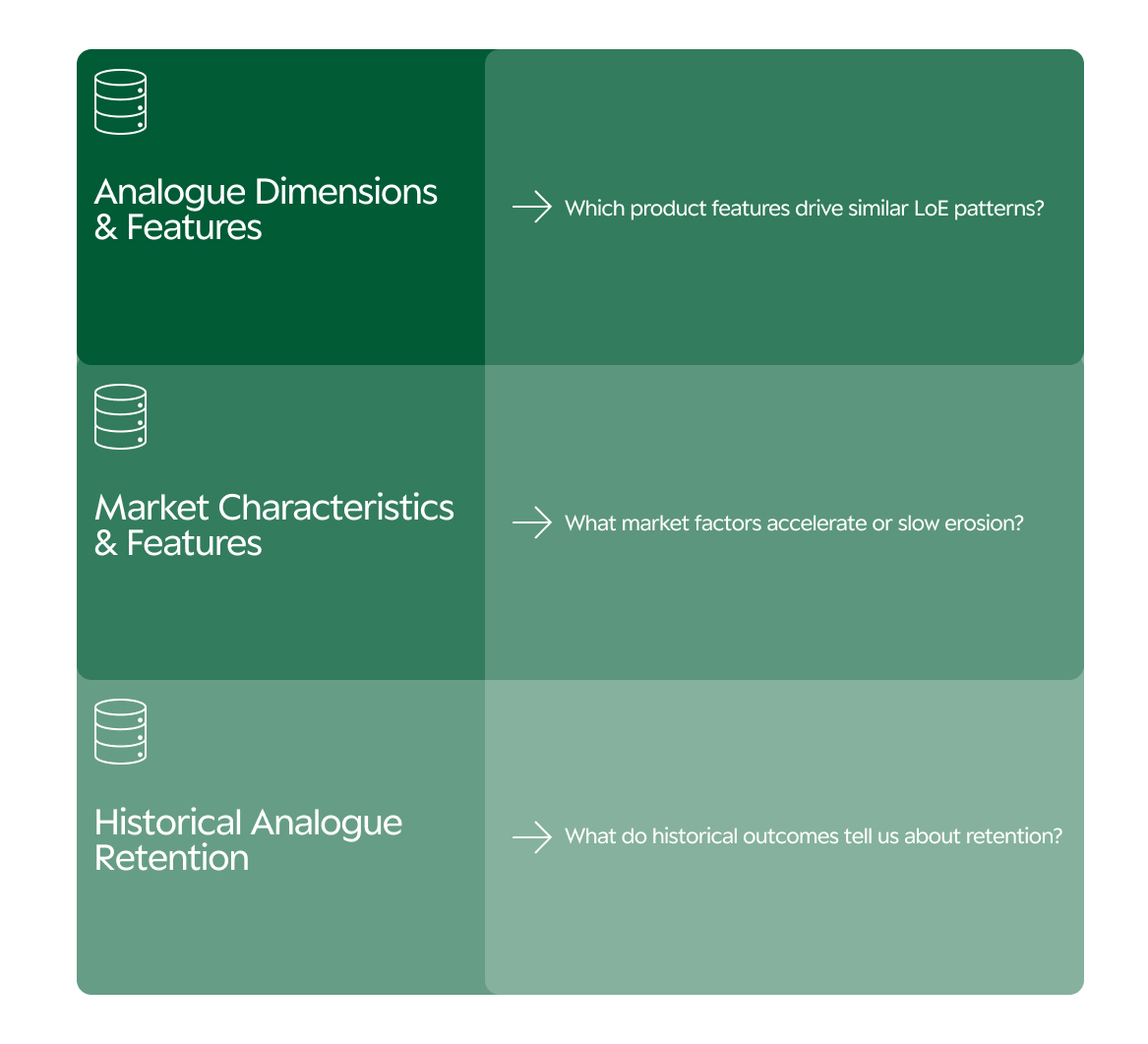
Using IQVIA MIDAS data, we constructed an analogue library covering hundreds of historical brand-country LoE events. For each analogue, we modelled 50+ product and market characteristics, grouped into three main categories:
- Clinical & product features (e.g. route of administration, molecule type, formulation complexity)
- Competitive & lifecycle features (e.g. time on market, pre-LoE market share, pioneer status)
- Country & market features (e.g. procurement centralization, substitution enforcement, pricing mechanisms)
These features were combined with observed post-LoE sales erosion patterns. The model runs thousands of simulations to learn which characteristics most strongly influence erosion behavior and how different feature combinations translate into distinct erosion trajectories. Based on this learning, the model generates a unique brand- and market-specific erosion curve for each target product-country combination. The approach captures non-linear effects, reduces subjective bias from manual analogue selection, and produces more accurate and explainable forecasts to drive better decision-making. Importantly, the model also provides feature-importance insights, allowing users to understand why a given erosion profile is predicted - not just what the prediction is. This enables teams to explore questions such as:
- Does longer exclusive time on market result in patient loyalty and translate into higher post-LoE retention?
- Are high-revenue brands more attractive targets for generic or biosimilar manufacturers and thus expected to erode faster?
- Do brands sold primarily through hospital channels face faster substitution and steeper erosion?
Using IQVIA MIDAS data, we constructed an analogue library covering hundreds of historical brand-country LoE events. For each analogue, we modelled 50+ product and market characteristics, grouped into three main categories:
- Clinical & product features (e.g. route of administration, molecule type, formulation complexity)
- Competitive & lifecycle features (e.g. time on market, pre-LoE market share, pioneer status)
- Country & market features (e.g. procurement centralization, substitution enforcement, pricing mechanisms)
These features were combined with observed post-LoE sales erosion patterns. The model runs thousands of simulations to learn which characteristics most strongly influence erosion behavior and how different feature combinations translate into distinct erosion trajectories. Based on this learning, the model generates a unique brand- and market-specific erosion curve for each target product-country combination. The approach captures non-linear effects, reduces subjective bias from manual analogue selection, and produces more accurate and explainable forecasts to drive better decision-making. Importantly, the model also provides feature-importance insights, allowing users to understand why a given erosion profile is predicted - not just what the prediction is. This enables teams to explore questions such as:
- Does longer exclusive time on market result in patient loyalty and translate into higher post-LoE retention?
- Are high-revenue brands more attractive targets for generic or biosimilar manufacturers and thus expected to erode faster?
- Do brands sold primarily through hospital channels face faster substitution and steeper erosion?
Using IQVIA MIDAS data, we constructed an analogue library covering hundreds of historical brand-country LoE events. For each analogue, we modelled 50+ product and market characteristics, grouped into three main categories:
- Clinical & product features (e.g. route of administration, molecule type, formulation complexity)
- Competitive & lifecycle features (e.g. time on market, pre-LoE market share, pioneer status)
- Country & market features (e.g. procurement centralization, substitution enforcement, pricing mechanisms)
These features were combined with observed post-LoE sales erosion patterns. The model runs thousands of simulations to learn which characteristics most strongly influence erosion behavior and how different feature combinations translate into distinct erosion trajectories. Based on this learning, the model generates a unique brand- and market-specific erosion curve for each target product-country combination. The approach captures non-linear effects, reduces subjective bias from manual analogue selection, and produces more accurate and explainable forecasts to drive better decision-making. Importantly, the model also provides feature-importance insights, allowing users to understand why a given erosion profile is predicted - not just what the prediction is. This enables teams to explore questions such as:
- Does longer exclusive time on market result in patient loyalty and translate into higher post-LoE retention?
- Are high-revenue brands more attractive targets for generic or biosimilar manufacturers and thus expected to erode faster?
- Do brands sold primarily through hospital channels face faster substitution and steeper erosion?
A scalable, drivers-based ML forecasting engine
Using IQVIA MIDAS data, we constructed an analogue library covering hundreds of historical brand-country LoE events. For each analogue, we modelled 50+ product and market characteristics, grouped into three main categories:
- Clinical & product features (e.g. route of administration, molecule type, formulation complexity)
- Competitive & lifecycle features (e.g. time on market, pre-LoE market share, pioneer status)
- Country & market features (e.g. procurement centralization, substitution enforcement, pricing mechanisms)
These features were combined with observed post-LoE sales erosion patterns. The model runs thousands of simulations to learn which characteristics most strongly influence erosion behavior and how different feature combinations translate into distinct erosion trajectories. Based on this learning, the model generates a unique brand- and market-specific erosion curve for each target product-country combination. The approach captures non-linear effects, reduces subjective bias from manual analogue selection, and produces more accurate and explainable forecasts to drive better decision-making. Importantly, the model also provides feature-importance insights, allowing users to understand why a given erosion profile is predicted - not just what the prediction is. This enables teams to explore questions such as:
- Does longer exclusive time on market result in patient loyalty and translate into higher post-LoE retention?
- Are high-revenue brands more attractive targets for generic or biosimilar manufacturers and thus expected to erode faster?
- Do brands sold primarily through hospital channels face faster substitution and steeper erosion?
A scalable, drivers-based ML forecasting engine
Using IQVIA MIDAS data, we constructed an analogue library covering hundreds of historical brand-country LoE events. For each analogue, we modelled 50+ product and market characteristics, grouped into three main categories:
- Clinical & product features (e.g. route of administration, molecule type, formulation complexity)
- Competitive & lifecycle features (e.g. time on market, pre-LoE market share, pioneer status)
- Country & market features (e.g. procurement centralization, substitution enforcement, pricing mechanisms)
These features were combined with observed post-LoE sales erosion patterns. The model runs thousands of simulations to learn which characteristics most strongly influence erosion behavior and how different feature combinations translate into distinct erosion trajectories. Based on this learning, the model generates a unique brand- and market-specific erosion curve for each target product-country combination. The approach captures non-linear effects, reduces subjective bias from manual analogue selection, and produces more accurate and explainable forecasts to drive better decision-making. Importantly, the model also provides feature-importance insights, allowing users to understand why a given erosion profile is predicted - not just what the prediction is. This enables teams to explore questions such as:
- Does longer exclusive time on market result in patient loyalty and translate into higher post-LoE retention?
- Are high-revenue brands more attractive targets for generic or biosimilar manufacturers and thus expected to erode faster?
- Do brands sold primarily through hospital channels face faster substitution and steeper erosion?
A scalable, drivers-based ML forecasting engine
The solution enables pharma organizations to anticipate LoE erosion faster, at lower cost, and with greater accuracy, allowing teams to focus on the strategic decisions that matter most around LoE. Phase 1 delivered a scalable forecasting capability and operating model that significantly outperformed traditional approaches. Compared to manual analogue-based forecasting, the model demonstrated:
- Materially improved predictive accuracy across initial pilot markets (90+% avg. accuracy)
- Learning from 900+ historical analogues, providing far broader empirical grounding than traditional methods
- Systematic incorporation of product and market drivers, reducing subjectivity and forecast variability
Beyond accuracy, the approach delivers several strategic and operational advantages:
- Reduced reliance on costly, one-off external analyses
- Shorter lead times and lower manual effort per forecast
- Full internal ownership with the ability to continuously improve the model
- Transparency into key erosion drivers, supporting stronger cross-functional alignment
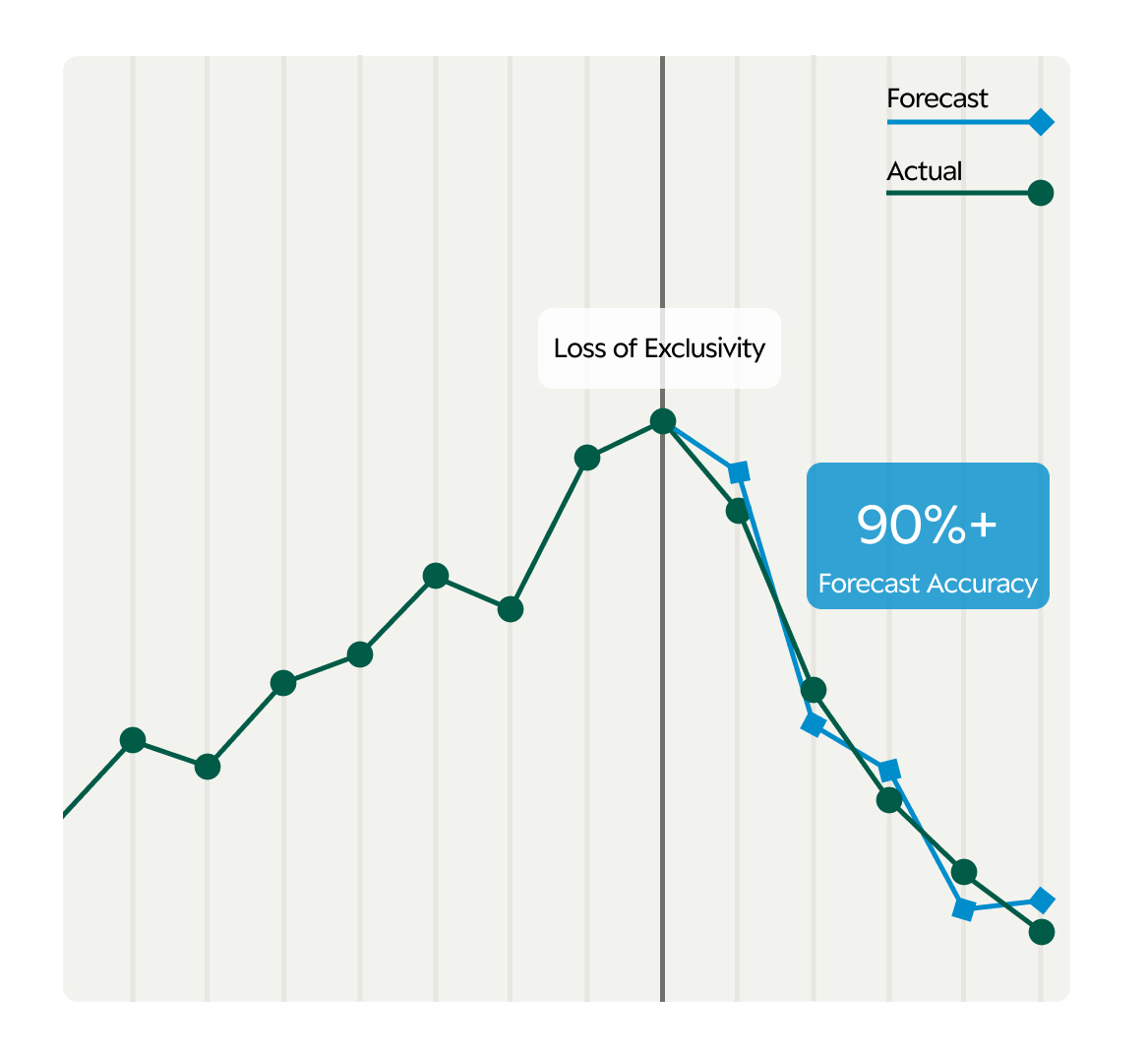
The solution enables pharma organizations to anticipate LoE erosion faster, at lower cost, and with greater accuracy, allowing teams to focus on the strategic decisions that matter most around LoE. Phase 1 delivered a scalable forecasting capability and operating model that significantly outperformed traditional approaches. Compared to manual analogue-based forecasting, the model demonstrated:
- Materially improved predictive accuracy across initial pilot markets (90+% avg. accuracy)
- Learning from 900+ historical analogues, providing far broader empirical grounding than traditional methods
- Systematic incorporation of product and market drivers, reducing subjectivity and forecast variability
Beyond accuracy, the approach delivers several strategic and operational advantages:
- Reduced reliance on costly, one-off external analyses
- Shorter lead times and lower manual effort per forecast
- Full internal ownership with the ability to continuously improve the model
- Transparency into key erosion drivers, supporting stronger cross-functional alignment
The solution enables pharma organizations to anticipate LoE erosion faster, at lower cost, and with greater accuracy, allowing teams to focus on the strategic decisions that matter most around LoE. Phase 1 delivered a scalable forecasting capability and operating model that significantly outperformed traditional approaches. Compared to manual analogue-based forecasting, the model demonstrated:
- Materially improved predictive accuracy across initial pilot markets (90+% avg. accuracy)
- Learning from 900+ historical analogues, providing far broader empirical grounding than traditional methods
- Systematic incorporation of product and market drivers, reducing subjectivity and forecast variability
Beyond accuracy, the approach delivers several strategic and operational advantages:
- Reduced reliance on costly, one-off external analyses
- Shorter lead times and lower manual effort per forecast
- Full internal ownership with the ability to continuously improve the model
- Transparency into key erosion drivers, supporting stronger cross-functional alignment
A new strategic forecasting capability
The solution enables pharma organizations to anticipate LoE erosion faster, at lower cost, and with greater accuracy, allowing teams to focus on the strategic decisions that matter most around LoE. Phase 1 delivered a scalable forecasting capability and operating model that significantly outperformed traditional approaches. Compared to manual analogue-based forecasting, the model demonstrated:
- Materially improved predictive accuracy across initial pilot markets (90+% avg. accuracy)
- Learning from 900+ historical analogues, providing far broader empirical grounding than traditional methods
- Systematic incorporation of product and market drivers, reducing subjectivity and forecast variability
Beyond accuracy, the approach delivers several strategic and operational advantages:
- Reduced reliance on costly, one-off external analyses
- Shorter lead times and lower manual effort per forecast
- Full internal ownership with the ability to continuously improve the model
- Transparency into key erosion drivers, supporting stronger cross-functional alignment
A new strategic forecasting capability
The solution enables pharma organizations to anticipate LoE erosion faster, at lower cost, and with greater accuracy, allowing teams to focus on the strategic decisions that matter most around LoE. Phase 1 delivered a scalable forecasting capability and operating model that significantly outperformed traditional approaches. Compared to manual analogue-based forecasting, the model demonstrated:
- Materially improved predictive accuracy across initial pilot markets (90+% avg. accuracy)
- Learning from 900+ historical analogues, providing far broader empirical grounding than traditional methods
- Systematic incorporation of product and market drivers, reducing subjectivity and forecast variability
Beyond accuracy, the approach delivers several strategic and operational advantages:
- Reduced reliance on costly, one-off external analyses
- Shorter lead times and lower manual effort per forecast
- Full internal ownership with the ability to continuously improve the model
- Transparency into key erosion drivers, supporting stronger cross-functional alignment
A new strategic forecasting capability
In practice, the solution supports multiple stakeholders looking to answer different key business questions:
Finance Leaders: How much LoE downside risk are we carrying, and when does it materialize?
Portfolio & Lifecycle Strategy Teams: Which assets are worth defending post-LoE, and which should be deprioritized?
Commercial Leaders managing late-lifecycle assets: Where and how much should we continue to invest in sales and marketing?
Data & Analytics Leaders: How can we move beyond traditional forecasting approaches towards scalable and explainable ML-driven models?
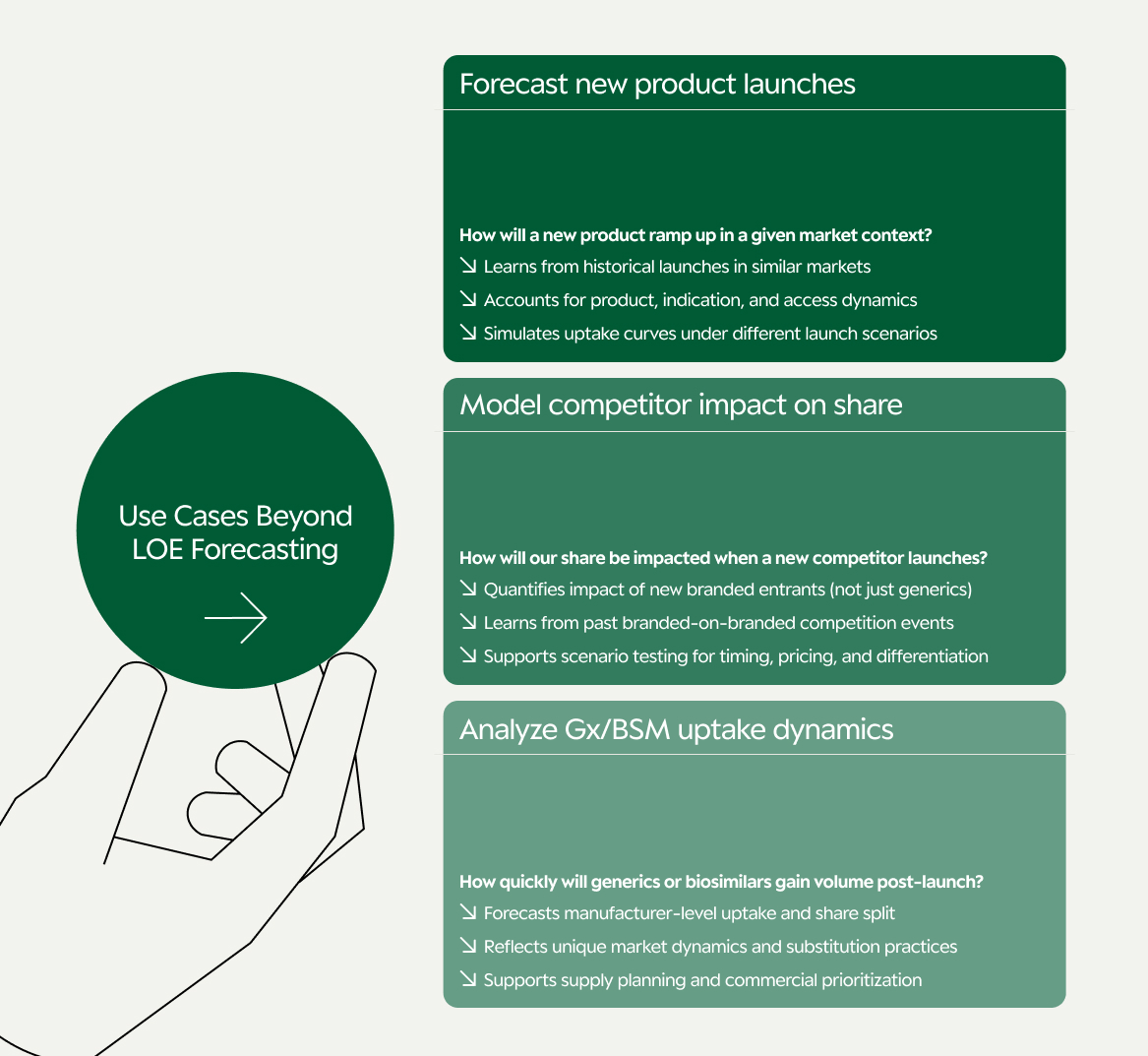
In practice, the solution supports multiple stakeholders looking to answer different key business questions:
Finance Leaders: How much LoE downside risk are we carrying, and when does it materialize?
Portfolio & Lifecycle Strategy Teams: Which assets are worth defending post-LoE, and which should be deprioritized?
Commercial Leaders managing late-lifecycle assets: Where and how much should we continue to invest in sales and marketing?
Data & Analytics Leaders: How can we move beyond traditional forecasting approaches towards scalable and explainable ML-driven models?
In practice, the solution supports multiple stakeholders looking to answer different key business questions:
Finance Leaders: How much LoE downside risk are we carrying, and when does it materialize?
Portfolio & Lifecycle Strategy Teams: Which assets are worth defending post-LoE, and which should be deprioritized?
Commercial Leaders managing late-lifecycle assets: Where and how much should we continue to invest in sales and marketing?
Data & Analytics Leaders: How can we move beyond traditional forecasting approaches towards scalable and explainable ML-driven models?
Who is it relevant for?
In practice, the solution supports multiple stakeholders looking to answer different key business questions:
Finance Leaders: How much LoE downside risk are we carrying, and when does it materialize?
Portfolio & Lifecycle Strategy Teams: Which assets are worth defending post-LoE, and which should be deprioritized?
Commercial Leaders managing late-lifecycle assets: Where and how much should we continue to invest in sales and marketing?
Data & Analytics Leaders: How can we move beyond traditional forecasting approaches towards scalable and explainable ML-driven models?
Who is it relevant for?
In practice, the solution supports multiple stakeholders looking to answer different key business questions:
Finance Leaders: How much LoE downside risk are we carrying, and when does it materialize?
Portfolio & Lifecycle Strategy Teams: Which assets are worth defending post-LoE, and which should be deprioritized?
Commercial Leaders managing late-lifecycle assets: Where and how much should we continue to invest in sales and marketing?
Data & Analytics Leaders: How can we move beyond traditional forecasting approaches towards scalable and explainable ML-driven models?
Who is it relevant for?
What we learned
A repeatable & highly automated forecasting approach reduces manual effort, lowers cost, and shortens planning cycles
Moving beyond a small, manually selected set of analogues unlocks richer data for better LoE forecasts
Explainable models help teams move away from outsourced, black-box forecasts and align faster
A drivers-based ML approach can materially outperform traditional methods – increasingly critical as LoE pressure peaks
Facing the patent cliff or forecasting uncertainty? Let’s talk.
Whether you’re preparing for loss of exclusivity, launching new products, or navigating intensifying competition, our team has deep experience building scalable, drivers-based ML forecasting capabilities. We’re happy to discuss how a similar approach could support your commercial and financial decisions.




Explore more cases
Medical Insights GPT
Explore how we helped a global pharma company transform their qualitative CRM insights into more strategic customer engagement

Unified HCP Engagement
Learn how we built a shared engagement roadmap that broke down silos and created a foundation for scalable, personalized HCP experiences.
Smarter pricing through AI
Explore how we created a data-driven advantage in a dynamic pricing market
Heading 1
Heading 2
Heading 3
Heading 4
Heading 5
Heading 6
Lorem ipsum dolor sit amet, consectetur adipiscing elit, sed do eiusmod tempor incididunt ut labore et dolore magna aliqua. Ut enim ad minim veniam, quis nostrud exercitation ullamco laboris nisi ut aliquip ex ea commodo consequat. Duis aute irure dolor in reprehenderit in voluptate velit esse cillum dolore eu fugiat nulla pariatur.
Block quote
Ordered list
- Item 1
- Item 2
- Item 3
Unordered list
- Item A
- Item B
- Item C
Bold text
Emphasis
Superscript
Subscript
Heading 1
Heading 2
Heading 3
Heading 4
Heading 5
Heading 6
Lorem ipsum dolor sit amet, consectetur adipiscing elit, sed do eiusmod tempor incididunt ut labore et dolore magna aliqua. Ut enim ad minim veniam, quis nostrud exercitation ullamco laboris nisi ut aliquip ex ea commodo consequat. Duis aute irure dolor in reprehenderit in voluptate velit esse cillum dolore eu fugiat nulla pariatur.
Block quote
Ordered list
- Item 1
- Item 2
- Item 3
Unordered list
- Item A
- Item B
- Item C
Bold text
Emphasis
Superscript
Subscript
Heading 1
Heading 2
Heading 3
Heading 4
Heading 5
Heading 6
Lorem ipsum dolor sit amet, consectetur adipiscing elit, sed do eiusmod tempor incididunt ut labore et dolore magna aliqua. Ut enim ad minim veniam, quis nostrud exercitation ullamco laboris nisi ut aliquip ex ea commodo consequat. Duis aute irure dolor in reprehenderit in voluptate velit esse cillum dolore eu fugiat nulla pariatur.
Block quote
Ordered list
- Item 1
- Item 2
- Item 3
Unordered list
- Item A
- Item B
- Item C
Bold text
Emphasis
Superscript
Subscript
Heading
Heading 1
Heading 2
Heading 3
Heading 4
Heading 5
Heading 6
Lorem ipsum dolor sit amet, consectetur adipiscing elit, sed do eiusmod tempor incididunt ut labore et dolore magna aliqua. Ut enim ad minim veniam, quis nostrud exercitation ullamco laboris nisi ut aliquip ex ea commodo consequat. Duis aute irure dolor in reprehenderit in voluptate velit esse cillum dolore eu fugiat nulla pariatur.
Block quote
Ordered list
- Item 1
- Item 2
- Item 3
Unordered list
- Item A
- Item B
- Item C
Bold text
Emphasis
Superscript
Subscript
Heading
Heading 1
Heading 2
Heading 3
Heading 4
Heading 5
Heading 6
Lorem ipsum dolor sit amet, consectetur adipiscing elit, sed do eiusmod tempor incididunt ut labore et dolore magna aliqua. Ut enim ad minim veniam, quis nostrud exercitation ullamco laboris nisi ut aliquip ex ea commodo consequat. Duis aute irure dolor in reprehenderit in voluptate velit esse cillum dolore eu fugiat nulla pariatur.
Block quote
Ordered list
- Item 1
- Item 2
- Item 3
Unordered list
- Item A
- Item B
- Item C
Bold text
Emphasis
Superscript
Subscript