
Unlocking Medical Insights for Commercial, Compliantly, with AI
How we helped a global pharma company unlock thousands of medical insights for Commercial, compliantly, with an AI Reviewer validated against the compliance experts' own ground truth.

Unlocking Medical Insights for Commercial, Compliantly, with AI
How we helped a global pharma company unlock thousands of medical insights for Commercial, compliantly, with an AI Reviewer validated against the compliance experts' own ground truth.
In every HCP interaction, medical science liaisons (MSLs) capture qualitative insight, from the concerns HCPs raise about treatment in practice, to why patients switch or stop therapy, to where access stalls. That intelligence is exactly the context Commercial lacks when engaging the very same HCPs, so both teams end up working from partial pictures of the same doctor.
The challenge for our client was that the medical insights were sitting in the CRM, with no compliant way to share them with Commercial teams. Some content is fine to share; some absolutely isn't. And doing that review by hand, insight by insight, was far too slow and costly to do at scale. So the insights stayed where they were, and every rep interaction was less informed than it could have been.
The client needed a way to make these insights compliantly shareable at scale: fast, consistent, auditable, and trusted by the people who own the compliance criteria.
In every HCP interaction, medical science liaisons (MSLs) capture qualitative insight, from the concerns HCPs raise about treatment in practice, to why patients switch or stop therapy, to where access stalls. That intelligence is exactly the context Commercial lacks when engaging the very same HCPs, so both teams end up working from partial pictures of the same doctor.
The challenge for our client was that the medical insights were sitting in the CRM, with no compliant way to share them with Commercial teams. Some content is fine to share; some absolutely isn't. And doing that review by hand, insight by insight, was far too slow and costly to do at scale. So the insights stayed where they were, and every rep interaction was less informed than it could have been.
The client needed a way to make these insights compliantly shareable at scale: fast, consistent, auditable, and trusted by the people who own the compliance criteria.
In every HCP interaction, medical science liaisons (MSLs) capture qualitative insight, from the concerns HCPs raise about treatment in practice, to why patients switch or stop therapy, to where access stalls. That intelligence is exactly the context Commercial lacks when engaging the very same HCPs, so both teams end up working from partial pictures of the same doctor.
The challenge for our client was that the medical insights were sitting in the CRM, with no compliant way to share them with Commercial teams. Some content is fine to share; some absolutely isn't. And doing that review by hand, insight by insight, was far too slow and costly to do at scale. So the insights stayed where they were, and every rep interaction was less informed than it could have been.
The client needed a way to make these insights compliantly shareable at scale: fast, consistent, auditable, and trusted by the people who own the compliance criteria.
Can medical insights reach Commercial compliantly?
In every HCP interaction, medical science liaisons (MSLs) capture qualitative insight, from the concerns HCPs raise about treatment in practice, to why patients switch or stop therapy, to where access stalls. That intelligence is exactly the context Commercial lacks when engaging the very same HCPs, so both teams end up working from partial pictures of the same doctor.
The challenge for our client was that the medical insights were sitting in the CRM, with no compliant way to share them with Commercial teams. Some content is fine to share; some absolutely isn't. And doing that review by hand, insight by insight, was far too slow and costly to do at scale. So the insights stayed where they were, and every rep interaction was less informed than it could have been.
The client needed a way to make these insights compliantly shareable at scale: fast, consistent, auditable, and trusted by the people who own the compliance criteria.
Can medical insights reach Commercial compliantly?
In every HCP interaction, medical science liaisons (MSLs) capture qualitative insight, from the concerns HCPs raise about treatment in practice, to why patients switch or stop therapy, to where access stalls. That intelligence is exactly the context Commercial lacks when engaging the very same HCPs, so both teams end up working from partial pictures of the same doctor.
The challenge for our client was that the medical insights were sitting in the CRM, with no compliant way to share them with Commercial teams. Some content is fine to share; some absolutely isn't. And doing that review by hand, insight by insight, was far too slow and costly to do at scale. So the insights stayed where they were, and every rep interaction was less informed than it could have been.
The client needed a way to make these insights compliantly shareable at scale: fast, consistent, auditable, and trusted by the people who own the compliance criteria.
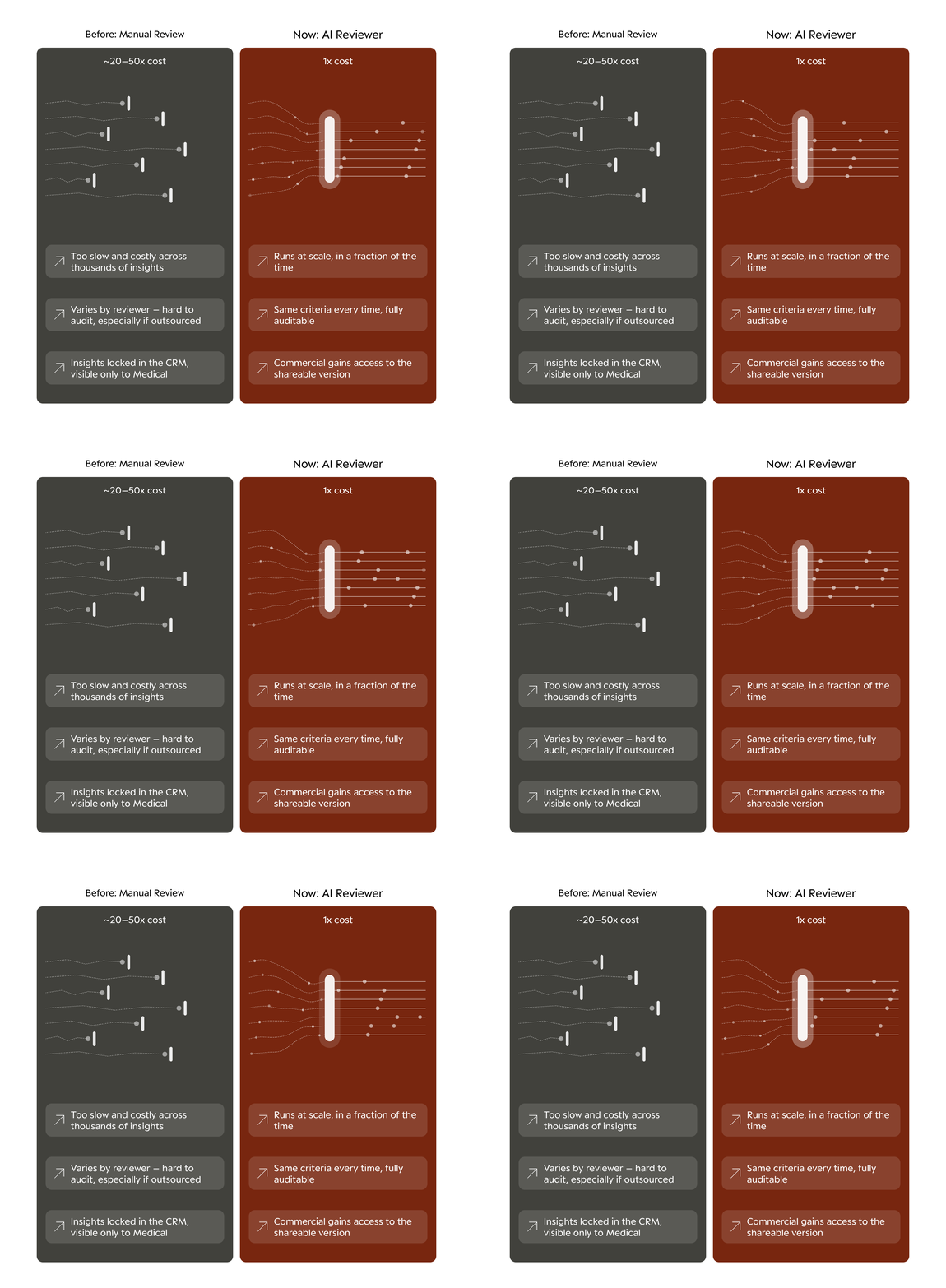
Manual compliance review couldn't scale, and a simple keyword filter couldn't be trusted with a process this nuanced. The strategic shift was to build an AI Reviewer, an agentic solution that reads each insight the way a compliance expert would.
Working closely with the client's Compliance and Legal leadership, we set out to:
1. Encode the compliance rules the experts actually use, plus their judgment for applying them to the gray areas.
2. Build an agent that judges each insight sentence by sentence, with a grounded, plain-English rationale.
3. Deliver the shareable version into the HCP profile reps already use, through existing access controls, with every decision in an audit trail.
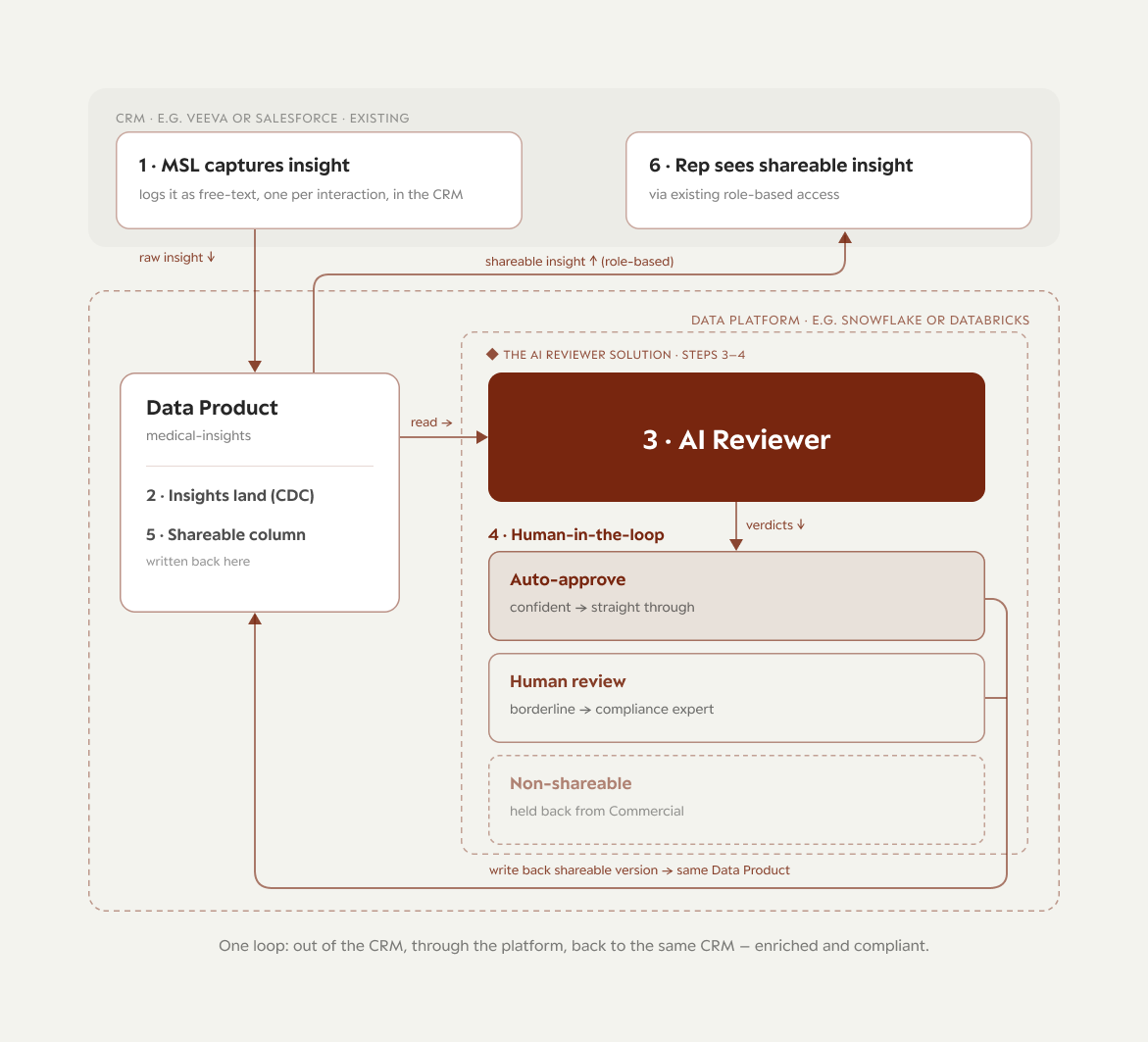
As a result, we built an AI Reviewer that automatically labels which insights are compliantly shareable – validated by the client's Compliance and Legal teams. This was designed to run at the individual HCP level (N=1), feeding each insight compliantly into the HCP's C360 profile.
Manual compliance review couldn't scale, and a simple keyword filter couldn't be trusted with a process this nuanced. The strategic shift was to build an AI Reviewer, an agentic solution that reads each insight the way a compliance expert would.
Working closely with the client's Compliance and Legal leadership, we set out to:
1. Encode the compliance rules the experts actually use, plus their judgment for applying them to the gray areas.
2. Build an agent that judges each insight sentence by sentence, with a grounded, plain-English rationale.
3. Deliver the shareable version into the HCP profile reps already use, through existing access controls, with every decision in an audit trail.
As a result, we built an AI Reviewer that automatically labels which insights are compliantly shareable – validated by the client's Compliance and Legal teams. This was designed to run at the individual HCP level (N=1), feeding each insight compliantly into the HCP's C360 profile.
Manual compliance review couldn't scale, and a simple keyword filter couldn't be trusted with a process this nuanced. The strategic shift was to build an AI Reviewer, an agentic solution that reads each insight the way a compliance expert would.
Working closely with the client's Compliance and Legal leadership, we set out to:
1. Encode the compliance rules the experts actually use, plus their judgment for applying them to the gray areas.
2. Build an agent that judges each insight sentence by sentence, with a grounded, plain-English rationale.
3. Deliver the shareable version into the HCP profile reps already use, through existing access controls, with every decision in an audit trail.
As a result, we built an AI Reviewer that automatically labels which insights are compliantly shareable – validated by the client's Compliance and Legal teams. This was designed to run at the individual HCP level (N=1), feeding each insight compliantly into the HCP's C360 profile.
From manual burden to an AI Reviewer
Manual compliance review couldn't scale, and a simple keyword filter couldn't be trusted with a process this nuanced. The strategic shift was to build an AI Reviewer, an agentic solution that reads each insight the way a compliance expert would.
Working closely with the client's Compliance and Legal leadership, we set out to:
1. Encode the compliance rules the experts actually use, plus their judgment for applying them to the gray areas.
2. Build an agent that judges each insight sentence by sentence, with a grounded, plain-English rationale.
3. Deliver the shareable version into the HCP profile reps already use, through existing access controls, with every decision in an audit trail.
As a result, we built an AI Reviewer that automatically labels which insights are compliantly shareable – validated by the client's Compliance and Legal teams. This was designed to run at the individual HCP level (N=1), feeding each insight compliantly into the HCP's C360 profile.
From manual burden to an AI Reviewer
Manual compliance review couldn't scale, and a simple keyword filter couldn't be trusted with a process this nuanced. The strategic shift was to build an AI Reviewer, an agentic solution that reads each insight the way a compliance expert would.
Working closely with the client's Compliance and Legal leadership, we set out to:
1. Encode the compliance rules the experts actually use, plus their judgment for applying them to the gray areas.
2. Build an agent that judges each insight sentence by sentence, with a grounded, plain-English rationale.
3. Deliver the shareable version into the HCP profile reps already use, through existing access controls, with every decision in an audit trail.
As a result, we built an AI Reviewer that automatically labels which insights are compliantly shareable – validated by the client's Compliance and Legal teams. This was designed to run at the individual HCP level (N=1), feeding each insight compliantly into the HCP's C360 profile.
The case in numbers
of insight content cleared as compliantly shareable. Most of what MSLs capture can be shared with Commercial. That's what makes the review worth doing.
agreement with expert ground truth. Measured against the experts' own decisions; where the AI Reviewer differed, it erred safely toward holding back.
lower running cost per insight. This changes the economics of compliance review: thousands of insights become viable to review.
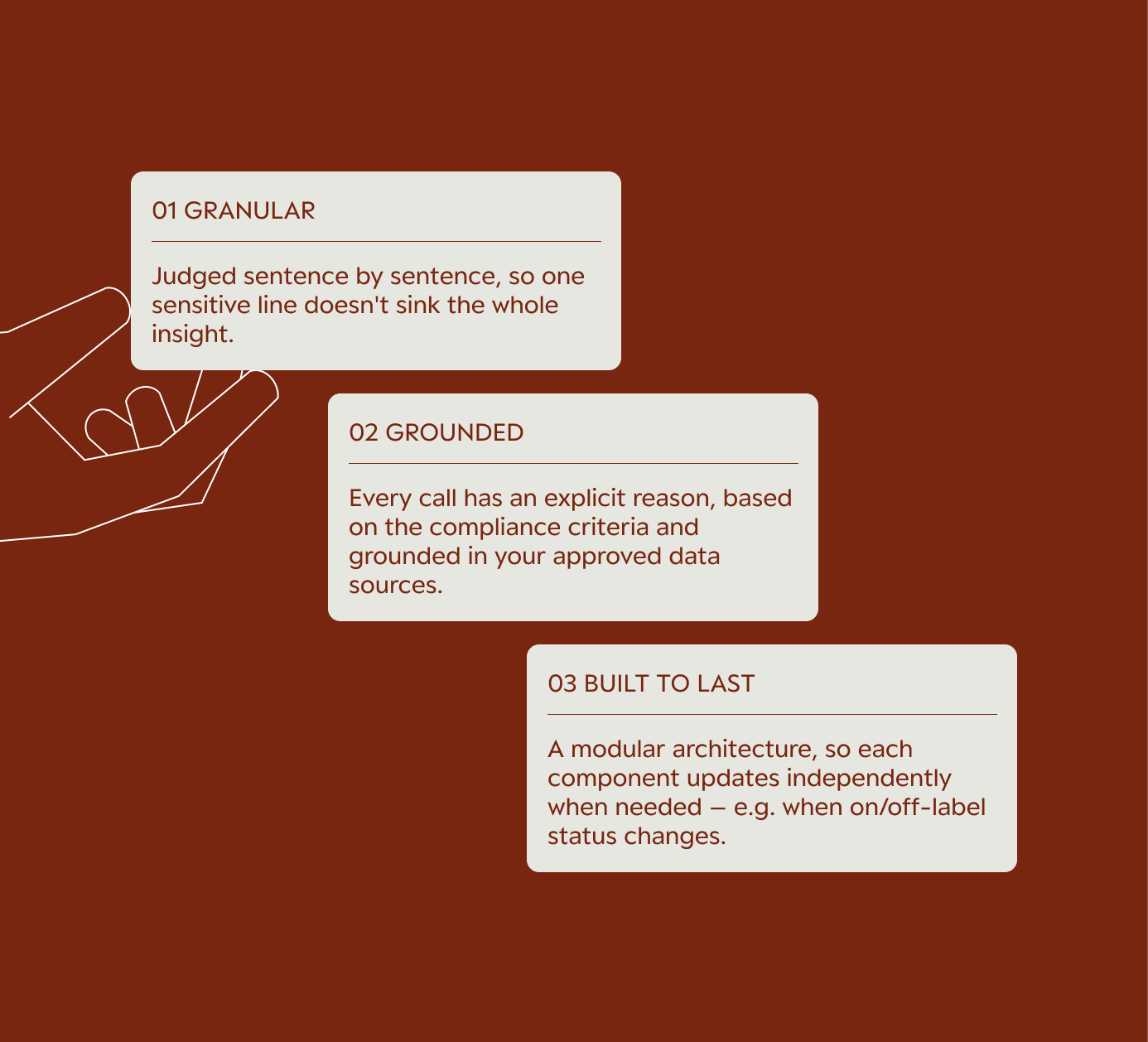
At its core, the AI Reviewer works the way a careful compliance reviewer would: it reads the whole insight for context, then decides sentence by sentence what can be shared. Nothing is rewritten or paraphrased; the original wording is preserved, and only the sentences that clear the rule set reach the rep.
1. Sentence-level classification
Each sentence is judged on its own, with a confidence score and a plain-English rationale. That finer unit of decision is what lets the shareable sentences through when one sentence is sensitive.
2. The rule set, as a skill
The approved multi-category rule set, loaded verbatim, plus encoded expert judgment: worked examples and carve-outs for the gray areas. When the rules change, the skill updates; the version is stamped on every decision.
3. Grounded tools
The agent grounds its calls with dedicated tools: product facts by market, a library of previously adjudicated hard cases, and a validating write-back, rather than relying on the model's memory.
A human stays in the loop where it matters. Most insights clear automatically; a compliance expert steps in only for the genuine judgment calls, based on the AI Reviewer's confidence. Every expert decision becomes ground truth – but the set is deliberately split in two: a case library the AI Reviewer can retrieve from at decision time, and a held-out evaluation set it never sees, used only to score its accuracy. This separation prevents leakage: the AI Reviewer is never measured on the same cases it learns from, so the ~95% reflects real performance, not memorization. As the experts adjudicate more, both pools grow and the system improves.
At its core, the AI Reviewer works the way a careful compliance reviewer would: it reads the whole insight for context, then decides sentence by sentence what can be shared. Nothing is rewritten or paraphrased; the original wording is preserved, and only the sentences that clear the rule set reach the rep.
1. Sentence-level classification
Each sentence is judged on its own, with a confidence score and a plain-English rationale. That finer unit of decision is what lets the shareable sentences through when one sentence is sensitive.
2. The rule set, as a skill
The approved multi-category rule set, loaded verbatim, plus encoded expert judgment: worked examples and carve-outs for the gray areas. When the rules change, the skill updates; the version is stamped on every decision.
3. Grounded tools
The agent grounds its calls with dedicated tools: product facts by market, a library of previously adjudicated hard cases, and a validating write-back, rather than relying on the model's memory.
A human stays in the loop where it matters. Most insights clear automatically; a compliance expert steps in only for the genuine judgment calls, based on the AI Reviewer's confidence. Every expert decision becomes ground truth – but the set is deliberately split in two: a case library the AI Reviewer can retrieve from at decision time, and a held-out evaluation set it never sees, used only to score its accuracy. This separation prevents leakage: the AI Reviewer is never measured on the same cases it learns from, so the ~95% reflects real performance, not memorization. As the experts adjudicate more, both pools grow and the system improves.
At its core, the AI Reviewer works the way a careful compliance reviewer would: it reads the whole insight for context, then decides sentence by sentence what can be shared. Nothing is rewritten or paraphrased; the original wording is preserved, and only the sentences that clear the rule set reach the rep.
1. Sentence-level classification
Each sentence is judged on its own, with a confidence score and a plain-English rationale. That finer unit of decision is what lets the shareable sentences through when one sentence is sensitive.
2. The rule set, as a skill
The approved multi-category rule set, loaded verbatim, plus encoded expert judgment: worked examples and carve-outs for the gray areas. When the rules change, the skill updates; the version is stamped on every decision.
3. Grounded tools
The agent grounds its calls with dedicated tools: product facts by market, a library of previously adjudicated hard cases, and a validating write-back, rather than relying on the model's memory.
A human stays in the loop where it matters. Most insights clear automatically; a compliance expert steps in only for the genuine judgment calls, based on the AI Reviewer's confidence. Every expert decision becomes ground truth – but the set is deliberately split in two: a case library the AI Reviewer can retrieve from at decision time, and a held-out evaluation set it never sees, used only to score its accuracy. This separation prevents leakage: the AI Reviewer is never measured on the same cases it learns from, so the ~95% reflects real performance, not memorization. As the experts adjudicate more, both pools grow and the system improves.
An agentic AI Reviewer, grounded and auditable
At its core, the AI Reviewer works the way a careful compliance reviewer would: it reads the whole insight for context, then decides sentence by sentence what can be shared. Nothing is rewritten or paraphrased; the original wording is preserved, and only the sentences that clear the rule set reach the rep.
1. Sentence-level classification
Each sentence is judged on its own, with a confidence score and a plain-English rationale. That finer unit of decision is what lets the shareable sentences through when one sentence is sensitive.
2. The rule set, as a skill
The approved multi-category rule set, loaded verbatim, plus encoded expert judgment: worked examples and carve-outs for the gray areas. When the rules change, the skill updates; the version is stamped on every decision.
3. Grounded tools
The agent grounds its calls with dedicated tools: product facts by market, a library of previously adjudicated hard cases, and a validating write-back, rather than relying on the model's memory.
A human stays in the loop where it matters. Most insights clear automatically; a compliance expert steps in only for the genuine judgment calls, based on the AI Reviewer's confidence. Every expert decision becomes ground truth – but the set is deliberately split in two: a case library the AI Reviewer can retrieve from at decision time, and a held-out evaluation set it never sees, used only to score its accuracy. This separation prevents leakage: the AI Reviewer is never measured on the same cases it learns from, so the ~95% reflects real performance, not memorization. As the experts adjudicate more, both pools grow and the system improves.
An agentic AI Reviewer, grounded and auditable
At its core, the AI Reviewer works the way a careful compliance reviewer would: it reads the whole insight for context, then decides sentence by sentence what can be shared. Nothing is rewritten or paraphrased; the original wording is preserved, and only the sentences that clear the rule set reach the rep.
1. Sentence-level classification
Each sentence is judged on its own, with a confidence score and a plain-English rationale. That finer unit of decision is what lets the shareable sentences through when one sentence is sensitive.
2. The rule set, as a skill
The approved multi-category rule set, loaded verbatim, plus encoded expert judgment: worked examples and carve-outs for the gray areas. When the rules change, the skill updates; the version is stamped on every decision.
3. Grounded tools
The agent grounds its calls with dedicated tools: product facts by market, a library of previously adjudicated hard cases, and a validating write-back, rather than relying on the model's memory.
A human stays in the loop where it matters. Most insights clear automatically; a compliance expert steps in only for the genuine judgment calls, based on the AI Reviewer's confidence. Every expert decision becomes ground truth – but the set is deliberately split in two: a case library the AI Reviewer can retrieve from at decision time, and a held-out evaluation set it never sees, used only to score its accuracy. This separation prevents leakage: the AI Reviewer is never measured on the same cases it learns from, so the ~95% reflects real performance, not memorization. As the experts adjudicate more, both pools grow and the system improves.
An agentic AI Reviewer, grounded and auditable
The proof of concept (PoC) did two things: it showed the value is real, and it showed an AI Reviewer can unlock it safely. Against the human baseline captured in the expert UAT, the solution demonstrated:
• The majority of insight content (>80%) cleared as compliantly shareable, enough to make the whole exercise worthwhile.
• ~95% agreement with the compliance experts' own decisions, and and where the AI Reviewer differed, it erred toward holding content back rather than oversharing.
• Feasibility and value proven in a 5-week PoC, validated by the people who own the criteria.
Orders of magnitude cheaper and more efficient, and that's what makes it viable
Automated review runs at a small fraction of manual cost (up to 50× lower per insight). That collapse is what makes review at scale viable. At near-zero marginal cost, thousands of previously unavailable insights reach the reps, and every HCP interaction is better informed. The value was always there; the cost was the only thing keeping it out of reach.
Beyond the numbers, the client gained a capability that is auditable (every decision reconstructible, stamped with the rule and model version in use), trusted (validated against expert ground truth, beyond plausible-sounding output), and compounding (expert corrections continuously feed the system).

The proof of concept (PoC) did two things: it showed the value is real, and it showed an AI Reviewer can unlock it safely. Against the human baseline captured in the expert UAT, the solution demonstrated:
• The majority of insight content (>80%) cleared as compliantly shareable, enough to make the whole exercise worthwhile.
• ~95% agreement with the compliance experts' own decisions, and and where the AI Reviewer differed, it erred toward holding content back rather than oversharing.
• Feasibility and value proven in a 5-week PoC, validated by the people who own the criteria.
Orders of magnitude cheaper and more efficient, and that's what makes it viable
Automated review runs at a small fraction of manual cost (up to 50× lower per insight). That collapse is what makes review at scale viable. At near-zero marginal cost, thousands of previously unavailable insights reach the reps, and every HCP interaction is better informed. The value was always there; the cost was the only thing keeping it out of reach.
Beyond the numbers, the client gained a capability that is auditable (every decision reconstructible, stamped with the rule and model version in use), trusted (validated against expert ground truth, beyond plausible-sounding output), and compounding (expert corrections continuously feed the system).
The proof of concept (PoC) did two things: it showed the value is real, and it showed an AI Reviewer can unlock it safely. Against the human baseline captured in the expert UAT, the solution demonstrated:
• The majority of insight content (>80%) cleared as compliantly shareable, enough to make the whole exercise worthwhile.
• ~95% agreement with the compliance experts' own decisions, and and where the AI Reviewer differed, it erred toward holding content back rather than oversharing.
• Feasibility and value proven in a 5-week PoC, validated by the people who own the criteria.
Orders of magnitude cheaper and more efficient, and that's what makes it viable
Automated review runs at a small fraction of manual cost (up to 50× lower per insight). That collapse is what makes review at scale viable. At near-zero marginal cost, thousands of previously unavailable insights reach the reps, and every HCP interaction is better informed. The value was always there; the cost was the only thing keeping it out of reach.
Beyond the numbers, the client gained a capability that is auditable (every decision reconstructible, stamped with the rule and model version in use), trusted (validated against expert ground truth, beyond plausible-sounding output), and compounding (expert corrections continuously feed the system).
Insights unlocked, operations that scale
The proof of concept (PoC) did two things: it showed the value is real, and it showed an AI Reviewer can unlock it safely. Against the human baseline captured in the expert UAT, the solution demonstrated:
• The majority of insight content (>80%) cleared as compliantly shareable, enough to make the whole exercise worthwhile.
• ~95% agreement with the compliance experts' own decisions, and and where the AI Reviewer differed, it erred toward holding content back rather than oversharing.
• Feasibility and value proven in a 5-week PoC, validated by the people who own the criteria.
Orders of magnitude cheaper and more efficient, and that's what makes it viable
Automated review runs at a small fraction of manual cost (up to 50× lower per insight). That collapse is what makes review at scale viable. At near-zero marginal cost, thousands of previously unavailable insights reach the reps, and every HCP interaction is better informed. The value was always there; the cost was the only thing keeping it out of reach.
Beyond the numbers, the client gained a capability that is auditable (every decision reconstructible, stamped with the rule and model version in use), trusted (validated against expert ground truth, beyond plausible-sounding output), and compounding (expert corrections continuously feed the system).
Insights unlocked, operations that scale
The proof of concept (PoC) did two things: it showed the value is real, and it showed an AI Reviewer can unlock it safely. Against the human baseline captured in the expert UAT, the solution demonstrated:
• The majority of insight content (>80%) cleared as compliantly shareable, enough to make the whole exercise worthwhile.
• ~95% agreement with the compliance experts' own decisions, and and where the AI Reviewer differed, it erred toward holding content back rather than oversharing.
• Feasibility and value proven in a 5-week PoC, validated by the people who own the criteria.
Orders of magnitude cheaper and more efficient, and that's what makes it viable
Automated review runs at a small fraction of manual cost (up to 50× lower per insight). That collapse is what makes review at scale viable. At near-zero marginal cost, thousands of previously unavailable insights reach the reps, and every HCP interaction is better informed. The value was always there; the cost was the only thing keeping it out of reach.
Beyond the numbers, the client gained a capability that is auditable (every decision reconstructible, stamped with the rule and model version in use), trusted (validated against expert ground truth, beyond plausible-sounding output), and compounding (expert corrections continuously feed the system).
Insights unlocked, operations that scale
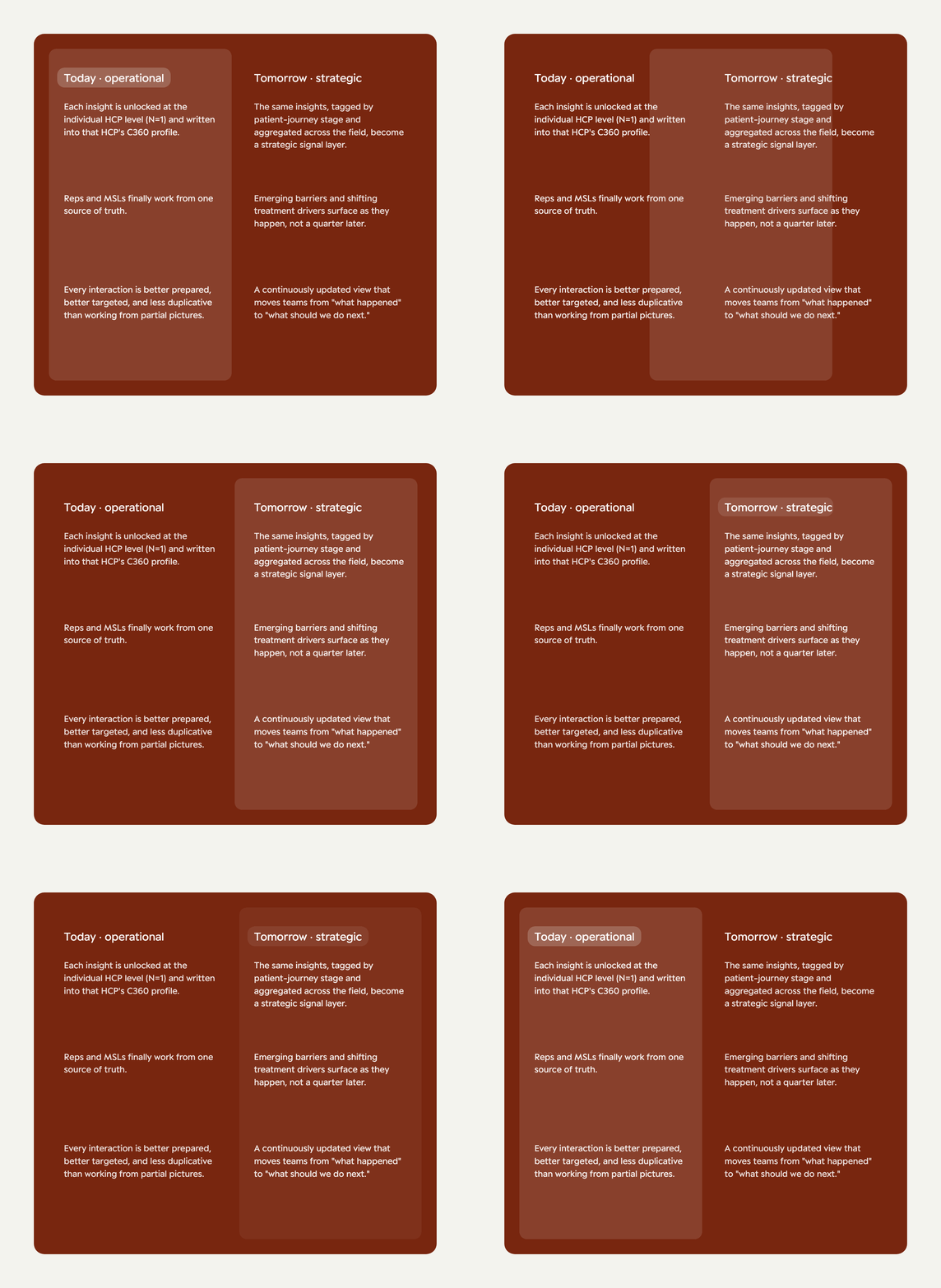
This is phase one. Today, unlocked insights are used at the operational level, informing each rep's HCP interactions. The same pipeline that already splits and classifies each insight can do more; for example, tag each sentence not only for compliance, but for what it says about the patient journey.
Because MSLs capture insights continuously, this becomes a living patient-journey resource that surfaces emerging shifts (e.g., new access barriers) as they happen, rather than waiting for the next market-research wave. Leadership, brand, market-access, and medical teams each get an early read on the same signal: where patients stall, why they switch, and what to prioritize next. Two examples of how a field signal could inform a global tactic:
ACCESS: HCPs repeatedly mention that infusion-center capacity can't support the dosing volume for new patients.
→ Build the case for a self-administration option, or negotiate alternate site-of-care reimbursement with payers.
COMMERCIAL: Switching conversations center on dosing burden, not doubts about efficacy.
→ Rework core messaging and objection handling around convenience, not efficacy.
This strategic use case complements market research rather than replacing it: MSLs capture what comes up naturally with the HCPs they already prioritize, not a representative sample. But as a continuous, near-zero-marginal-cost signal, it covers ground survey waves can't.
This is phase one. Today, unlocked insights are used at the operational level, informing each rep's HCP interactions. The same pipeline that already splits and classifies each insight can do more; for example, tag each sentence not only for compliance, but for what it says about the patient journey.
Because MSLs capture insights continuously, this becomes a living patient-journey resource that surfaces emerging shifts (e.g., new access barriers) as they happen, rather than waiting for the next market-research wave. Leadership, brand, market-access, and medical teams each get an early read on the same signal: where patients stall, why they switch, and what to prioritize next. Two examples of how a field signal could inform a global tactic:
ACCESS: HCPs repeatedly mention that infusion-center capacity can't support the dosing volume for new patients.
→ Build the case for a self-administration option, or negotiate alternate site-of-care reimbursement with payers.
COMMERCIAL: Switching conversations center on dosing burden, not doubts about efficacy.
→ Rework core messaging and objection handling around convenience, not efficacy.
This strategic use case complements market research rather than replacing it: MSLs capture what comes up naturally with the HCPs they already prioritize, not a representative sample. But as a continuous, near-zero-marginal-cost signal, it covers ground survey waves can't.
This is phase one. Today, unlocked insights are used at the operational level, informing each rep's HCP interactions. The same pipeline that already splits and classifies each insight can do more; for example, tag each sentence not only for compliance, but for what it says about the patient journey.
Because MSLs capture insights continuously, this becomes a living patient-journey resource that surfaces emerging shifts (e.g., new access barriers) as they happen, rather than waiting for the next market-research wave. Leadership, brand, market-access, and medical teams each get an early read on the same signal: where patients stall, why they switch, and what to prioritize next. Two examples of how a field signal could inform a global tactic:
ACCESS: HCPs repeatedly mention that infusion-center capacity can't support the dosing volume for new patients.
→ Build the case for a self-administration option, or negotiate alternate site-of-care reimbursement with payers.
COMMERCIAL: Switching conversations center on dosing burden, not doubts about efficacy.
→ Rework core messaging and objection handling around convenience, not efficacy.
This strategic use case complements market research rather than replacing it: MSLs capture what comes up naturally with the HCPs they already prioritize, not a representative sample. But as a continuous, near-zero-marginal-cost signal, it covers ground survey waves can't.
From individual HCP insight to a field-wide signal
This is phase one. Today, unlocked insights are used at the operational level, informing each rep's HCP interactions. The same pipeline that already splits and classifies each insight can do more; for example, tag each sentence not only for compliance, but for what it says about the patient journey.
Because MSLs capture insights continuously, this becomes a living patient-journey resource that surfaces emerging shifts (e.g., new access barriers) as they happen, rather than waiting for the next market-research wave. Leadership, brand, market-access, and medical teams each get an early read on the same signal: where patients stall, why they switch, and what to prioritize next. Two examples of how a field signal could inform a global tactic:
ACCESS: HCPs repeatedly mention that infusion-center capacity can't support the dosing volume for new patients.
→ Build the case for a self-administration option, or negotiate alternate site-of-care reimbursement with payers.
COMMERCIAL: Switching conversations center on dosing burden, not doubts about efficacy.
→ Rework core messaging and objection handling around convenience, not efficacy.
This strategic use case complements market research rather than replacing it: MSLs capture what comes up naturally with the HCPs they already prioritize, not a representative sample. But as a continuous, near-zero-marginal-cost signal, it covers ground survey waves can't.
From individual HCP insight to a field-wide signal
This is phase one. Today, unlocked insights are used at the operational level, informing each rep's HCP interactions. The same pipeline that already splits and classifies each insight can do more; for example, tag each sentence not only for compliance, but for what it says about the patient journey.
Because MSLs capture insights continuously, this becomes a living patient-journey resource that surfaces emerging shifts (e.g., new access barriers) as they happen, rather than waiting for the next market-research wave. Leadership, brand, market-access, and medical teams each get an early read on the same signal: where patients stall, why they switch, and what to prioritize next. Two examples of how a field signal could inform a global tactic:
ACCESS: HCPs repeatedly mention that infusion-center capacity can't support the dosing volume for new patients.
→ Build the case for a self-administration option, or negotiate alternate site-of-care reimbursement with payers.
COMMERCIAL: Switching conversations center on dosing burden, not doubts about efficacy.
→ Rework core messaging and objection handling around convenience, not efficacy.
This strategic use case complements market research rather than replacing it: MSLs capture what comes up naturally with the HCPs they already prioritize, not a representative sample. But as a continuous, near-zero-marginal-cost signal, it covers ground survey waves can't.
From individual HCP insight to a field-wide signal
What we learned
Capturing the experts' own validated decisions is what turns a helpful AI tool into a decision system you can measure, trust, and audit. Without it, you have opinions about quality; with it you have proof.
Judging each sentence, not the whole insight, is what lets the shareable parts survive. What the AI decides on matters as much as which model does the deciding.
There's no blueprint for a first-of-its-kind solution, so prove the risky part early. A focused 5-week PoC, validated by the people who own the decision, showed feasibility and value before anyone committed to scaling.
Two things never stop moving, by country and over time: compliance rules and product information. Both are versioned, modular parts, so a newly approved indication means a planned update, not a rebuild.
Expert-level accuracy doesn't come from writing rules and walking away. It takes embedding with Compliance and Legal, iterating on live cases, codifying the judgment behind the rules. The rules were the easy part.
Sitting on medical insights Commercial can't see? Let's talk.
Whether you're trying to unlock medical insights for Commercial, make compliance review scale, or turn field signals into strategic advantage, our team has built and validated exactly this kind of capability. We're happy to talk through what a similar approach could look like for your setup – or just trade notes on building AI agents for pharma operations.



Explore more cases

Heading 1
Heading 2
Heading 3
Heading 4
Heading 5
Heading 6
Lorem ipsum dolor sit amet, consectetur adipiscing elit, sed do eiusmod tempor incididunt ut labore et dolore magna aliqua. Ut enim ad minim veniam, quis nostrud exercitation ullamco laboris nisi ut aliquip ex ea commodo consequat. Duis aute irure dolor in reprehenderit in voluptate velit esse cillum dolore eu fugiat nulla pariatur.
Block quote
Ordered list
- Item 1
- Item 2
- Item 3
Unordered list
- Item A
- Item B
- Item C
Bold text
Emphasis
Superscript
Subscript
Heading 1
Heading 2
Heading 3
Heading 4
Heading 5
Heading 6
Lorem ipsum dolor sit amet, consectetur adipiscing elit, sed do eiusmod tempor incididunt ut labore et dolore magna aliqua. Ut enim ad minim veniam, quis nostrud exercitation ullamco laboris nisi ut aliquip ex ea commodo consequat. Duis aute irure dolor in reprehenderit in voluptate velit esse cillum dolore eu fugiat nulla pariatur.
Block quote
Ordered list
- Item 1
- Item 2
- Item 3
Unordered list
- Item A
- Item B
- Item C
Bold text
Emphasis
Superscript
Subscript
Heading 1
Heading 2
Heading 3
Heading 4
Heading 5
Heading 6
Lorem ipsum dolor sit amet, consectetur adipiscing elit, sed do eiusmod tempor incididunt ut labore et dolore magna aliqua. Ut enim ad minim veniam, quis nostrud exercitation ullamco laboris nisi ut aliquip ex ea commodo consequat. Duis aute irure dolor in reprehenderit in voluptate velit esse cillum dolore eu fugiat nulla pariatur.
Block quote
Ordered list
- Item 1
- Item 2
- Item 3
Unordered list
- Item A
- Item B
- Item C
Bold text
Emphasis
Superscript
Subscript
Heading
Heading 1
Heading 2
Heading 3
Heading 4
Heading 5
Heading 6
Lorem ipsum dolor sit amet, consectetur adipiscing elit, sed do eiusmod tempor incididunt ut labore et dolore magna aliqua. Ut enim ad minim veniam, quis nostrud exercitation ullamco laboris nisi ut aliquip ex ea commodo consequat. Duis aute irure dolor in reprehenderit in voluptate velit esse cillum dolore eu fugiat nulla pariatur.
Block quote
Ordered list
- Item 1
- Item 2
- Item 3
Unordered list
- Item A
- Item B
- Item C
Bold text
Emphasis
Superscript
Subscript
Heading
Heading 1
Heading 2
Heading 3
Heading 4
Heading 5
Heading 6
Lorem ipsum dolor sit amet, consectetur adipiscing elit, sed do eiusmod tempor incididunt ut labore et dolore magna aliqua. Ut enim ad minim veniam, quis nostrud exercitation ullamco laboris nisi ut aliquip ex ea commodo consequat. Duis aute irure dolor in reprehenderit in voluptate velit esse cillum dolore eu fugiat nulla pariatur.
Block quote
Ordered list
- Item 1
- Item 2
- Item 3
Unordered list
- Item A
- Item B
- Item C
Bold text
Emphasis
Superscript
Subscript